
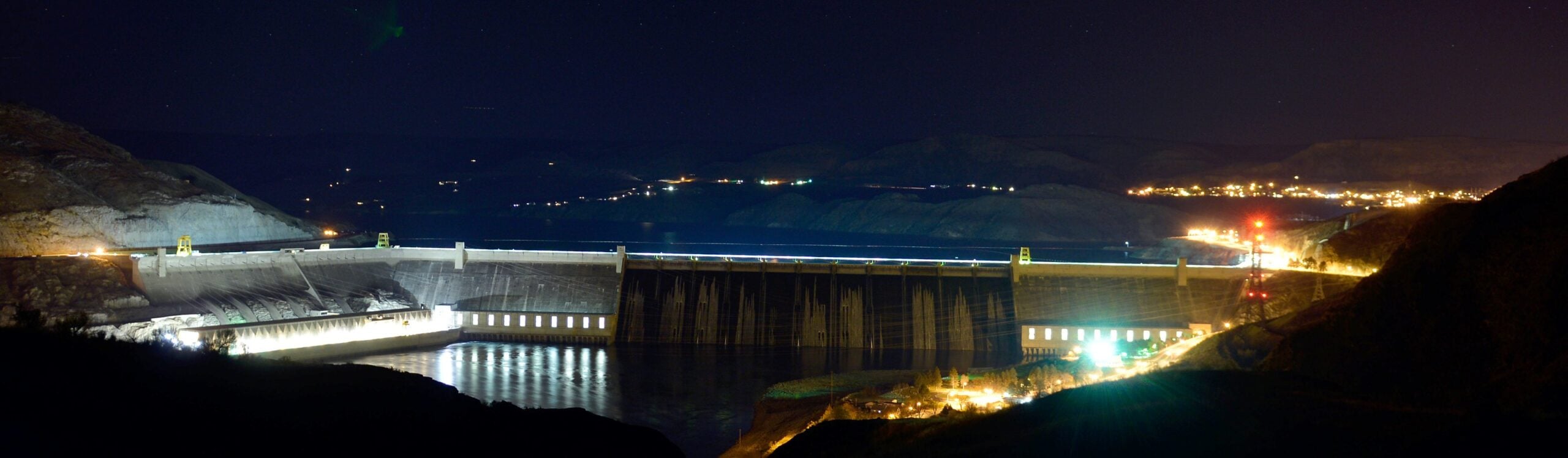
Grand Coulee Dam: Tours, Laser Show, and the Full Story
The Saturday Verdict: worth a Saturday if you live in Spokane. Worth an overnight from anywhere else, because the show does not start until after dark, and out here that means ten o’clock in July and half past nine in August.
Running right now: the One River, Many Voices laser light show runs nightly through September 30, 2026. Free, no tickets. Start times move with the sunset: 10 p.m. through July 31, 9:30 p.m. from August 1, and 8:30 p.m. from September 1 until the season closes. Tours of the Keys pumping plant run Fridays through Sundays through October 31, at 9, 10 and 11 a.m. and 1, 2 and 3 p.m. Also free, also no reservations.
Most guides to Grand Coulee Dam hand you the same list of numbers. Biggest concrete structure in the country. Biggest power producer in the country. Twelve million cubic yards. Enough concrete to build a sidewalk around the equator twice.
All true, and none of it explains why the visit is actually worth making.
Here is the part that does. In 2014 the Bureau of Reclamation threw out the laser show it had been projecting onto the spillway for twenty five years and spent $2.3 million building a new one. They brought in fourteen stakeholders to write it, including the tribes of the upper Columbia, and the new show says out loud what the old one did not: that the river had people on it, that it had salmon in it, and that the dam ended one of those things permanently.
The federal agency that operates the dam changed the story it tells about the dam. Most travel writing about Grand Coulee has not caught up.
So go. See the thing. It is staggering up close. Just go knowing what you are looking at, because the most interesting thing happening at Grand Coulee in 2026 is not the dam. It is what is happening in the river above it.
What You Are Actually Looking At
The dam stands 550 feet high, runs 5,223 feet across, and holds close to 12 million cubic yards of concrete. It is the largest hydropower producer in the United States, putting out more than 21 billion kilowatt hours a year, roughly enough for 2 million households. Behind it, Lake Roosevelt backs up about 150 miles toward the Canadian border.
Construction ran from 1933 to 1941 on the original dam and left powerhouse, with the right powerhouse finished in 1948 and a third plant added between 1967 and 1975. It cost about $300 million in the dollars of the day. It cost 77 workers their lives during the first build, and four more during the later expansion.
The water it holds irrigates about 670,000 acres of the Columbia Basin, which is the reason the sagebrush desert south of here grows potatoes, apples, and wine grapes. That was always the point. The power was, in the beginning, almost a side effect that turned out to matter enormously when the country needed aluminum for aircraft two years after the first generators spun up.
The irrigation number is worth sitting with, because it is the one place the project fell short of its own pitch. Grand Coulee was sold on watering 1.1 million acres. It waters about 670,000. The rest of the plan was never finished, and the canals that would have carried it are still drawn on maps nobody is building from.
The American Society of Civil Engineers lists it among the seven civil engineering wonders of the United States. Woody Guthrie was hired by the Bonneville Power Administration in May 1941 and produced 26 songs in 30 days about this river, including the two everyone still knows, “Roll On, Columbia” and “Grand Coulee Dam.” He was paid a single month of federal salary for the lot of them.
Standing at the base of it, the scale does not read as a number. It reads as a wall that blocks out the sky.
I have driven past this dam dozens of times, and I have stopped and looked at it from the viewing areas more than once. Nothing about that prepares you for the size of it. Photographs flatten it and the numbers do not help. You have to stand there, and even then it takes a minute to land.
The Laser Light Show
This is the reason to time your visit rather than just make it.
The show is projected directly onto the face of the spillway, which at 5,223 feet wide is the largest screen you will ever watch anything on. It runs about 30 minutes. It is free and there are no tickets. It covers the geology of the coulee, the people who lived on this river before the dam, the construction, and the cost, including the loss of the salmon fishery.
The surface it plays on is not smooth, which is part of why it works. Eleven drum gates run across the spillway crest, each one 135 feet long and 30 feet tall, and 40 outlet tubes eight and a half feet across punch through the face below them. When the images move over that hardware the whole wall reads as texture rather than a screen.
The schedule is in the callout at the top of this page, but the shape of it matters: the start time chases the sunset backward through the season. Ten at night in July. Half past nine in August. Half past eight in September. Reclamation can cancel a show without notice, so it is worth checking the official schedule before you build a night around it.
One thing nobody tells you: a start time that late quietly rules out the day trip. Seattle to Grand Coulee is about four and a half hours. If you drive out for a July show, you are not driving home afterward. Either build in a night, or come in September when the show starts at 8:30 and the math gets survivable.
Watch it from the visitor center side. The lawn and the parking areas there face the spillway square on, and the sound carries from speakers on that side. A few hotels in Coulee Dam have rooms and viewing areas that look straight at it, which is the low effort version.
One night a year the show comes with fireworks. On the Fourth of July the laser show is paired with a fireworks display over the dam. Any other night, what you get is the show.
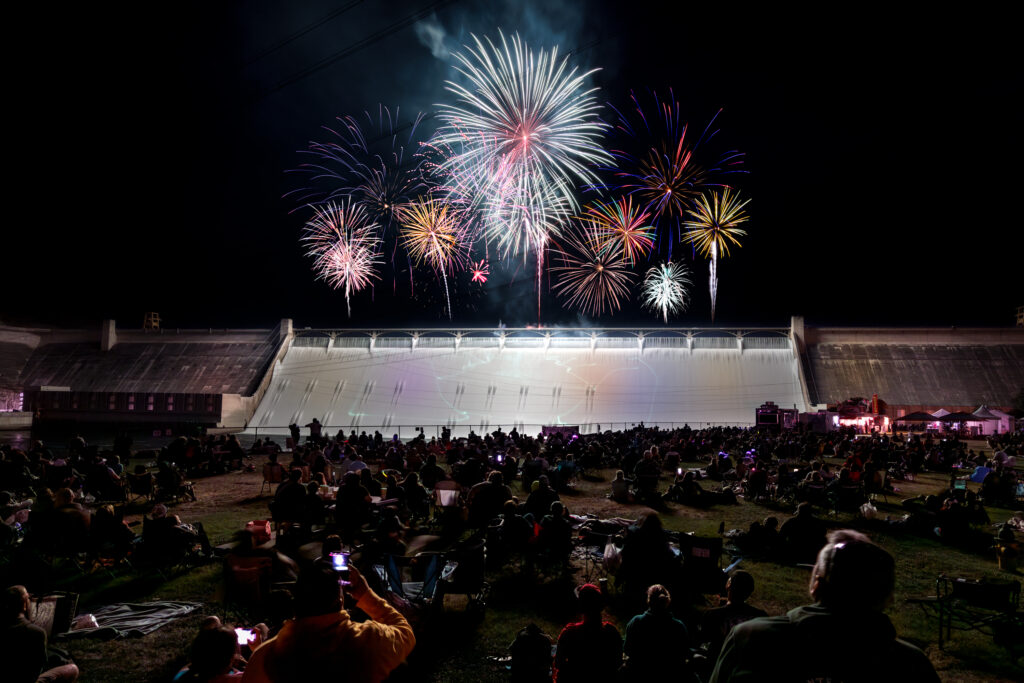
Bring something to sit on and something warm. The desert dumps its heat fast after sundown, and you will be sitting in the dark a while before anything happens. A thermos of something hot is not a bad idea either. Fill it before you settle in, because in July the show starts an hour after most kitchens in town have shut.
The River Before the Dam
A hundred miles upriver from where you are standing, there was a waterfall called Kettle Falls.
It was one of the two great fishing sites on the Columbia, the other being Celilo Falls far downstream. People had fished it for thousands of years. Salmon coming up the river stacked below the falls and were taken with dip nets and platforms and weirs, and the site drew families from across the interior Northwest every season.
Grand Coulee Dam was built with no fish ladders. Not a broken set, not an inadequate set. None. A 1938 study concluded that no ladder in the world could lift fish over a climb of more than 300 feet, and the dam is 550 feet tall. The decision was made and the dam went up.
In June 1940, with Lake Roosevelt already filling and Kettle Falls about to go under, people gathered there for what became known as the Ceremony of Tears. It began on June 14 and ran three days. Accounts put attendance as high as 10,000, drawn from tribes across the region. Then the water came up and the falls were gone.
Salmon kept arriving at the base of Grand Coulee Dam for a few more years, working upriver on instinct to spawning beds they could no longer reach. By 1943 they stopped coming. Between Grand Coulee and Chief Joseph Dam downstream, which was finished in 1955 and also has no fish passage, more than a thousand miles of spawning habitat went dark.
There was mitigation, of a sort. The government built three hatcheries, at Leavenworth, Winthrop, and Entiat, which together still produce over two million fish a year. Look at a map and the problem is obvious: all three sit downstream of the blockage. They replaced fish for the lower river. They did nothing at all for the thousand miles above it, or for the people who had fished those miles.
That is not a footnote to the engineering story. In the upper Columbia it is the engineering story.
Salmon Are Going Back Above the Dam
Here is what almost nobody visiting Grand Coulee knows, and it is the reason this article exists.
The salmon are coming back. Not through the dam, because there is still no way through it. By truck.
The Confederated Tribes of the Colville Reservation, the Spokane Tribe of Indians, and the Coeur d’Alene Tribe have spent the better part of a decade catching adult salmon below the blockage and releasing them above it, into the tributaries and reaches where they used to spawn. The first releases were small and experimental. In 2025 more than 4,500 adult salmon went in, with close to 900 of those released into the stretch of river that runs up to the Canadian border. That is roughly ten times what went in seven years earlier.
They are also rearing and releasing juveniles at scale, and this is where it stops being symbolic and starts being science. The 2025 season was the fourth year of yearling Chinook studies: roughly 2,000 fish released carrying acoustic telemetry tags and another 170,000 carrying PIT tags, so that every one of them that moves downriver reports where it went and whether it survived the dams. You do not tag 170,000 fish to make a point. You tag them because you intend to run the numbers.
Anglers in British Columbia have started reporting incidental catches of Chinook in water that had not held them for decades.
The money behind it is real now too. In September 2023 the federal government and the Bonneville Power Administration settled with the Colville, Spokane, and Coeur d’Alene tribes and committed $200 million over twenty years toward the work. The long range plan the upper Columbia tribes are working from runs on a twenty year horizon of its own.
Whether it ultimately works is an open question. Fish released above a dam still have to get their offspring back down past two of them. But it is happening, right now, about an hour’s drive from the visitor center parking lot, and it makes the dam a more interesting place to stand than any statistic about concrete.
Touring the Dam
The tours have changed and a lot of published guides have not noticed.
One thing nobody tells you: you cannot tour the inside of the dam. What is offered is a guided tour of the John W. Keys III Pump-Generating Plant, the facility that lifts Columbia River water up out of Lake Roosevelt and into Banks Lake to feed the irrigation project. It runs about an hour, it is free, and it is genuinely worth doing.
Do not treat it as the consolation prize. The pumping plant, which went into service in 1951, is arguably the more interesting building. The dam holds water back, which is a thing you can understand by looking at it. The pumping plant moves water uphill, hundreds of feet of it, continuously, so that a desert two counties away can grow potatoes. Standing next to machinery that large doing something that unlikely is the part of the visit people tend to remember.
The catch is the schedule. Tours run Fridays, Saturdays, and Sundays only, from May 22 through October 31, 2026, at 9, 10 and 11 a.m. and 1, 2 and 3 p.m. First come, first served, no reservations. Show up on a Tuesday in June and you will get the visitor center and nothing else. Plenty of people do exactly that.
Travel light for it. Every person on the tour goes through a metal detector, and bags, purses, backpacks and packages are not allowed. Cameras are fine but camera cases stay in the car. Check the times before you drive out, too, because they changed from last year and older guides are still printing the old ones.
The Grand Coulee Dam Visitor Center is open daily, 8:30 a.m. to 5 p.m., closed only for Thanksgiving, Christmas, and New Year’s Day, with no seasonal change to those hours. It is free. The exhibits cover the geology of the coulee, the construction, the people of the upper Columbia, and the effect on the river, and there is a film if you want the overview version. If you are only stopping for an hour on a drive through, this is the hour.
Where to Get the Best View
The dam is hard to photograph from the ground because you cannot get far enough back.
Crown Point Vista solves that. Take SR 174 about two miles west of the town of Grand Coulee and watch for the signs. A narrow road climbs to a gravel lot and a viewpoint that looks down on the entire dam and the river running away below it. It is the only place you can see the thing whole. It is a Steamboat Rock State Park site, so a Discover Pass is required for the lot, and the drop offs are steep and not suited to small kids.
The local move: go up to Crown Point in the last hour of daylight for the wide view and the photographs, then drive back down to the visitor center side for the show. That sequence gets you both, and it fills the awkward gap between sunset and a start time that will not come for another hour. Crown Point stays open until the show ends, so there is no rush and no gate to beat on the way out.
The bridge between Coulee Dam and the visitor center gives a good straight on view at eye level. The visitor center lawn is the show seat.
Planning Your Visit
Getting there. About four and a half hours from Seattle over Highway 2 or I-90, roughly two hours from Spokane, and about two hours from Wenatchee. There is no fast way. That is part of the appeal and all of the problem.
When to go. Late May through September, which is the only window when the laser show and the tour both run. September is the sweet spot: the show starts at 8:30, the days are still long enough to do something else first, and the heat has broken. July and August are the busiest and the hottest. This is high desert, so afternoons in the upper 80s are normal and hot spells push past 95.
What it costs. The visitor center is free. The tour is free. The laser show is free. Nothing about the dam itself takes money. A Discover Pass covers Crown Point Vista, Steamboat Rock, and Sun Lakes-Dry Falls if you are doing the wider loop.
How long you need. Two hours covers the visitor center and a viewpoint. A full day plus an evening covers the tour, Crown Point, a swim in Banks Lake, and the show. That second version is the trip worth taking.
Fuel and supplies. Fill the tank in Coulee City, Wilbur, or before you leave Spokane. Services out here are thin and hours are short.
Where to Eat and Stay
Grand Coulee, Electric City, and Coulee Dam sit within a couple of miles of each other and function as one small town. Two food options worth naming, both confirmed operating.
La Presa Mexican Restaurant, 515 E Grand Coulee Ave, is the one locals send you to and the highest rated restaurant in town. Open daily, 11 a.m. to 9 p.m., which matters enormously in a place where a lot of kitchens close early. Casual pricing.
Horn’s Electric City Bar & Grill, 2 W Coulee Blvd in Electric City, opens at seven in the morning and serves breakfast through late. It is a dive bar with a good breakfast and painted ceiling tiles, and it stays open well past when everything else has shut. Casual pricing, and the right answer for a morning start or a late bite after the show.
For lodging, the Columbia River Inn sits directly across from the visitor center in Coulee Dam, which puts you a short walk from the show. Coulee House Inn & Suites, also in Coulee Dam, has balcony rooms facing the spillway and a guest viewing area for the laser show, which is the least effort possible way to see it. Rates in a town this size move around with the season and the events calendar, so check current pricing when you book. Summer weekends fill, and there is not much slack in the local room supply when they do.
Lake Roosevelt
The lake behind the dam is the part of this trip most people drive past on their way to look at concrete.
Lake Roosevelt runs about 150 miles upriver toward the Canadian border and carries roughly 600 miles of shoreline, which is more coast than most people picture when they hear the word reservoir. It is managed as a national recreation area, and the swimming, boating, and camping along it are the reason locals come back when the dam itself is old news to them. Spring Canyon, a few minutes east of the town of Grand Coulee, is the closest developed access to the dam and the easiest place to get in the water without a plan.
The water level is worth checking before you commit to a specific boat launch. This is a working reservoir, drawn down in spring for flood control and refilled through the summer, so a ramp that was fine in August can be a long walk in May.
Worth knowing: the Keller Ferry crosses Lake Roosevelt on SR 21 north of Wilbur, it runs on demand from 6 a.m. to midnight seven days a week with the last run at 11:30 p.m., and it is completely free. Twenty cars at a time on the M/V Sanpoil. It is the least known ferry ride in the state and it turns the drive home toward Republic into something worth doing on purpose.
Making a Weekend of It
The dam is the anchor, and the country around it is better than the country you drove through to reach it.
Steamboat Rock State Park is twenty minutes south on Banks Lake, and it is the best swimming and camping within reach of the dam. The climb up Steamboat Rock itself is a short, steep haul onto a 600 acre plateau with a view down the whole coulee. Do it early. There is no shade on that scree.
Another thirty minutes south, Sun Lakes-Dry Falls State Park overlooks a cliff 400 feet high and three and a half miles wide that was once a waterfall four times the size of Niagara. Understanding what carved this landscape makes the dam make more sense, and our conversation with CWU geologist Nick Zentner is the best short course on how the Ice Age floods built the coulee you are driving through.
If you are travelling with kids and need somewhere to let them off the leash on the way through, there is a surprisingly big community playground in Coulee City that has saved more than one drive. Both towns sit in Grant County, which is worth a wider look if you are building a longer loop.
Go While the Story Is Changing
There is a version of this trip where you drive out, read the plaques, watch the light show, say “that is a lot of concrete,” and drive home. It is a fine trip. Plenty of people take it.
There is a better one available, and it does not cost anything extra. Watch the show, and pay attention when it gets to the part about the river before 1941. Then think about the fact that somewhere north of where you are sitting, in the dark, there are salmon in water that had none for the better part of eighty years, because three tribes decided that a dam with no fish ladder was not going to be the last word.
The concrete is not going anywhere. It will look exactly the same in ten years. The other thing might not, in either direction.
One admission before you go. I have been told for years that the laser show is the one thing out here you really have to see, and I still have not gone. Dozens of drives past that dam and I have never once timed one to be there after dark. That changes this summer. Maybe I will see you out there.
Go this season. The show ends September 30.
Frequently Asked Questions
Is the Grand Coulee Dam laser light show still running?
Yes. The One River, Many Voices laser light show runs nightly from May 22 through September 30, 2026, and is free with no ticket required. Start times shift with the sunset: 10 p.m. through July 31, 9:30 p.m. from August 1, and 8:30 p.m. from September 1 through the end of the season. The show runs about 30 minutes. It has run every summer since 2014, but dates for the following season are not announced until spring.
Can you tour Grand Coulee Dam?
You can tour the John W. Keys III Pump-Generating Plant, not the interior of the dam itself. Guided tours run Fridays, Saturdays, and Sundays only, from May 22 through October 31, 2026, at 9, 10 and 11 a.m. and 1, 2 and 3 p.m. They are free, last about an hour, and are first come first served with no reservations. Every participant passes through a metal detector, and bags and backpacks are not allowed. The visitor center is open daily year round and does not require a tour.
What are the Grand Coulee Dam Visitor Center hours?
The visitor center is open daily from 8:30 a.m. to 5 p.m. Pacific Time, closed only on Thanksgiving, Christmas, and New Year’s Day. There is no seasonal change to those hours. Admission is free. It has exhibits on the geology, the construction, the tribes of the upper Columbia, and the dam’s impact on the river.
Does Grand Coulee Dam have fish ladders?
No. Grand Coulee Dam was built without fish passage of any kind and has never had it. A 1938 study concluded no ladder could carry fish over a climb of more than 300 feet. The dam permanently blocked salmon and steelhead from more than a thousand miles of spawning habitat in the upper Columbia. Chief Joseph Dam, completed downstream in 1955, also has no fish passage.
Are salmon returning above Grand Coulee Dam?
Salmon are being returned by hand, not by fish passage. The Confederated Tribes of the Colville Reservation, the Spokane Tribe of Indians, and the Coeur d’Alene Tribe have been trucking and releasing adult salmon above the blockage. In 2025 more than 4,500 adults were released, roughly ten times the number in the first releases seven years earlier. A September 2023 federal settlement with those three tribes committed $200 million from the Bonneville Power Administration over 20 years to support the work.
Where is the best view of Grand Coulee Dam?
Crown Point Vista, about two miles west of the town of Grand Coulee on SR 174, gives the best overall view. It looks down on the whole dam and the river below it, which no ground level viewpoint can do. It is a Steamboat Rock State Park site, so a Discover Pass is required, and the drop offs are not suited to small children. It stays open until the laser show ends. For the show itself, the visitor center side is where you want to be.
How big is Grand Coulee Dam?
The dam stands 550 feet high with a crest length of 5,223 feet and holds nearly 12 million cubic yards of concrete. It is the largest hydropower producer in the United States, generating more than 21 billion kilowatt hours a year, enough for roughly 2 million households. Lake Roosevelt, the reservoir behind it, runs about 150 miles upriver.
How far is Grand Coulee Dam from Seattle and Spokane?
Grand Coulee is about four and a half hours from Seattle and roughly two hours from Spokane. Because the laser show does not begin until 10 p.m. in midsummer, it is a realistic day trip only from Spokane and the Columbia Basin. From the west side, plan on staying the night.
Before you go
That is the whole idea behind the Explore Washington State Card. Free to carry, with a little something waiting at participating places when you visit. Your zip code is a vote for which towns we sign up next, and our weekly Washington travel newsletter starts landing right away.
Get your free card- About the Author
- Latest Posts

Explore Washington State has been covering the real Washington for more than a decade. State parks, small towns, back roads, rest stops, and the people who make this place worth exploring. What started as a hyperlocal project covering individual communities grew into a full media project with more than 340 podcast episodes, a weekly newsletter with over 6,300 subscribers, and coverage of all 146 Washington State Parks. The content here comes from people who have actually been to these places: locals, regulars, and lifelong Washington residents who care more about getting it right than getting clicks.


