
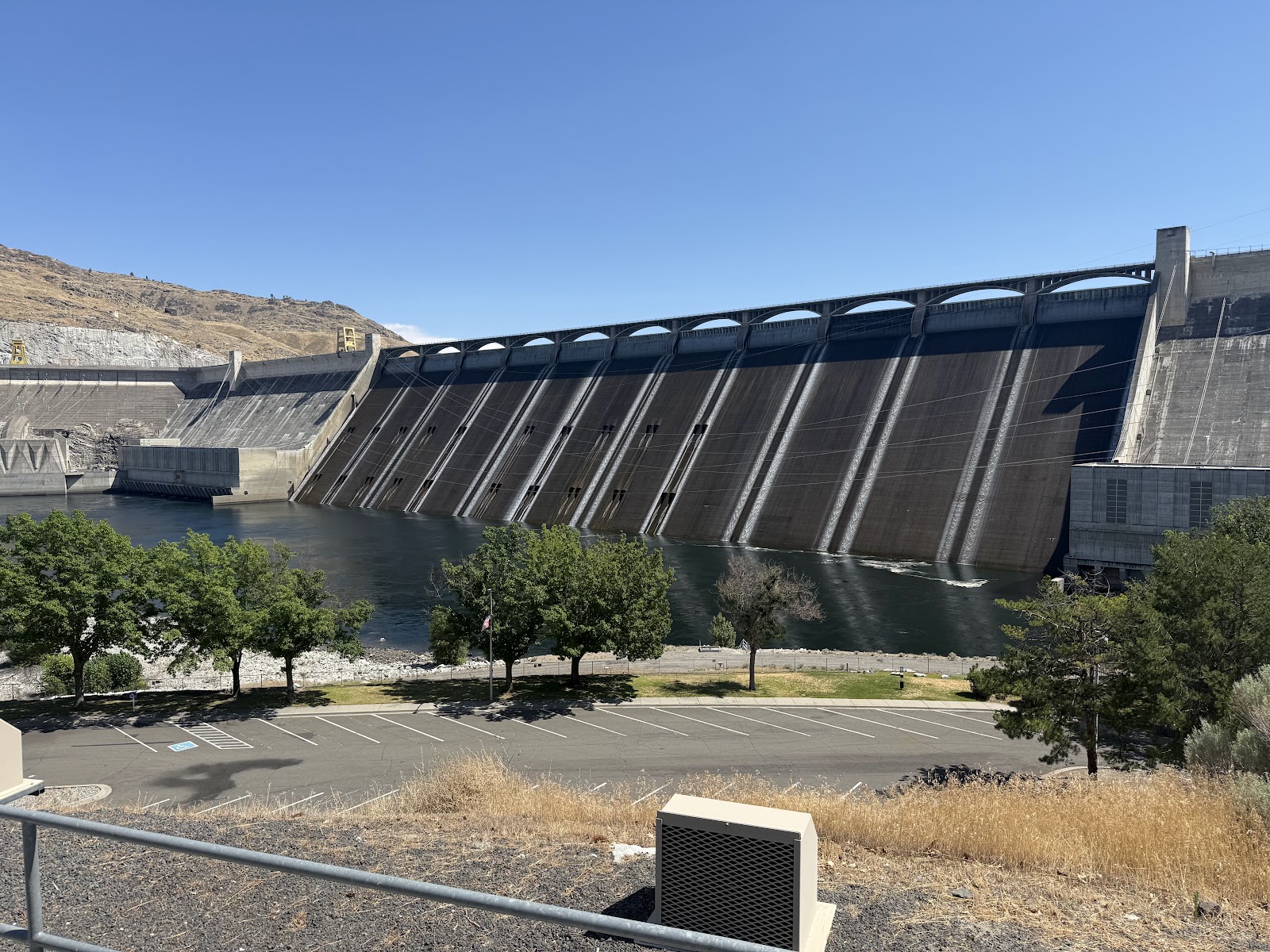
Grand Coulee Dam Visitor Center
Photo: Sylwia Romanowski via Google Maps
The Grand Coulee Dam Visitor Center sits at the base of the dam along Highway 155 in the town of Coulee Dam, and it is the natural place to start any visit to Grand Coulee. The center is run by the U.S. Bureau of Reclamation, the federal agency that operates the dam, so the exhibits come straight from the people who keep the water and the power flowing.
Reclamation calls Grand Coulee the largest hydropower complex in the United States. Standing below that wall of concrete is impressive on its own, but the visitor center is where you learn what the dam actually does for the river, the farms of the Columbia Basin and the people whose lives it changed. Plan to come back after dark, too, when the dam becomes the screen for a laser light show in season.
What You’ll See
- A building shaped like a generator. Architect Marcel Breuer designed the center in the late 1970s to resemble a generator rotor. It was retrofitted in 2004 to meet seismic and accessibility standards.
- Hands on exhibits. Exhibits installed in 2006 explain Grand Coulee’s role as one of the main irrigation, flood control and hydroelectric dams on the Columbia River.
- The human story. The displays also describe the dam’s effects on Native Americans and early settlers, so you get more than the engineering.
- An auditorium. A place to sit down, get oriented and take in the scale of the project before you head outside.
- One River, Many Voices. The evening laser light show runs about 30 minutes, and no tickets are required.
If you want to go deeper, Reclamation offers seasonal guided public tours of the John W. Keys III Pump-Generating Plant across the river. Tours last about an hour and are offered on a first come, first served basis.
The Story Behind It
Grand Coulee Dam and its Left Powerhouse were built between 1933 and 1941, authorized first under the National Industrial Recovery Act and later by the Rivers and Harbors Act. When the final generator came online in 1980, the complex reached a generating capacity of more than 6,809 megawatts, supplying up to 21 billion kilowatt hours of electricity, according to Reclamation.
Power is only half of it. The dam anchors the Columbia Basin Project, which Reclamation says includes about 330 miles of major canals plus lakes and reservoirs, and about 2,000 miles of laterals that irrigate approximately 680,000 acres. The visitor center came decades after the dam itself, when Breuer’s rotor shaped building went up in the late 1970s.
Tips for Your Visit
- Start at the visitor center even if you plan to tour. Reclamation’s directions to the tour building begin there, heading northwest on Highway 155 across the Grand Coulee Bridge and down Marina Way.
- Leave purses, bags, backpacks, fanny packs and packages in the car if you are touring. Everyone passes through a metal detector, cameras are allowed but camera cases must stay in your vehicle, and there is no storage on site.
- Tours have limited space and can be canceled without notice, so build some flexibility into your day.
- The visitor center is fully accessible, with accessible and family restrooms, and service animals are permitted. Parking is available for cars as well as buses and RVs.
- Tours and the laser light show are seasonal; check the Reclamation website for the current schedule before you go.
Plan Your Visit
Address: Highway 155, Coulee Dam, WA 99116
Phone: 509.633.9265
Website: usbr.gov/pn/grandcoulee
Hours and admission: Check the museum website for current days, hours, and admission before you visit.
Directions: View on Google Maps