Voluntold: How Brian Alley Ended Up Running a Folk Festival in Winthrop
Brian Alley did not set out to run a music festival. He offered to help with one.
He spent years on the road with Never Come Down, a Portland band that played bluegrass instruments and pretty much anything else, from Gillian Welch to Ween. When the band was booked for Cidergrass, a small festival in Winthrop that had started, skipped a year and come back, Brian saw a good idea that needed someone who had watched a lot of festivals from backstage. He offered to handle booking and production. By the next spring he realized he was running the whole thing. The board had handed it to him at a meeting he was not at. He was voluntold.
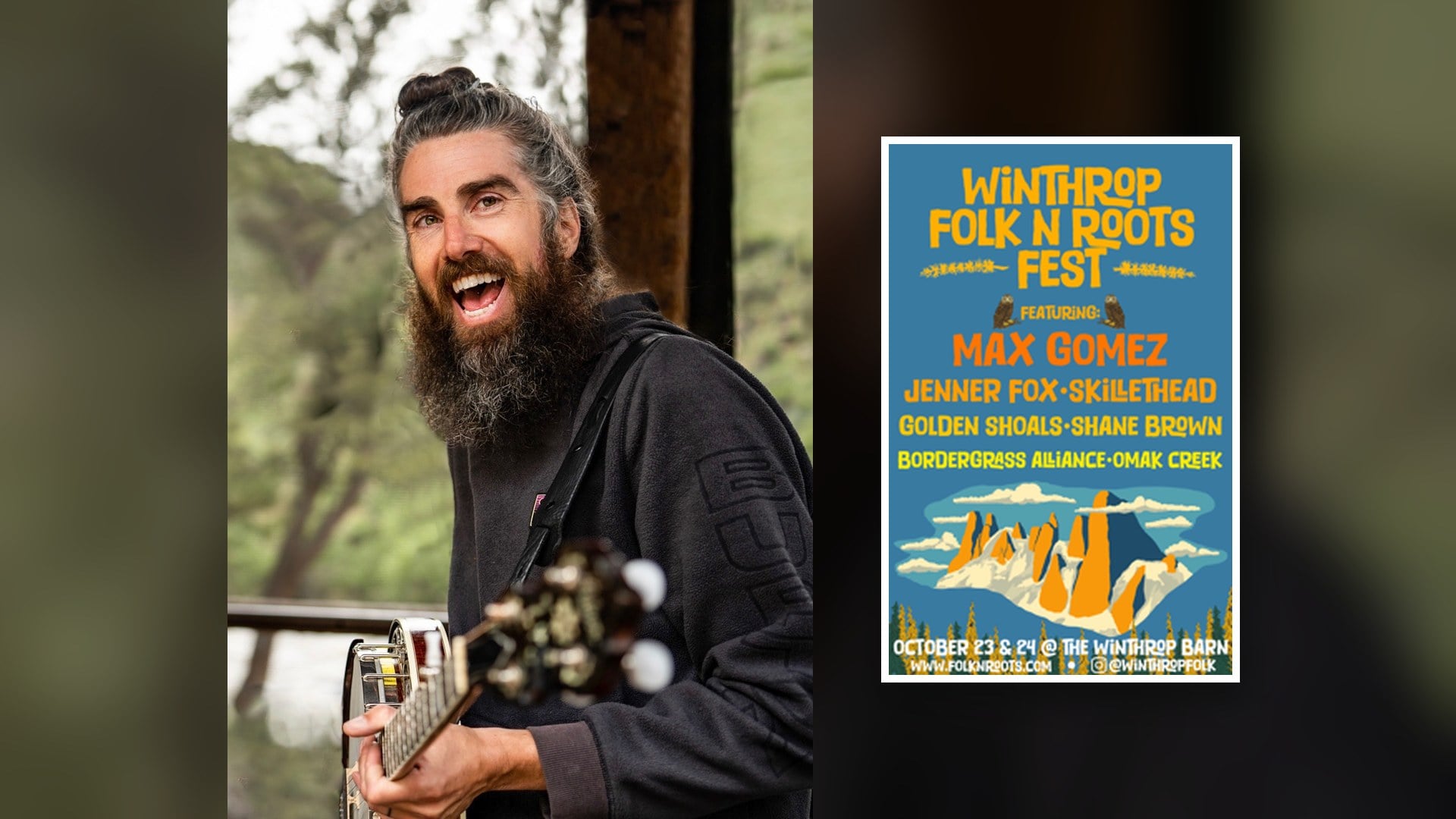
That festival is now the Winthrop Folk N Roots Fest, and it returns to the Winthrop Barn on October 23 and 24, 2026.
Scott sat down with Brian at his kitchen table in the Methow Valley, over Blue Star coffee from an AeroPress, with a washing machine that forced one early pause and a bird that bounced off the window halfway through.
Small on purpose
The festival has one stage and seven acts, headlined by Max Gomez. Brian says he could name three years of lineups from memory; the hard part is picking seven or eight a year. One stage means nobody has to choose between two sets, every artist plays to a full house, and people stay from the first song to the last. The barn holds 400 by the fire marshal’s count, and Brian wants to see what 300 feels like before he starts looking for a second main stage.
The part he cares about most happens after the scheduled music. The artists gather at the North Cascades Mountain Hostel, eat together, and the instruments come out. Brian brought that idea home from Hardly Strictly Bluegrass in San Francisco, where Andrew Marlin of Watchhouse once wandered over and asked to warm up with his band. “It didn’t feel like ladder climbing.” When musicians start playing when nobody asked them to, he counts the weekend a winner.
The money, said out loud
Brian is blunt about what it takes to keep live music alive. His goal is that every musician leaves with at least $300 for each day they play, with food and lodging covered so none of it goes to a motel room. For a band on the road 200 days a year, that is still only about $60,000. It is also why the lineup is seven acts and not twelve.
Tickets have a set price, but there is also a limited number of pay what you can passes, and patron passes for people who want to pay more so a neighbor can get in. There is no VIP package. As Brian puts it, “this is a community thing.” The Saturday daytime workshops, showcases and jams around town, at places like the library and a yoga studio, are free.
The festival runs through Mountain Music Fund, the nonprofit Brian started with three other board members. The longer dream is a music camp leading up to the festival, modeled on the week he spent every summer as a kid at RockyGrass in Lyons, Colorado, so that nobody slips through the cracks because they cannot afford it.
Why Winthrop in October
Late October is shoulder season in the valley. The summer crowds are gone, a lot of touring musicians are home and glad for the work, and a festival weekend brings visitors to local businesses right when they need it, especially after a smoky summer. Brian’s pitch: think Sisters Folk Fest meets Wintergrass, in a barn, the weekend before Halloween. Bring layers, because you might see the first snowflakes of the year. He has still managed a hike on festival weekend the last couple of years.
Also in this episode
What makes a sound “very Portland,” and why the Northwest might be the home of “emo grass.” A hostel show in Reykjavik during Iceland Airwaves. Why a small town is kind to kind people, and why Brian now builds an extra half hour into every trip to the store for the conversations in each aisle.
And the questions every guest gets. Coffee is Blue Star Coffee Roasters in Twisp, an Americano with cream or an oat milk latte, with a nod to Lariat Coffee Roasters in Winthrop. Lunch is the premade veggie sandwich at the Mazama Store, on what he is pretty sure is their sourdough. Cake or pie: pie, no question, apple with a flaky puff pastry top. For more to do in the valley, start with our Winthrop guide.
Winthrop Folk N Roots Fest
October 23 and 24, 2026 at the Winthrop Barn, 51 State Route 20, Winthrop. Friday 5pm to 11pm, Saturday 11am to 11pm. Full weekend pass $120, Saturday only $70, Friday only $60, patron weekend pass $175, and a limited number of pay what you can community passes. The lineup: Max Gomez, Jenner Fox, Skillethead, Golden Shoals, Shane Brown, Bordergrass Alliance and Omak Creek.
Links
- Winthrop Folk N Roots Fest: folknroots.com
- Tickets: Winthrop Folk N Roots Fest 2026 on Zeffy
- Want to help Mountain Music Fund? winthropfolk@gmail.com
- Blue Star Coffee Roasters, Twisp: bluestarcoffeeroasters.com
- Lariat Coffee Roasters, Winthrop: lariatcoffee.com
- The Mazama Store, Mazama: themazamastore.com
- North Cascades Mountain Hostel, Winthrop: northcascadesmountainhostel.com
Related episodes
- Exploring Twisp and the Methow Valley with Juliet Kennedy, just down the road
- Weird on Purpose: the As Many Weirdos As Possible music project, another conversation about making music happen on your own terms
- Kate Miller and the save of Bonaparte Meadows, elsewhere in Okanogan County
Brian Alley Winthrop Folk N Roots Fest Episode Transcript
Scott Cowan:
Hello friends, and welcome to the Exploring Washington State podcast. My name is Scott Cowan, and I’m the host of the show. Each episode, I have a conversation with an interesting guest who is living in or from Washington State. These are casual conversations with real and interesting people. I think you’re going to like the show, so let’s jump right in with today’s guest. Okay. I am sitting down with Brian Alley and we’re going to talk about, we’re going to talk about a lot of things, but nothing that we talked about before this episode, but you are putting together a music festival and for the life of me, it is escaping me, but it is the Winthrop Folk and Roots Festival and it’s returning to the Methow Valley October 23rd and 24th, 2026. So if you’re listening to this afterwards, We still have a bunch of interesting stuff you want to hear too. So welcome.
Brian Alley:
Thanks, Scott. Good morning.
Scott Cowan:
Good morning. And thank you for the coffee. So we are sitting here at his house at a kitchen table and drinking local coffee, Blue Star Roasters, my, one of my favorites. Let’s start with the festival for a minute. Why you, how did you get involved? Yeah, what’s the kind of… give me the overarching premise. Why a music festival in Winthrop?
Brian Alley:
Yeah, so I, um, crap, I’m sorry, can we pause for a minute? She left the washing machine on and I don’t want to ruin the… ruin your whole audio thing.
Scott Cowan:
It won’t, but okay.
Brian Alley:
All right.
Scott Cowan:
Sorry about that. No, it’s all good.
Brian Alley:
You don’t like to edit, do you? Just want to start from the top?
Scott Cowan:
Yeah, we’ll just… I’ll cut that bit. Okay, so Brian, we’re gonna get started. I want you to tell me, what was the motivation and inspiration for you to start? Well, it’s not start because you, you’re adapting. Is that a good word?
Brian Alley:
Sure. Okay. Yeah.
Scott Cowan:
Yeah. So Why you? Why’d you… I’m joking when I say running an event’s easy. Yeah, got lots of time on your hands.
Brian Alley:
No, but all serious, pays in dividends, right? Yeah, right.
Scott Cowan:
Um, and so why? What’s your backstory?
Brian Alley:
Um, well, I feel like that’s a, a multi pronged question. There’s like the functional, like purely just, well, here’s what happened kind of story, which is, um, I was in a touring band for many years. I had met a lot of people here in the Methow Valley that knew I was a musician, had heard my band, and decided to book us for this festival that had already been kind of happening here, had been started. It went one year, skipped one year, came back. It was called Cidergrass. It was a really awesome idea to have something like that here in the Valley, but it became clear that there wasn’t anyone who really knew how to run a festival in the ways that I had seen them over the years of traveling around. And that’s no knock against the folks who started to organize it. They were doing the best with what they had.
Scott Cowan:
Sure.
Brian Alley:
But having been all over the country and the world seeing festivals large and small, especially from behind the scenes. I had a lot of insight. So I just offered to help since I live here. And it was really just a matter of trying to streamline what my… in my mind, I was gonna help with just like the booking and the, you know, and trying to do like artist relations and production level stuff and figuring the other fellas involved could sort of continue on with like… choosing the music they like and all that thing, all that stuff. And, um, you know, the location and the flow and all that could kind of be theirs and the, the vibe.
Scott Cowan:
Mm hmm.
Brian Alley:
Um, and then about… so the, the festival is planned to be in October, as it… as I think it probably kind of always will be for various reasons. But, um, uh, as about maybe May or June kind of approached last year, I was like, okay, it seems like I’m kind of Running this whole thing. It looks like I’m kind of in charge. And they were very gracious in giving me a lot of leeway in terms of letting me really get involved in planning. So, I was very fortunate to have a group of friends around who understood what I’m doing and are now on the board of this 501(c)(3) we’ve started, or they’re volunteers, or people who just come out of the woodwork and help. however they can. Um, so really it was, it was just kind of like raising my hand to sort of lend a helping hand and winding up, you know, this, it’s yours was basically what happened.
Scott Cowan:
They voted you in when you weren’t at the meeting?
Brian Alley:
That’s right. Yeah, I was, I was voluntold.
Scott Cowan:
Voluntold. So, okay, as a touring musician, you’ve seen festivals around, around the US. What… put you on the spot. In all your times of touring, what was the… and I normally ask this question slightly differently of musicians, so I’m going to ask it to you twice. So the first question is, where’s the coolest venue you’ve ever played? I don’t care if it’s in Washington. Normally I just ask Washington, but where’s the coolest venue you ever got to be on the stage of?
Brian Alley:
Oh man, that’s a tough question. You know, you find out that the interesting thing about being a touring musician is everything is pretty much the exact same from day to day, but then also like wildly different at the I feel really proud of the stuff we accomplished. The band is called Never Come Down. They’re still doing it. We got to play Hardly Strictly Bluegrass in San Francisco.
Scott Cowan:
Which stage?
Brian Alley:
We played… it was the newest stage that year. That was the Horseshoe Hill stage. And I love that stage. We go every year. And that was really special because I really believe in the curation of that festival. festival. And so, to be on someone’s radar there, I thought was… we’re not famous and all that, but I think that doesn’t matter at that festival. And so, I thought that was really cool. And just the people cruising around backstage, and it wasn’t just about the hang and being around famous people. It was like… Scott Cowan: Yeah.
Brian Alley:
It’s probably just gonna sound name droppy, but Andrew Marlin from the Punch Brothers and, you know, Watchhouse fame was back there with Jimmie Dale Gilmore. And, um, uh, Andrew had a set coming up after ours at a bigger stage and just wanted to warm up. So he just wandered over and heard us warming up for ourselves, like, hey guys, I really need to warm up, can I join you? And so we’re just hanging out playing music with Andrew while Jimmie Dale’s just kind of like hanging, listening.
Scott Cowan:
That’s cool.
Brian Alley:
And it was, uh, It didn’t feel like ladder climbing. And it probably sounds name droppy that I’m saying this, but it was just a really cool vibe. Like, everybody’s guard was really down. And I think that Hardly Strictly Bluegrass really does a great job of bringing the barriers down for artists and musicians.
Scott Cowan:
Mm hmm.
Brian Alley:
And that’s a lot of inspiration I take from that festival for this. So that was a really cool thing, was getting to play that festival. And then very, very… and that was kind of late in our career, in my tenure. with the band. But fast forward to when we were a very new band, we, through a long series of events, which may be a bit too long for this podcast, wound up in Reykjavik at Kex Hostel in the middle of the city during the Iceland Airwaves Festival, which is a really cool fest that happens also in October and is extremely eclectic, mostly… like punk and rock and roll, but also hip hop and folk from especially Iceland, but also just like around Europe and around the world. And so we wound up playing a show in this beautiful hostel in Reykjavik during Iceland Airwaves. And that was also just like this really amazing, cool experience.
Scott Cowan:
Okay. So because of the wide variety of genres at that festival, How, how was your band? How did, how did they find you? How’d you, how’d you end up on the stage? I guess that might be a really long answer, but if you could condense it, how did you guys end up there?
Brian Alley:
Sure. Um, well, so Kex Hostel is this renowned hostel in Europe and especially in Iceland, and the people who started that are clearly music lovers. Like, if you ever have been there or make your way there, you’ll, you’ll tell. There’s books everywhere, but there’s always great music playing. Um, it’s an artist’s haven. Like, during when it’s not festival time, they’re often having, um, you know, open mics or showcases or having people come and play there. So it’s a hub for artists. And so the owners of Kex, who we got to know, um, were talking about opening another location somewhere in the, in the world. There was only one. Now there are 2, the second one being in Portland, Oregon, where our band formed. And they thought it would be really cool to like send a band from Portland to Airwaves.
Scott Cowan:
Oh.
Brian Alley:
for this kind of announced that they were going to open this Portland, uh, location and just like kind of create a little musical ambassadorship or whatever. And they came to this open mic that we, we hosted… not, not really an open mic, kind of a controlled jam, let’s call it.
Scott Cowan:
Okay.
Brian Alley:
That we had been doing for years and years until COVID finally shut it down. But, um, yeah, they heard something that was in my mind, very Portland now looking back. And it was funny because, you know, we… so they asked us to come and be the band to kind of represent Portland for this at Iceland Airwaves. And, um, they, uh, you know, it was kind of a novelty thing having like a… this kind of bluegrass adjacent sort of band, um, playing music in Iceland. But, you know, for 99% of our musical and touring lives, you know, there’s nothing but banjos and mandolins and fiddles around. We’re anything but novelty. So it was kind of, it was kind of funny being, you know, for us everything except for what we were doing was, was really amazing and novelty.
Scott Cowan:
So… So you followed a punk act, but there was a hip hop act.
Brian Alley:
Totally.
Scott Cowan:
Type thing. It was like, okay.
Brian Alley:
Yeah, very eclectic.
Scott Cowan:
Now you said something, and before I ask the question, I gotta preface this, but I always make fun of Portland. So… Brian Alley: Of course.
Scott Cowan:
I think I told you that before.
Brian Alley:
Yeah, I’ve heard, I listened.
Scott Cowan:
I don’t want to make fun of Portland, but you said something and I do want to understand. You said very Portland sound or something to that effect. Can you, how would you define that? And why would you say Portland sound?
Brian Alley:
Yeah, so, um, without getting too much into the nuance, I guess, of like bluegrass music, you know, we used bluegrass instruments, but we did not play any traditional music other than Like during the… we would play 3 hours every Tuesday, 3 or 4 hours every Tuesday night. And then when we were all bringing our musical proclivities together, and some of that would include old bluegrass standards, but a lot of it could have been anything from Gillian Welch to Ween, like anything. I think, you know, as you get further and further away from the mothership of bluegrass anyways, which is, you know, somewhere around North Carolina and Kentucky, depending on who you ask, um, um, you know, most traditionalists will say Rosine, Kentucky, where, um, Bill Monroe was from.
Scott Cowan:
Right.
Brian Alley:
But as you get further and further away, you kind of find, uh, sort of more maybe ingredients or things kind of finding its way into the sets, in my opinion.
Scott Cowan:
Okay.
Brian Alley:
Also, being so far away from the mothership, but also in a very damp, dark, moody place like Portland and Seattle, both, you know, the whole Northwest really, like, um, it’s almost like emo grass, you know, is a lot of the stuff that you hear kind of, you know, that I think of some of my favorite musicians from the Northwest and it’s, um, It’s often very… it’s not always like happy and joyful and 120 beats per minute. A lot of it can be a little more serious and brooding. And we would definitely find ourselves in that category in terms of a lot of the material we wrote.
Scott Cowan:
Okay. So you said you get farther away from the mothership, and now we’re in Winthrop, which is about as far as Portland is from the mothership, if you will. Winthrop is pretty… I don’t want to say middle of nowhere, but the highway does close from one direction here any, any, any quote unquote day now for the winter. So you’re kind of at the end of the road.
Brian Alley:
Right.
Scott Cowan:
During the winter here, which is awesome, I think. But I don’t live here. I don’t know. I don’t know. I kind of have, like, envisioned, you know, I thought about, like, when my wife and I moved to Wenatchee from the west side, This was on my radar. Winthrop, Twisp was on my radar, like, I’d like to live there. And then she kind of goes, yeah, you’d probably be like Jack Nicholson in The Shining come winter though. And it’s like, okay. And I don’t know.
Brian Alley:
Well, I always thought that was actually like a happy, joyful children’s story. It was only until much later that people told me it was a Stephen King adaptation of a horror flick. So I actually did like… no, I always kind of fancied that character. So winters here are really blissful, actually.
Scott Cowan:
Right. And there’s a lot to do here. during the winter.
Brian Alley:
Definitely.
Scott Cowan:
And I’m going to quiz you on that in a little bit. So let’s go. Let’s… like I told you, this is going to be disjointed. So we’ve talked about stages that you played on that are memorable to you. Now let’s go back to the festival. You mentioned that you appreciate the way Hardly Strictly Bluegrass is put together. As a… I’ve only been there one time and it was amazing. I was so impressed from a listener’s perspective. My only objection is I want to see somebody at that stage and somebody at this other stage. And there was, you know, I wish there was a little, I wish there was ways, but there’s not. So we had to make some hard choices. Yep. Which I guess is a good thing that it’s hard choices versus, oh, I’m only here to see X, you know.
Brian Alley:
That’s the only kind of negative thing I could imagine thinking or saying about that festival is that there’s so many great choices. It’s impossible to program. To be able to see everything.
Scott Cowan:
But the other, the other side of that, from the listener side of it, is the serendipitous listening to somebody that you weren’t aware of and going, wow, I’m glad. I’m trying to think who. So my, my reaction to somebody I had not heard of previously was… and I stayed, I watched him because I can’t remember, I think I can’t remember who was the, the act coming up next is the one I wanted to see, but it was Chuck Prophet, who I’d never heard of, listened to before. And I was… I really enjoyed his set, and I, I’ve listened to more, a lot more of his music over the years since. I didn’t know who he was, and because I want to say maybe it was Dave Alvin is who I was waiting to see. I think that was it. Um, but I saw Chuck Prophet. And so I’m sure that of all the people that go there Some people are also experiencing this. I had no idea this band was cool. I didn’t know who they were. I’m glad I listened. That’s kind of cool. But what do they have now, 7 stages, isn’t it?
Brian Alley:
I think that’s right.
Scott Cowan:
Yeah. Yeah, I mean, a lot of… I mean, there’s a lot of choices going on, and, um, it’s, it’s very cool. I’m putting you on the spot with this question, and I’m preface it telling you I know this is gonna be a hard question. If you could take one thing that you experienced at Hardly Strictly What would you want to import into your festival?
Brian Alley:
It’s a great question. Um, I think 2 things come to mind.
Scott Cowan:
Okay.
Brian Alley:
Um, number one is this is a very small place and it’s a very small… there’s 3 things actually now that you mention it. Um, and it’s a very, um, small population. It can only handle so many people. So you’re never going to get the half a million people coming through here, nor do we necessarily want that in a small place like this. Um, But having multiple stages is a really cool thing and one of my favorite things about a lot of festivals I’ve been to. And so, you know, we start small in earnest. The cool thing about having one stage is there are no tough choices to be made.
Scott Cowan:
Right.
Brian Alley:
Every, every artist who comes gets heard, and the people here care enough about the music that they will be here from the beginning till the end of the festival, not ducking out and going to have dinner or whatever. Or maybe, but like, but people are enjoying the music and, and that is the focus. And, um, so I think multiple stages is a really sweet thing, and I can see a way where we maybe have an additional stage within the next 5 years or something, or even 2.
Scott Cowan:
Okay.
Brian Alley:
Um, so I think that’s a really cool thing. Um, I think the other thing that is amazing about Hardly Strictly that, um, we have already sort of incorporated here is the artist hang and the sort of secret music that happens behind the scenes when they’re not on stage and the crowds aren’t around. And Hardly Strictly Bluegrass and a lot of the artists and curators around there put these like little events together where the musicians show up to, and it’s no pressure, but generally people bring instruments and just hang out and eat and play music until the wee hours. And that’s like one of my favorite parts about that festival.
Scott Cowan:
Right.
Brian Alley:
And one of my favorite parts about this festival is that we’ve created space for the artists to sort of let their hair down, so to speak, and just gather around food and in a relaxing place at our friends, the North Cascades Mountain Hostel. We put all the musicians together and we have food there so they can just hang out. And if the fancy strikes them, which it often does, there’s some pretty amazing jamming that kind of goes down. And so that’s the thing that you can’t create or dictate that neither festival has any control over, but I think for me it’s an indicator of a winner if people are pulling the instruments out and playing when they’re not expected to, you know, the people who are booked for the festival and enjoying themselves. That’s to me like a really good sign.
Scott Cowan:
Yeah, no, that… and yeah, you can’t, you can’t manufacture that. That’s a very organic type of experience. I can only, I can only imagine that because If you asked me to play an instrument, no, everyone would leave. It would be like, no.
Brian Alley:
So, well, like the… so the third thing, I don’t mean to cut you off, but there, there, the third thing came to mind, like probably the coolest thing about Hardly Strictly Bluegrass that most people are probably aware of is that it’s a free festival.
Scott Cowan:
Yes.
Brian Alley:
Um, because a very kind, wealthy, visionary person, um, you know, gave a lot of money to make sure that this thing kind of goes on. And that such an eye popping amount of money that just like, I guess the interest on that trust basically goes to pay for all of the… and when you see the level of production goes into that, you just can’t believe it. And, you know, I love the idea of, you know, this place has a lot of wealthy, kind, art loving people. And my hope is that with this, um, so we, we started a nonprofit and the mission is to create access for everyone. I was really inspired by Heartland Strictly Bluegrass. You know, it’s like you can live in the city and, and it, and anybody who wants to come can come and experience the best music that the world has to offer. Yeah. Um, what did I see?
Scott Cowan:
Did I see for this year, did I think Alison Krauss Yep. So they brought in Robert Plant.
Brian Alley:
Yeah, right. Yeah.
Scott Cowan:
You know, and I’m like, okay, I mean, it’s unfortunate that Alison Krauss canceled.
Brian Alley:
But not a bad… yeah, not a bad stand in.
Scott Cowan:
If we’re gonna have a, you know, if that’s the, if that’s the, uh, the stand in or the stunt double, I guess is what I would say, it’s Robert Plant. Okay, you know.
Brian Alley:
Yeah.
Scott Cowan:
And the lineup every year is Super strong.
Brian Alley:
Yeah.
Scott Cowan:
So your lineup, little small festival, early stages, right? You’re not really super well established. You don’t have the years of history that probably Strictly… Brian Alley: Year 2.
Scott Cowan:
Year 2. And you’re in Winthrop, which is not the Bay Area. That’s good, by the way. Um, how is it for you? Are you the primary source of Outreach to get the musicians here?
Brian Alley:
Yeah.
Scott Cowan:
Okay.
Brian Alley:
Yes. I mean, that was, you know, going back to the original idea of like how I thought I could help was really my connections just through years of playing music together and also knowing how to do that job, having been on the other side of it, having booked the band, my own band for many years, and then working directly with our agents when we had them to like kind of help facilitate that thing and looking at offers. And so just knowing Knowing how to do that, just knowing how to run that part of the business was, I think, important and felt to me like the one place where I could really maybe manage that. I just also love music. I love listening to music and I love going to festivals. So I have all these… I could probably name off 3 years’ worth of artist lineup I’d like to see right now. I have no shortage of who I want to come. It’s just a matter of, you know, it’s almost the hard work of like, I can only pick 7 or 8 bands this year.
Scott Cowan:
How do you curate?
Brian Alley:
Yeah, how do I curate? And are they available? And, um, can we afford them right now?
Scott Cowan:
Right. And well, some of the… are they available based on where they’re touring? You’re probably not going to get a band that’s in the Southeast right now to come up here. It just logistically would be prohibitive.
Brian Alley:
How… Scott Cowan: so for this year’s lineup, and I’d like to talk about this, the specific lineup, but I do want this episode to be interesting to people beyond when the festival’s already happened for 2026. So how early did you start booking? How… yeah, so what’s the timeline? Last year’s festival finished up, you probably were exhausted, you took an hour or two off, then… no, I’m kidding, but you’re right.
Brian Alley:
Probably pretty close.
Scott Cowan:
Yeah, pretty close. So when do you start booking? When do you start booking for a festival in October?
Brian Alley:
Well, I think everybody would probably have opinions about that, and I think if there’s any, uh, anybody out there who does any sort of event, not just a music fest but maybe an art fest or music, uh, movie, you know, festival or any of that kind of stuff, um, sorry, film festival. I don’t want to denigrate the art. I think everybody would have opinions on that. I jumped in late last year, the first year for this festival, having transformed it from what was called Cidergrass into now the Winthrop Folk and Roots Fest. I think I didn’t even start reaching out to artists until the early spring, and that was far too late. We started kind of more in the late winter, and now I’m like, well, actually, some of the artists that I really love that I would love to have next year, I should have already contacted them or will be by the time this festival ends.
Scott Cowan:
Yeah.
Brian Alley:
There’s all sorts of strategy involved in terms of especially being up here sort of in the hinterlands. Yeah, we’re really far away. It’s cost prohibitive for me to fly somebody directly from Nashville here, but if I give people enough heads up and they’re their team is already talking about a Northwest tour, then it’s like, oh, we hadn’t decided when we were going to go to BC and Bellingham and Seattle and all those places yet, but maybe next fall would be a good time to do that. So that kind of can plant the seed for them to start building tours. And the, the one band that I do have coming the farthest away, they’re a duo. The one member lives in BC One member lives down in Nashville.
Scott Cowan:
All right.
Brian Alley:
And, um, they tour pretty constantly in addition to doing their own other kind of projects. And so giving them enough lead time allowed them to put some other shows together in the Northwest. So that’s kind of like the way tiny festivals like ourselves can, can sort of get people from, from further out than just regional. Um, that said, Like, there are so many great artists from last year, this year, and that I, that I want to have come in future years that are, you know, you could go just within, you know, from California up to British Columbia and over to Montana or whatever. And, you know, all these states around and it’s, um, there’s such a healthy ecosystem of all sorts of music.
Scott Cowan:
Right.
Brian Alley:
Um, that said, we of course want to branch out and have it be All genres.
Scott Cowan:
Okay.
Brian Alley:
Folk and roots music is a huge umbrella. It’s really just a matter of, does it… it’s usually rooted in some sort of musical tradition. Oftentimes, there’s innovation involved, but maybe not. So some great preservationist kind of bands are out there of all sorts, but not being limited to one thing. And my friends, the people I know, the people I’ve invited, last year and this year generally are people that I know personally. It’s easier to, to, to work with people you know. And, and these are people that I love, that I believe in, that I want to bring to this community.
Scott Cowan:
Mm hmm.
Brian Alley:
But, um, but my world is pretty narrow, right? All of our worlds are relatively small. And so, um, the big dream is to like open it up and have it be, you know, Zydeco or reggae or music from West Africa or wherever these people might be traveling from. If we can find them and bring them here, that’s the goal.
Scott Cowan:
Well, excuse me, this region, this little valley, not the valley, in my view, has a pronounced affinity for the arts.
Brian Alley:
Definitely.
Scott Cowan:
And so they’re open to… I would… I’m putting my opinion here.
Brian Alley:
My… Scott Cowan: in my opinion, I would think this, this community is open to West African band coming in. They want to… I don’t know what that’s going to sound like, I want to go check that out. They’re not going to be like, oh, I don’t know what that is, I don’t want to go. They’re more like, let’s go, let’s go listen. let’s go, let’s go hear what this, this performer has to offer. Let’s go listen to this band. So I think, you know, the festival has the opportunity here versus if you were in a community that was, you know, just into hip hop and you brought a bluegrass band in, the, the, the, the audience would empty out for that performance even no matter how wonderful the musicianship was.
Brian Alley:
Yeah, or top 40 country or whatever you find. Yeah. Definitely. I think oftentimes, and not necessarily fairly so, but sure. I mean, sometimes small towns get kind of pigeonholed into this small minded or whatever kind of ways of thinking. And this place, whether or not that’s true at all anywhere, I’m sure most people would take umbrage with that, but certainly not here. This is a place that is full of very curious people, full of people who have lived very worldly lives.
Scott Cowan:
Mm hmm.
Brian Alley:
of interesting people who find their way here. And so, yeah, I mean, that’s my challenge always is like, not, you know, don’t, um, don’t assume that your, your audience doesn’t know every bit as much as you do about any of this stuff, if not more.
Scott Cowan:
If not more, yeah.
Brian Alley:
Yeah.
Scott Cowan:
Your venue that you’re running the festival at, approximately how many people can enjoy themselves there? In other words, we could always pack it full and it’s not fun, but what, what do you think is like the sweet spot target for an audience?
Brian Alley:
Well, the fire marshal says 400 people can have fun in there.
Scott Cowan:
Okay.
Brian Alley:
Um, I, I think I’ve never been in there when it’s been, um, sold out for any sort of event. I have been in there when it’s been very packed. Um, the fun thing about that is that it’s, you know, it’s often Mostly local folks, and most of us tend to be homebodies, so we’ve all sort of steeled ourselves to be surrounded by each other.
Scott Cowan:
Right.
Brian Alley:
So it feels like a safe space even when it is that full. 400 people isn’t a lot to anyone living in a major city, but here it feels like a lot. And I would say probably in order to give everybody plenty of room to sit and dancing space and a place to kind of, you know, we still have to have room for merch and a bar. So we haven’t hit even 300 folks yet.
Scott Cowan:
Okay.
Brian Alley:
I’d be curious to see what 300 people feels like in there. I think that probably is about, you know, once we start hitting 300 people sort of consistently, I’m gonna be really thinking about having another place, um, to have main stage music. Um, The very cool thing that I felt was like a sort of a happy accident last year was before we’d kind of come up with articles of incorporation for this nonprofit that hadn’t even begun yet and a mission and a vision and all that stuff, we just thought it would be cool to, while we have all of our pals here, put them in some smaller sweet little rooms around town to either teach on a topic that they know a lot about or do a little showcase like a little short set, like a little snippet of what they might do on the main stage or Q&A or host a jam. And so we get to do that on the Saturday afternoon of the festival every year where we put them either at the library or the yoga studio or… I just saw a bird fly into the window right over your shoulder.
Scott Cowan:
I heard it.
Brian Alley:
He’s okay. He’s okay.
Scott Cowan:
Okay, he’s okay.
Brian Alley:
Gotta put some stickers on there. Anyhow, that is a cool thing that we get to do. It doesn’t has not drawn so many people that we… that it becomes prohibitive in terms of space, but is a really cool thing that kind of became the central, you know, uh, mission for us, which is to bring the music to everybody. Of course, we want to sell tickets and have this thing go on. That’s the only way, unless we have a very wealthy person just give us a whole bunch of money, that we can make this thing for free for everybody, which I would love to do. If anybody out there is listening and wants to help me make that happen, it’s, uh, winthropfolk@gmail.com.
Scott Cowan:
We’ll put it in the show notes too.
Brian Alley:
Yeah. But aside from that, we can at least bring some free music to people here.
Scott Cowan:
Right.
Brian Alley:
And that’s, I think, really important. We do have some very affluent folks up here, but we have regular working class people too where $100 for a weekend of music is a stretch. And we get that. And traveling around the world playing music, I saw more times than not, you’re playing music for the people who can afford to see the music. It’s not necessarily the people who would connect with your music or love going to music. It’s just the people who could afford the ticket oftentimes. And so how do we fix that?
Scott Cowan:
Yeah, that’s a, that’s a topic for another series of conversations.
Brian Alley:
Absolutely.
Scott Cowan:
Um, do I… I do want to ask you a question. So you talked about this community, you know, we’ve talked and I mentioned that I think it’s very diverse and eclectic, but many small towns in my experience, um, can be unwelcoming to new, new people, to the new face in the, in the town. How did you find it when you moved here? Because you’re not from here originally, so you’re not a local guy, if you will. I mean, you’re local now, but you weren’t.
Brian Alley:
It depends on who you ask. Yeah, right, right.
Scott Cowan:
So how do you think… how does Winthrop… because Like you said, there’s a lot of people here with a very colorful past, and from the west side of the state, other places in the United States, it’s been kind of a collector of personalities. When you first moved here, did it take a long time to feel like this was a community that you were a part of?
Brian Alley:
Yes and no. I mean, I think For me, I was a touring musician when I met my partner who had lived here for a long time. So I kind of in a way had a little bit of a passport that I was connected to somebody who lived here a long time, who was vouchsafe. And so, you know, if I got the stamp of approval from her, I was vetted. So that was good. But also, like, I was gone a lot. So maybe there was like this mystique, like I would appear and then I would disappear and then I would reappear, you know.
Scott Cowan:
His hair’s different this time.
Brian Alley:
Who is that guy?
Scott Cowan:
I don’t quite recognize him.
Brian Alley:
And that was actually like a big… for me, one of the major considerations for getting off of the road. I traveled a lot, and, you know, all the details of that aside, like, I, I really have grown to love this place, the place itself, the people, um, and I wanted to have more time here. And so, you know, I would be, I would be out, you know, working my part time job or, or just in the post office or somewhere, and someone would be like, hey, Brian, and, and And I couldn’t remember their name, or I saw their face and I recognized them, or I didn’t recognize them at all. And that would be really trippy. And I got so tired of that feeling. And also, I was really thinking, I’ve never really lived in a small, small town like this. And I want to lean into that. And it’s like, I love going to the store and having to build in an extra half an hour because every aisle, there’s going to be a 2-minute conversation with somebody. And having the time for that, I think, is really sweet. So, I was lucky in that I was welcomed here, but I do think this is a very kind place and special in that way that it is kind to kind people and it’s welcome to welcoming people.
Scott Cowan:
Yeah.
Brian Alley:
And I think it’s more what I’ve had to keep in mind is in the city, living there for many years, your defenses are up, your guard is up. a little bit more. And so it’s not so much about ingratiating yourself here. It’s about not getting yourself voted off the island.
Scott Cowan:
Out of the valley.
Brian Alley:
Yeah, out of the valley. Unkind people or people who do untoward things to their friends and neighbors or whomever, you don’t tend to last. Whereas in the city, there’s enough anonymity that you burned that bridge, but there’s plenty more bridges. It’s like, you know, here everybody knows each other. You really have to, right, you know, like, if, if kindness and patience aren’t your thing, you might have to dig deep to find those things. And I’ve definitely had to learn to be a more patient person, and that’s been good for me.
Scott Cowan:
Okay.
Brian Alley:
Yeah.
Scott Cowan:
All right. So how many, how many performers do you have lined up for this, this year?
Brian Alley:
This year, um, is about as many as we can sort of reasonably schedule without keeping people just sat in a chair at the barn all day long, which I really, as much as I love music, it’s a big ask of people.
Scott Cowan:
Yeah.
Brian Alley:
It’s a cold time of year. The weather, you can’t count on it. Plus maybe you want to get out and get into the mountains if it is a halfway decent weekend. So We have 8.
Scott Cowan:
Okay.
Brian Alley:
7 technically with our headliner Max Gomez is going to do kind of like 2 different sorts of things. But I suppose 8 right now as long as we’re just at the Winthrop Barn for 2 days, about as many as we can do. Starting small to me made a lot of sense. I’ve seen a lot of festivals try to go whole hog and people tend to leave on Sunday Right, especially if they don’t know that, you know, I have to gain people’s trust.
Scott Cowan:
Right.
Brian Alley:
Trust that we as an organization are choosing great music and, you know, making it a good experience for everybody. And until we really nail that, to add days and add performers and stuff is kind of like a disservice to everyone. So I wanted to make sure everyone who plays has a full house And so in my mind, it’s like from about 5 or 6 PM on Friday and Saturday going till about 10:30, 11 each night, which, you know, Methow midnight is 9 PM. So it’s a big ask as it is.
Scott Cowan:
I’d say the sidewalks roll up, but there’s really not any sidewalks. So I mean, they can’t really… Brian Alley: The boardwalks. Yeah, the wooden boardwalks roll up. Yeah.
Scott Cowan:
That’s… but that’s still… that’s, that’s a very… to me, that’s a very healthy amount of music and something that I could commit to seeing. And now I want to talk about… because you’ve got… and this is kind of blending in your nonprofit thing as well, I think. You mentioned to me when we were talking on the phone, uh, you… and you mentioned it earlier in this conversation… you, you want to make the music accessible to anybody who wants to hear it. Regardless of their financial abilities to pay for it. So what I think I saw online, I got it. So I hope I’m right here, but I got to… I don’t want you to correct me if I’m… well, you’re going to correct me, but I already… you might.
Brian Alley:
But should I correct you if you’re wrong or not?
Scott Cowan:
Go ahead.
Brian Alley:
Okay.
Scott Cowan:
I’m just thinking, I think I’m right, but I could be wrong. It won’t be the first time in this conversation I’m wrong. You have the ability for somebody to contribute more to help somebody who doesn’t have the financial resources, which I think is a really… I think, I think it’s very cool.
Brian Alley:
Who… Scott Cowan: I don’t know how I want to say this… who is your target audience for this year? Where… like, what I mean by that is I’m thinking people that enjoy music, you want them to come out. You want your, your friends and neighbors in, in the Methow Valley to come out. But where else are you hoping to pull people from? And what do you… what are you trying to say to them to get them to come?
Brian Alley:
Well, I think the coolest sort of happy accident from last year was, okay, first of all, we don’t have a lot of money to work with. The balancing act here is for how much music we can offer you, which is about 4 bands each day, plus some workshops on Saturday, which are free.
Scott Cowan:
Mm hmm.
Brian Alley:
Does that justify the cost of the tickets? the cost of the ticket, first of all. And so unfortunately, like any other event, we’re beholden to having to sell tickets right now. We don’t have any… none of us have a rich uncle that can bankroll this whole thing.
Scott Cowan:
Right.
Brian Alley:
But in order to meet the main mission we have, the idea was, okay, 2 things. If we just give people a pay what you can model, then… and not make it strictly that. We have a ticket, but then we all… that is a set price. But then there’s also this pay what you can. And I believe in the goodness of… good nature of humans that only the people who need that sort of thing will avail themselves of it.
Scott Cowan:
Right.
Brian Alley:
But to offset that potential cost for us so that none of us are left holding a bag for thousands of dollars that we can’t afford, Um, to, to give people the option to be generous. And I also believe that there are… and I’ve already found out by selling some of these patron passes… there are a lot of generous people out there who are willing to just pay more and not getting a VIP package, because I really don’t believe in the caste system at these festivals. And like, well, okay, to make more money, we’ll, we’ll do a VIP thing and we’ll give them… it’s like, no, this is a community thing.
Scott Cowan:
Right.
Brian Alley:
And luckily, these people have been very gracious. They’ve paid more for no added benefit, only just to know that they’re helping their neighbors.
Scott Cowan:
Okay.
Brian Alley:
So that’s been a really cool thing to witness. And as far as drawing people in, the happy accident that I kind of alluded to was that Most of the people that I’m really connected to live here in the Northwest. These are the people I’ve played music with the most.
Scott Cowan:
Mm hmm.
Brian Alley:
These are also the people that had the shortest distance to drive, and so I could… I didn’t have to build in an extra $1,000 or $2,000 or $3,000 into the budget in order to just get them here, just to get them here, you know? And those people come with their own audiences. So that’s like what’s really cool is like all of these people coming up from Central Oregon or over from Bellingham or Seattle or parts of California. Max is coming from New Mexico, but a lot of people know who he is, and so they’re bringing their own audiences in.
Scott Cowan:
Right.
Brian Alley:
And that is like a really cool thing about festivals versus just, you know, evenings with or one night with, you know, you’re always gonna get people from various backgrounds or whatever, but these people are bringing their own kind of rabid fans here and they’re all mixing. And so that’s been a really cool thing to witness. And I think something I’ll always kind of try to keep is like strong representation of Northwest bands, A, because their fans can come with them, but also because we just have this amazingly diverse landscape of… Scott Cowan: Also, from other conversations I’ve had, it seems that post COVID that small venues are having a harder time. Okay, so it’s hard… harder for them to pay a musician or musicians to come and perform because they’re not bringing enough people in the door to, like you said, can’t leave them holding the bag. I was watching a video, um, I don’t know, I don’t know the guy per… I know I’ve met him, but I don’t… I can’t say I know him. Um, owns 2 music venues in the greater Seattle area, small, small venues. And he’s like, yeah, we can, you know, bring a band in and guarantee the band… he doesn’t say numbers, but I’ll say guarantee the band X and at the end of the night we still lost money even if the room was fairly full because he’s trying to pay the band a fair way. He made a comment like, I think what basically he… if I had 3 bands playing tonight, they’re at the end of the night, each member is gonna get like $27.
Brian Alley:
Yeah.
Scott Cowan:
Which is not a livable wage, and then the bar still loses money. So how do you… short of deep passion, right, in deeper pockets… how do you… how do these small venues survive? I’m wondering if festivals, more like an annual or semi annual event, is maybe the model that can help, because you’ve got all year to build your audience, you’ve got all year to build your set, your bands, your performers, and then you got more time to market it XYZ is playing Saturday night. Oh, I can’t go Saturday night, but if I know about this festival in advance, I can move my calendar around. So do you think festivals are on… I don’t want to say on solid footing, but are they on… do you think that there’s a hope for festivals?
Brian Alley:
Well, I mean, I think the squeeze is on for musicians and for anybody who presents music anywhere. The behemoths of Spotify and Live Nation moved in quickly and absolutely decimated the landscape. And I urge anybody listening to divest themselves of both of those things. Stop using Spotify and stop going to Live Nation shows. And that’s a really easy thing to say. It’s harder to implement.
Scott Cowan:
Mm hmm.
Brian Alley:
But it’s kind of, as a musician or a music goer, you’re sort of paying your captors when you do that. And I’m not here to preach or anything like that, and I hope I don’t get you in trouble, but… Scott Cowan: You’re fine.
Brian Alley:
They’ve really… they did a lot of damage, and that is why a lot of us, both whether you’re a touring musician or somebody who’s just trying to present live music, have a really hard time. And it’s by design. They want sort of a… homogeneous landscape. You saw with the Ed Sheeran stuff how they’ve… basically a wealthy venue owner can just decide, I don’t like your politics, you can’t play here. That’s terrifying.
Scott Cowan:
Right.
Brian Alley:
And this is the world we currently live in. So being a touring musician, owning a little bar that books live music 3 to 5 nights a week, or being a small festival or a large established festival, and continuing to present is more and more an act of defiance if you’re not in those people’s good graces. So A, I like being a thorn in the side of those people hopefully, but that’s not why we do it. Festivals… Scott Cowan: That’s just an added benefit.
Brian Alley:
Yeah, yeah, exactly. Hopefully we’re annoying the right people. No, festivals are not on solid footing. The thing we have going for us, just like the little bar in town somewhere, is that people still care. about music, and it is still this universal connector that… yeah, it’s gotten harder to make money at. And, you know, like, there are people all over the place on the internet talking about how and why that is. It is harder to make money as a venue or an artist.
Scott Cowan:
Mm hmm.
Brian Alley:
But it’s important work, and I think the people who are still sticking it out and doing it are doing it not because it’s, it’s not profit driven. It’s just, it’s a thing. It’s a, it’s part of the fabric of who, who they are. And so knowing that, I’ve just had to be very careful in my calculus of, yeah, you know, my mission from the artist side is to give everybody a very, like, it’s a living way, it’s a livable wage. That’s kind of why I’m limited again by the number of artists I bring is like, I can sell X number of tickets. I want to pay each musician X number of dollars.
Scott Cowan:
Mm hmm.
Brian Alley:
go home without having to spend any of that on lodging or food.
Scott Cowan:
Right.
Brian Alley:
And so, if every musician walked away from every gig or festival with $300 in their pocket for every day they played, which is what I shoot for and hopefully more, then at minimum $300 a day while you’re here without having to spend any of that, then You know, that’s most hardcore touring acts like ourselves, we’re out for 200 days a year or more. That’s only $60,000.
Scott Cowan:
Right.
Brian Alley:
Um, it’s not… Scott Cowan: you’re not getting rich.
Brian Alley:
Yeah, yeah, it’s not. But it’s… but that would be a huge bump if everywhere a 5-piece band went, they played, they stayed for the… you know, their lodging was taken care of and they ate and they made $1,500 and then got on the road and went to the next place, or, or if they had to spend a day traveling, they made $3,000 or whatever, then suddenly we’re kind of moving in the right direction of keeping touring music alive. Um, yeah, it’s a… it’s, it’s hard to be on the promoter booker side of things and know like, yeah, your talent budget, quote unquote… I hate that word… but that is going to eat up a ton of money, but that’s where the money needs to go. And a lot of of people are upside down. They think, oh, well, I need to get people to come here and spend a bunch of money at the bar, so my marketing budget needs to be massive. And yeah, I learned a lesson about marketing last year. That’s not my strong suit, but you have to tell people what you’re up to and get them going. At the same time, we run a really lean, tight ship here. There’s no administrative costs. Nobody’s getting paid other than artists.
Scott Cowan:
Okay. Okay, so to put the festival on, how big is the crew that’s on, on, on the weekend? Okay, like, because throughout the year, I’m sure you’re… you’ve got help from some people that are helping you, even though you’re doing the yeoman’s work, if you will. But fast forward to it’s the week of the festival, how many people does it take to put on The festival.
Brian Alley:
So there’s 4 of us on the board of Mountain Music Fund, and we’re working year round on our various little committees to make everything happen. And then, um, the weekend of, one of those board members, Sam Israel… all the people, Sam Israel, Tina Katz, Sol Gutierrez, and myself, you know, we have other, of course, jobs. We don’t, we don’t get paid for this. It’s a, it’s a It’s a crime of passion. Crime of passion, okay. Love it. And Sam really takes the reins in terms of volunteer organizing. So we all bring our own friends in. This is a place where we’re very lucky. It’s not a hard sell to get people to roll their hands up and get their hands dirty. And in fact, did I say roll their hands up?
Scott Cowan:
Roll their sleeves up.
Brian Alley:
Roll their sleeves up.
Scott Cowan:
Roll their sleeves up.
Brian Alley:
Roll their hands up is kind of a cool visual too. Roll their hands up and get their sleeves dirty. It’s easy to do. Yeah, so this is a place full of involvement, so that’s lucky. About 20 to 30 volunteers over the course of the weekend to make it happen is about what we… Scott Cowan: That’s not that many. I mean, it is, but it’s not.
Brian Alley:
Right, yeah. I mean, I think for a small 2-day festival, yeah, it doesn’t sound like a ton, especially when you compare it to one of these massive days or week long sort of things where suddenly it becomes, yeah.
Scott Cowan:
So you got, and those folks are coming from within the community. So you got… Brian Alley: Nearly all, yeah.
Scott Cowan:
20, 30 community people pitching in to help put this festival on for the 2 days. Is, at the risk of asking you a question that I hope the answer is what I want it to be versus the wrong way, is Winthrop Is the town of Winthrop supportive of this?
Brian Alley:
Yes. I mean, we’ll see. And yes, I believe so. I mean, the town itself, I think we’re really a blip on the radar. There’s so much going on. Actually, the real honest answer is I don’t know. I mean, we are… this town thrives on events. And there are a lot of people like myself doing all sorts of other things, whether it’s classic car shows or hot air balloon festivals or whatever. These people who are passionate about this one niche thing… Scott Cowan: Mm hmm.
Brian Alley:
that get more attention than this festival does. It’s small, but I believe in it. And I think about Sisters Folk Fest as one of those kind of transformative things where it’s hard to imagine the town of Sisters as it currently exists without Sisters Folk Fest. And there’s no denying that that festival’s happening. Right now, we’re still really small, a couple hundred people coming, maybe 150 or 200 people coming from outside the valley. That’s hardly more than what we get on a normal weekend. It’s much less probably actually during the summer.
Scott Cowan:
But that’s during the summer and you’re October. You’re in the shoulder season, if you will. I have to guess that tourism here in October is noticeably slower than it is in August. Yeah, not a standstill, but slower.
Brian Alley:
So definitely slows down by then.
Scott Cowan:
You’re bringing 150 people into the community on a Friday and a Saturday. And if they’re staying overnight, so there’s probably lodging for some of them, some are probably camping You know, whatever. But they’re, they’re probably eating food, drinking coffee, you know, they’re, they’re putting their dollars into the community, which is a benefit to the, to the entire community. So, I mean, I just think it’s… I just think it’s very cool that you’re doing this because, well, I think it’s probably way more work than you’re even beginning to acknowledge.
Brian Alley:
It’s a lot of work, but, but like I said, it’s, um, it is something I care about. And, and like you said, you know, alluding to the fact that it’s, it’s… we’re kind of well into the shoulder season at that point where, um, a lot of the local businesses are, are starting to wonder, you know, hunker down, especially on a summer like this where we had a lot of smoke and a lot of people didn’t… weren’t able to make a whole lot of hay while the sun was shining.
Scott Cowan:
The sun wasn’t… we couldn’t see.
Brian Alley:
The sun was literally blotted out. So yes to that, and I do believe that stuff like this will benefit all business owners and just people in the Valley because I really believe the folks who come to an event like this are here for connection and art. But on the flip side of that, it’s also really… it starts to be kind of a scary time as a for a musician because your touring season is over and now you’re kind of like thinking about, okay, this is the pile of money I maybe came home with for the year. Now it’s got to last me till kind of festival season starts again. And, um, that is also kind of a cool happy accident that, um, you know, I can… I… a lot of these people are available in October, you know. Right.
Scott Cowan:
I said in July.
Brian Alley:
Yeah, if I wanted to… yeah, exactly. If I wanted to do this exact same festival in June or July or August, I probably couldn’t have done it because a lot of these people would have been busy and I would have had to somehow come up with even more money, like a bidding war or something. Whereas these people are all like, I think, I don’t want to speak for them, but I know when I was in that position, grateful for work in October, November.
Scott Cowan:
Right. This is some extra sprinkles on top of what we thought we were going to get.
Brian Alley:
Yeah. And for the folks who’ve never been here before, it’s a real treat. I think when you don’t know what you’re getting into and you see the name of some town and you look on the map and you’re like, wow, that’s out there. And how long is this drive? And who is this guy? And what is this barn? And what is all… and then it’s a lot of unknowns. And then you get here and hopefully we’ve created this thing where it goes from being this mysterious kind of, oh God, what have I got myself into, to hopefully being a highlight for them. A real highlight. I know it is for the people who come for the shows. I know, you know, that was the undeniable thing. It was like, yes, it’s a lot of work, and it was nerve wracking last year. Like, am I doing this right? I’ve never done this before. To like, while the weekend was happening, being like, oh yeah, there’s… it doesn’t matter how I feel about it. Like, this is important. Like, I… we have to keep doing this.
Scott Cowan:
What’s the What’s the takeaway that we need to leave the listener with about the festival? I’ve got some other questions for you, not festival related, but sure. What’s the takeaway? So if you’ve listened this far, what do you want them to do? What do you want them to know?
Brian Alley:
Well, I mean, if you love music and you love fun, this festival checks both of those boxes. Okay. Um, so, you know, if, if you’re free the weekend before Halloween, I mean, that’s generally when we plan to keep doing this thing.
Scott Cowan:
Okay.
Brian Alley:
The weather can be awesome. It can be dicey. I think of it, for those hardcore festivalgoers out there, kind of like a Sisters Folk Fest meets Wintergrass, where it’s like there’s venue… the town hopefully becomes the canvas by which this whole festival is presented on, but count on it being potentially cold. Luckily, you get to cozy up and we don’t have to worry about the weather and all that stuff. So it’s also how often in your life anymore do you get to be part of something totally new, sort of an experiment where you get to shape it? I don’t get to decide what this festival is. I don’t know what it is. I just kind of create… myself and the rest of the board, we kind of create the space by which It takes a life of its own, and the people who come are the ones who get to decide that. So I think it’s… for me, I don’t think it’s a hard sell. I love music, and I love festivals, and I love getting to be a part of creating one in the Valley. And also, this place is just drop dead gorgeous. I mean, I was able to hike the last couple of years on the same weekend as the festival, so it’s It’s totally doable for the hardy among us. Like, you know, you might get some, some of the first snowflakes of the year, but, um, it’s a… it’s one of my favorite times of year up here.
Scott Cowan:
Yeah, it is beautiful here. All right, so speaking of here, Winthrop, the Methow Valley, when you’re not… well, from what I was told earlier today, you’re the type of guy who rolls out of bed and starts playing your guitar, your banjo. So music is a very important to you and you’re practicing all the time. Yeah. Noodling all the time. I don’t know what, whatever you want to say the word is.
Brian Alley:
A little bit of both.
Scott Cowan:
Okay. So when you’re not playing and you’re not working on the festival, what do you like to do? What’s, what do you like to do around here? Like what’s, you say you like it here. Like, okay. So what keeps you here? What, not, what do you like about it here?
Brian Alley:
Sure. Yeah. I mean, the, I’ve, I’ve lived in, you know, I grew up in Colorado. I’ve lived in places where, uh, and in Oregon where access to the outdoors was relatively easy. But here, it’s not access. It’s like we’re in it. You can look out this window that we’re talking next to right now. It’s like I can throw a pair of cross country skis or a splitboard on and just be immediately going. Yeah, I didn’t think about that. But yeah, you’re right. Or on my bike or out for a run. Or I could be Well, like, you know, some of my favorite amazing backcountry hikes, you know, from here to parked and walking in under an hour. Or like, if I only have 20 or 30 minutes, I, I can get… I could find a trailhead where I know there won’t be anybody and I can cruise around for, for however, for miles. So I, I love the fact that there’s no, um, there’s hardly any distinction between, you know, the outdoors and where we live.
Scott Cowan:
Right. And as we look out the window, you’re right. I just realized as you said that, yeah, you could just poof and you’re, you’re okay. All right, so there’s an abundance of outdoor activity. So I have questions I always ask every guest, and I prepped you for 2 of them. I remember you promised to play along with the 3rd one, right? So I’m gonna let you, I’m gonna let you… I’ve never done this before, so you’re… oh boy. Do you want to take the hard question, the one you don’t know about first, or do you want the ones you kind of know I’m going to hit you with?
Brian Alley:
Oh, boy. I feel like for your hardcore listeners, it’s best to keep them on the edge of their seat if they’re still listening. Perfect. If they’ve stayed awake through my voice.
Scott Cowan:
So it’s every time coffee. Now, I think I know what you’re going to say. I might be wrong. I’m looking for a great cup of coffee in winter. Trip, Twisp, Mazama, I’ll let you pick kind of the whole, this whole valley will qualify. Where would you send me for coffee?
Brian Alley:
Um, I think you were already there this morning, Scott.
Scott Cowan:
Probably.
Brian Alley:
But, um, uh, yeah, one of my favorites is Blue Star.
Scott Cowan:
Okay.
Brian Alley:
Um, most, uh, you know, not to, um, diminish Lariat Roasters, which is also here in the valley and are great folks and, uh, lived right across the street from their roaster actually. But I love Blue Star. Many of the places in town brew Blue Star Coffee, and I think Dan and Meg are awesome. Speaking of very interesting people, people who really bring a lot of passion to what they do. You think, oh, a little small town like Twisp. It’s like, these are not podunk people. They’ve gone all over the world and really know what the heck they’re doing, and they’re very well known for what they do. So that comes through. Their coffee is awesome. Their new space is beautiful. The people who work there are all wonderful. Like, you know, sometimes you can kind of get the snub from a barista in certain places, and, and I don’t, I don’t get that there. No, they’re wonderful folks.
Scott Cowan:
Because you’re local. See, I, I… but I didn’t get snubbed today being some guy who randomly walked in, so I get that. What’s your go to drink there?
Brian Alley:
Uh, man, it depends on the time of year, but I think lately I’ve just been kind of like either an Americano guy and I’ll add some cream, or I’ve been loving oat milk lattes lately.
Scott Cowan:
Okay. Yeah. And so before we hit record today, you asked me if I wanted a cup of coffee. And, you know, you’re the… you were the first house outside of mine that had an AeroPress that made me coffee with an AeroPress, which seems weird when I say it like that because the AeroPress is pretty common, but yet it’s not. Yeah. Did you… how did you learn about the AeroPress? Did you learn from Blue Star?
Brian Alley:
No, although they are very big proponents, I think, in their own personal lives when they’re not going through… I mean, not everybody has an espresso machine. Also, they’re kind of a pain to like clean and all that other stuff. So even if you have one at your disposal, I mean, for me, it’s like the fastest way to go from bean to bloodstream. So I think that like, I love that aspect of it. Okay. And it’s easy to clean up. And, you know, we bring… we have I have 2 actually. I have one here and then I have one that’s just like always loaded in the camping kit. Yeah. Um, it’s easier to, it’s just easy to hike around with and clean. And so, and I really like the taste of the AeroPress actually more than, than regular drip.
Scott Cowan:
So I didn’t ask you, and because I didn’t pay, I wasn’t looking over your shoulder. Uh, are you using the paper filters or do you have a, uh, do you have a metal filter?
Brian Alley:
No, I hope this doesn’t come off as like a, like me plugging all these various things. There’s a, I think AeroPress does now make their own like metal screen.
Scott Cowan:
Now they do.
Brian Alley:
But there was another company, Fellow, that makes these… they make this metal screen and they also have… it has kind of what looks like a… forgive me, it kind of looks like a cloaca where it’s just like everything kind of shoots out, but you get almost like the same sort of crema that you do from an espresso machine, which is pretty rad.
Scott Cowan:
Right.
Brian Alley:
So I don’t know. It makes a good cup of coffee. I’m a big fan. I drink a lot of it throughout the day.
Scott Cowan:
Okay. That’s fine. All right, so it’s about lunchtime. Yep. Stock question number 2, where’s a great place for lunch in this region?
Brian Alley:
So, um, we are in Winthrop right now. Um, you know, the valley here, the Methow Valley, kind of consists really of 4 or 5 towns depending on who, who you ask, with Mazama being kind of the northernmost and then down to Carlton or the town of Methow.
Scott Cowan:
All right.
Brian Alley:
Um, there’s so many options between Twisp, Winthrop, and even Mazama. It’s so hard to pick, but I really love the Mazama Store. I think the Mazama Store is such like a staple Methow Valley place.
Scott Cowan:
Okay.
Brian Alley:
Um, I think the people who own it and operate it are really nice. A lot of our friends work there and are very talented, bakers and food and beverage craftspeople of all sorts. I, you know, I would send you to the Mazama Store. I think they have everything from like the pre made sandwiches, like I usually take hiking, are excellent, to their baked goods. Everything is… Scott Cowan: I’ve never been in there. Oh man, on my drive in today, I, I looked at it and like, I looked at it differently today for some reason. So the fact that you’re You’re bringing it up 3 hours later is interesting to me. So the Mazama Store, huh?
Brian Alley:
I’d send you to the Mazama Store. Okay. No, and I hope there’s no shade from any of our pals who run businesses around here.
Scott Cowan:
It’s impossible if, you know, you… I’m putting you in any kind of an impossible spot. Sure. Because, you know, like, please just pick one. But even more impossible spot, but this is your own personal choice. If you were at the Mazama Store grabbing a sandwich for lunch today, what would it be?
Brian Alley:
They have this like veggie one that I’ve been really digging, and I haven’t had it in a while, but, uh, you know, it’s like tomato season and lettuce season, and they often put all those things on it. And it’s just like this big delicious pile of veggies and cheese and aioli and Mama Lil’s peppers on this… on like, I’m pretty sure it’s like their sourdough. You know, they’re kind of famed for their sourdough loaves, also known as crack. And then they… but they have these like beautiful country loaves and spreads.
Scott Cowan:
Okay.
Brian Alley:
And so like if I were to go with their premade sandwich. I love their like pre made veggie one. Okay, they’re always changing the menu, so it’s interesting. And it’s easy to get like boring and make one thing, and they, they do a great job.
Scott Cowan:
You’d probably do veggie. That would be today. If we were to go to lunch after this, you’d probably go, I’m gonna do veggie today.
Brian Alley:
I probably would, unless like, unless I saw like some delicious sort of like grilled something earlier with a soup, then I might be like, oh man.
Scott Cowan:
Because it is kind of… the weather’s just… it’s… I mean, fall is It’s in the air. I think it’s here.
Brian Alley:
It’s in the air. Yeah.
Scott Cowan:
All right, the last question, the hard question. You… again, I gotta preface, you promised you’d play along and you have to answer. It’s a very simple X or Y question. Okay, you ready?
Brian Alley:
Okay, here we go.
Scott Cowan:
Cake or pie?
Brian Alley:
Oh yeah, cake or pie. I do… I remember hearing this one. Um, pie, no question.
Scott Cowan:
Okay, so you’re one of those people that just… you got the answer. Some people are like, you know, I asked them to pick what arm they want me to cut off, left or right, and they’re like, I don’t know. Yeah. Okay, so pie. What type of pie?
Brian Alley:
I mean, fruit pie for sure. I think it’s often seasonal for me, but if I had to pick like one pie the rest of my life, it’d probably be apple pie with like a… yeah, with like the flake, like puff pastry top.
Scott Cowan:
No wrong answers, by the way. I’m not looking at you going… but it’s interesting. Okay, so apple seems to be I keep saying this every episode. I’m gonna go get all the data and get all the numbers, but just casually, cuz I’m the one asking the question and hearing all the answers. Apple, I think pie’s in the lead, by the way. Cake over pie. I think pie, it, it, I say that the next 4 people will say cake. That’ll be just kind of the way. But Apple seems to be the predominant choice. And I don’t know if it’s because we’re in an area that’s got such an abundance of apples, or if it’s because it’s the type of pie that we grew up with.
Brian Alley:
Well, for me, like, the stone fruits and the berries get mushy.
Scott Cowan:
Okay.
Brian Alley:
Oftentimes they get mushy, and so… and they kind of lose their own flavor character in a lot of ways. Whereas with an apple, you can still get like some bite to an apple even after it’s been baked. I think sometimes the flavor is often enhanced. Unpopular opinion, if I had to pick like my favorite pie of all time, it would be probably key lime. But I wish it was not standard necessarily to always be a graham cracker crust because I love like the puff pastry, like flaky. It’s like, if there’s anybody out there who feels like making a key lime pie but with like a lattice top and like how you would do an apple pie, I would love that. I would be more than happy to sample it for you.
Scott Cowan:
Quality control?
Brian Alley:
Yeah. I think that to me is like dream pie. Career opportunity for you? Possibly. I think that’s like… yeah, it probably pays every bit as much as being a professional banjo player as a professional pie eater, probably about the same.
Scott Cowan:
Well, it would be one thing if you could do that offseason, music one season, pie tester the other. I don’t know. All right. So, cool follow up to this. When you were a kid growing up, when you had cake or pie at home, what, what did your family have?
Brian Alley:
My dad’s favorite cake was always, uh, pineapple upside down cake, and he loved like pecans, pecan pie, nuts. Both of my parents really liked nuts, and my mom would put like walnuts in her pineapple upside down cake, which I think is still probably the best pineapple upside down That’s an odd combo to me, but okay. Yeah. Yeah, pecan pies. They’re Southern folk, so I think maybe that was part of it, like why the pecan pies and stuff like that. And anyhow, it was probably more cake than pie, but that… and if it was pie, it was oftentimes that pecan pie. But that was just because it’s like Dad was king, and not in an unkind, like a very benevolent, like all loved by all kind of a king, but it’s like, what’s Dad want? Dad wants pecan pie, or Dad wants pineapple upside down cake.
Scott Cowan:
That’s what we get. Yeah. And we’re happy about it.
Brian Alley:
And then probably third, third in line would have been apple pies. He loved apple pie, and I think I got that from him too.
Scott Cowan:
Yeah, I, I have this theory that what we grew up with kind of dictates our cake or pie decision.
Brian Alley:
Interesting.
Scott Cowan:
But it Does it? Well, yours kind of didn’t prove it either, though. I mean, because you just said pecan pie, which I don’t think of pecan pie as like stone fruit pie or, you know.
Brian Alley:
Maybe there’s… maybe. But, you know, you’re getting kind of into like Freudian and Jungian topics where maybe there’s like some rebellion that’s, that’s like inherent to the whole thing where it’s like maybe we, we secretly want what we can’t have or feel like we shouldn’t have.
Scott Cowan:
I don’t know. Yeah. I mean, that’s hard. That could be a another, a whole nother podcast series that we could be talking about. As we wrap this up, did we… did I not ask you a question that we should have brought up? Is there something that we just unintentionally skipped over?
Brian Alley:
You didn’t ask me like what my annual wage was as a touring banjo player.
Scott Cowan:
Okay, I don’t normally ask people their their wages, but I feel like you have a joke to go on.
Brian Alley:
No, I just was gonna tell you I can’t answer that. I don’t answer those kinds of questions. You don’t ask them and I don’t answer.
Scott Cowan:
I don’t think, based on my friends that are musicians, yeah, we just don’t talk about it.
Brian Alley:
Yeah, right.
Scott Cowan:
We just don’t talk about that. It’s polite company. We just don’t do it.
Brian Alley:
No, I think we did a good job. I had a lot of fun and I hope all your listeners out there got all the information they want. And I… Scott Cowan: number one, we’re going to make sure we leave contact information, and the website will be available. They can go and buy tickets, they could go and donate and to contribute. We didn’t talk enough about the, about the nonprofit though. Can you, in a brief period… Brian Alley: Sure.
Scott Cowan:
Why did you decide to start this, and what do you hope it will accomplish over the next couple of Great.
Brian Alley:
Okay. Yeah. Try to keep it short and sweet. Why? Because last year, we were kind of working in town in tandem with the Chamber of Commerce from town, which is also a nonprofit. It is not the town of Winthrop. And I kind of just felt like in order to really expand the mission that I wanted to do to create equal access, and not that the chamber or the town or anybody was not in line with this, it just became clear that in order to make that a reality, I kind of had to create my own thing.
Scott Cowan:
Okay.
Brian Alley:
We have some amazing arts organizations here in the valley as it stands with Methow Arts and Cascadia Music kind of doing similar work, but not exactly this. So there was a niche that needed to sort of be filled specifically for really for this festival. And the dream of the future being that we create kind of like a music… I shudder at the word of like academy or camp, but a way where people can also come probably leading up to the festival and hang out with like minded people and groups. Yeah. Great singer songwriter creators in their own right to learn how to be expressive and create on their own instruments of choice. And so the big vision of having like a really robust educational component and hang in addition to the festival. And so then it was like, okay, well, Winthrop Folk and Roots is the festival, but maybe there’s this other thing. And we decided to call it Mountain Music Fund. And Mountain Music Fund is really the fundraising an arm that actualizes, yes, the festival, but eventually this camp as well. And the, you know, the goal really being, you know, I was very fortunate. I grew up to very loving parents who, um, you know, we weren’t rich, but we weren’t poor, and they could afford every year to send me to this like week long music camp in Lyons at Rocky Grass near where I grew up. And I would, you know, they were formative years for me to get to see and be around other musicians who are learning music and to really commune. And so recreating that for people and making sure that nobody slips through the cracks because they can’t afford it. So for me, it just feels like an awesome opportunity to be able to pay back the debt to society that was afforded to me and my, you know, via my parents, but also just people willing to do, to create these sorts of spaces. So, yeah.
Scott Cowan:
Well, that’s, I mean, that’s amazing. And I don’t have any doubt that you’ll get this going here sooner rather than later. I’m not putting any pressure on you, but sooner rather than later.
Brian Alley:
Well, time’s a wastin’, you know, I’m a middle aged guy now. It’s like, you know, it’s time to, time to get moving here. Tick tock, tick tock.
Scott Cowan:
All right. Thank you.
Brian Alley:
Thank you, Scott.
Scott Cowan:
I really enjoyed this.
Brian Alley:
Likewise.
Scott Cowan:
I’m actually going to… I say this publicly, I’m going to actually try to make it up to the festival. I don’t think I can make both days. So I’m going to… but I want to come up. Any excuse to get up here is an excuse I should take. Yeah. Unless you’re… unless the festival… is the festival open to dogs? Because I have a very needy 140-pound Bernese Mountain Dog Yeah, I know.
Brian Alley:
I’m… the barn, it would be actually, I would love to see that personally, just like, because everybody around here loves it, loves a dog, myself included. Imagining that many dogs running around would be fun, but also out of my hands. The barn and dogs, it’s not a thing, but, uh, maybe an idea for the future, a spinoff.
Scott Cowan:
A spinoff, a dog friendly festival.
Brian Alley:
I’m sure. Well, yeah, an indoor dog friendly festival specifically sounds like a riot.
Scott Cowan:
That’d be… what could go wrong? Nothing could go wrong.
Brian Alley:
What could possibly go wrong?
Scott Cowan:
Thanks so much.
Brian Alley:
Thank you, Scott.
Scott Cowan:
Hope you enjoyed the show. You can reach me on Twitter @ExploreWAState. I’d love to hear your comments. You can also visit our website at explorewashingtonstate.com. If you know anyone who would like the show, it’d be amazing if you’d share the show with them. This is the biggest way that we grow this show. Good old word of mouth. Glad you were here with me today, and I hope to have you listening to the next episode. See you then.
Before you go
That is the whole idea behind the Explore Washington State Card. Free to carry, with a little something waiting at participating places when you visit. Your zip code is a vote for which towns we sign up next, and our weekly Washington travel newsletter starts landing right away.
Get your free card- About the Author
- Latest Posts
Explore Washington State has been covering the real Washington for more than a decade. State parks, small towns, back roads, rest stops, and the people who make this place worth exploring. What started as a hyperlocal project covering individual communities grew into a full media project with more than 340 podcast episodes, a weekly newsletter with over 6,300 subscribers, and coverage of all 146 Washington State Parks. The content here comes from people who have actually been to these places: locals, regulars, and lifelong Washington residents who care more about getting it right than getting clicks.