
We Talked to the Guy Who Spent 15 Years Getting to Curlew Lake—And He’s Not Leaving
Joe Giampietri worked in grocery stores for 15 years. Department lead, manager, the whole climb. Respectable career. But here’s the thing—he knew it wasn’t what he wanted.
When Joe was 18, he spent a summer working at Yellowstone. One summer. That was enough. He came back to Spokane and thought, “Yeah, that. I want to do that.” And then life got in the way for a decade and a half.
“I was always kind of like, well, I always wanted to do this other job, you know,” Joe told us. So he went back to school at Spokane Community College, got into their natural resources program, and started working seasonal gigs summers at Riverside State Park, winters at Mount Spokane. Four years of summers. Then Alta Lake, Lake Chelan, Sun Lakes, Steamboat Rock. Bouncing around eastern Washington, learning the work.
This past May, he landed at Curlew Lake State Park as the fulltime ranger. Twenty miles from Canada, Ferry County, about as far northeast as you can get in Washington without crossing the border.
And he’s not planning to leave anytime soon.
Only Four Rangers Since 1958
Here’s something about Curlew Lake: people don’t leave. Since the park opened in 1958, only four people have held Joe’s job. The guy before him? Twenty-one years. Before that? Decades.
Joe’s figuring out why. “Curlew Lake is known as the most relaxing state park in the Washington State park system,” he says. It’s quiet. Eighty campsites, three miles of trails, one boat launch. Joe runs it with two other people during the summer.
The park sits on the lake’s east shore mix of RV sites, tent sites, some walk-in spots tucked up on hillsides. The only public boat launch on the whole lake, so anyone not staying at a private resort comes through here. Fishermen. Families. People from the west side who drive seven hours on a Friday night, camp the weekend, and head back Sunday before work on Monday.
That’s dedication. Or maybe they just know something.
Planning a visit to Curlew Lake? Check out our complete park guide with camping info, trails, facilities, and everything you need to know.
Why You’d Drive That Far
Ferry County doesn’t show up on most people’s radar. That’s part of the appeal. But if you’re going to make the drive, here’s what you’re getting into:
Curlew Lake is one of seven lakes in Washington with tiger muskie. That’s a big, toothy, terrifying-looking fish that they call “the fish of 10,000 casts.” Trophy fishing. The lake also has rainbow trout, smallmouth bass, kokanee, and thanks to someone illegally dumping them eight years ago yellow perch everywhere. Joe says the perch are actually great for kids learning to fish because they’ll bite at anything.
When the lake freezes over in winter, ice fishermen take over. The park’s open year-round, even though the campground shuts down October 31st. Joe plows out parking and keeps access open. He’s planning snowshoe programs this winter, first day hikes, the whole thing.
In the town of Republic, you can dig for 50-million-year-old fossils at the Stone Rose site. Eocene period. Joe brings shale rocks out to the park and lets kids crack them open to find their own fossils. There’s also the Ferry County Rail Trail an old railroad bed turned bike path that runs from Republic all the way to the Canadian border. Train tunnel, historic bridge over the lake, the works.
And yeah, there’s gold rush history, old mines, an abandoned hotel from 1907 where everything’s still sitting exactly where it was when they locked the doors.
Joe knows all of it. He’ll tell you about it when you check in.
Check In at the Ranger Station
That’s Joe’s advice, actually. Even if you’ve already got a reservation, stop by the ranger station. “It’s not just about that piece of paper showing that you have that campsite,” he says. “It’s about giving us the opportunity to share what’s going on in the area.”
Local events. Ranger programs. Where to eat. (He recommends Fat Guys Food Truck in Republic—smash burgers and sweet potato fries—or Tugboats up in Curlew if you’re heading north.)
We asked Joe which campsite he’d pick if he was camping at his own park. He didn’t hesitate: site 36. It’s a hike-in tent site up a steep hill with a view all the way to the north end of the lake. It doesn’t book much because of that hill—too far from the bathroom, too steep for some folks. But Joe says the view’s worth it.
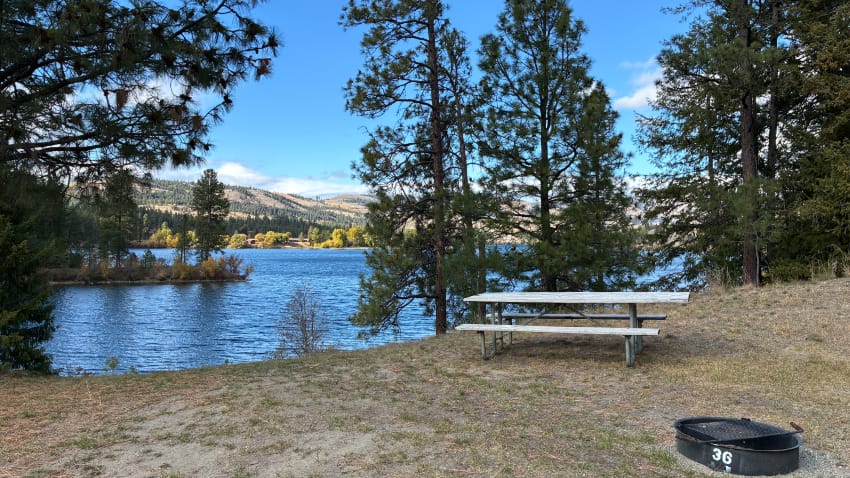
After 15 years of waiting, Joe’s exactly where he wants to be. And if the pattern holds? He might just stay for the next 20.
Listen to our full conversation with Joe Giampietri in the latest episode of Exploring Washington State.
Welcome to the Exploring Washington State podcast. My name is Scott Cowan and I’m the host of the show. Each episode I have a conversation with an interesting guest who is living in or from Washington state. These are casual conversations with real and interesting people. I think you’re going to like the show. So let’s jump right in with today’s guest. My guest today is Joe Giampietri, who is the park ranger at Curlew Lake State Park.
Scott Cowan [00:00:32]:
Jim. Joe. Joe. Scott, stop. Take 25. Sorry, Joe. Why am I calling you Jim? I don’t know why I was thinking. My guest today is Joe Giampietri the park ranger at Curlew Lake State Park.
Scott Cowan [00:00:52]:
Joe, welcome to the show. Sorry for butchering your name.
Joe Giampietri [00:00:57]:
Thanks, Scott. Thanks for having me.
Scott Cowan [00:01:00]:
How you and I started talking is that I am working on. We have this at Explore Washington State. We have this state parks directory where we list all the state parks and we’re going to go through it now for the summer winter hours transition. And there was some confusion, so I actually called the number and you called me back and we’ll get into that. But before we start talking about your park, I want to talk about you for a couple of seconds. Joe, as a kid, did you want to be a park ranger? How did you get to where you are today?
Joe Giampietri [00:01:34]:
Yeah, so growing up, I grew up in the Spokane area and fortunately my family always went camping. We had ocean trips every summer to state parks specifically.
So, so we would go over to Twin Harbors or Grin or Ocean City and camp at state parks. And so just that love of the outdoor, of going camping with family and, but doing it at a state park where, where I saw rangers driving around, I saw people mowing the lawn, I saw all the stuff that happens in a state park and just kind of caught fire on it. And it’s something I’ve, I always wanted to do. And so that, that love of, of state parks really started at an early age for me and. Yeah, so.
Scott Cowan [00:02:24]:
So you grew up in Spokane and what’s the. How does one. Well, in your case. Let’s just talk about your specific case. How did you become a park ranger? What was the process for that?
Joe Giampietri [00:02:36]:
Yeah, so I, I became a park ranger actually, a little bit later on in my career. I had a, a different career starting out. Well, right after high school, I, I went to, I went to Yellowstone and I worked a summer at Yellowstone and that’s kind of where I was like, yeah, this is what I want to do, you know, work in a park and, and be a Ranger
and came back to Spokane and after that summer and ended up, you know, just getting a job to, you know, start working and stuff and worked in a grocery store and 15 years later, you know, you’re. I’m still working in a grocery store and kind of climbed some ladders and you know, did some department leads and stuff like that.
But I was always kind of like, well, I always wanted to do this other job, you know. And, and so yeah, I went to. I put. Went back to college and went to Spokane Community College and did a natural resource program there, a two year program.
Joe Giampietri [00:03:35]:
And then started working summers as a seasonal park aid at Riverside State park and just kind of got my foot in the door there and ended up working about four summers there and and then doing a couple winters up at Mount Spokane working as a park aide there. So. And then finished my, my degree and then promoted into a.
A ranger position and yeah. Moved out to Central Washington and worked at Alta Lake in a Bridgeport area and kind of bounced around the eastern Washington and working at Lake Chelan and most recently at Sun Lakes and Steamboat and Dry Falls Visitor Center. And then I got the opportunity to come up here to Curlew Lake and just a dream park up here. And so that’s how I kind of got here and my path. So yeah, definitely very cool.
Scott Cowan [00:04:27]:
I In fact I was at Yesterday I was. I had to go up to Tonasket in Omak and all that. So I took the long way and I actually went out to Steamboat and Dry Falls and drove, drove around and it was a beautiful as I’m guessing it was beautiful up in Curlew yesterday. I mean up there, you know, it was blue sky, the water looked great, the fall leaves were turning. It was absolutely like just magnificent.
And and I told you, I know it won’t go into the story for this but you know, I told you about my mom and when she was a kid how they would drive from Tacoma over there to the lake that is predating the state park. But anyway, that area. So you.
Scott Cowan [00:05:15]:
Man, I have so many, I have so many questions for you. But let’s talk about the park. What can you. What do you know about the history of your park? What like when was. When did it become a state park?
Joe Giampietri [00:05:33]:
Yeah. So Curly Lake it was. It’s kind of pieced together over the years and it was. It’s a lot of the land in Curlew Lake State park is actually owned by Department of Fish and Wildlife and the park was much smaller originally, but 1958 was when the park was created and it was donated land from some of the local families here and put together with fish and wildlife land. And it, it just kind of expanded over the years.
So, so now it’s about 80 acres and there’s 80 campsites, about three miles of trails, hiking trails and, and a busy boat launch. And so we’ve got a little bit of different camping, we’ve got RV sites, we’ve got tent sites, some primitive sites and trails. And so it’s, it’s a, it’s a really quiet, calm park and, and family oriented park.
Scott Cowan [00:06:37]:
Well, let me ask you this question. On an annual basis, do you have any idea how many visitors Curlew Lake State park is a host for?
Joe Giampietri [00:06:49]:
Yeah, so it’s a seasonal campground. So we’re open April through October, the end of October. And I was trying to pull up some numbers here but not able to get into my computer. But I, I thought I saw it. As far as our numbers, about 50, 000. And I might be off on that, but I believe our numbers are, are that I might be way off. But it’s, it’s a, it’s busy in the summertime, but in our shoulder season we definitely drop off.
Scott Cowan [00:07:23]:
Now, when you say it’s closed during winter online, there seems to be some conflicting. I hate to, you know, question the park ranger, but there seems to be no confusion. Yeah, it’s closed, right.
Joe Giampietri [00:07:38]:
You know, camping’s closed. Yeah. And I think a lot of us get caught up in saying the park’s closed because the campground, because that’s really the primary focus of, of this park. But, and the bulk of the work. But yeah, the park, the park stays open year round. It’s just the campground closes on October 31st, but our boat launch stays open year round. Something unique about our boat launch here at the park that I didn’t mention. It’s actually a no fee boat launch.
Joe Giampietri [00:08:08]:
It was, it was written into the, the donation of the land that.
Scott Cowan [00:08:15]:
When.
Joe Giampietri [00:08:15]:
This, when this property was donated by the family that donated to the state, they wrote in the contract saying that there, there shall now be no boat launch fee at that launch where other parks do charge anywhere from five to seven dollars. But yeah, the park, the water access to the lake stays open year round.
It’s just the camping facilities closed. So it is kind of confusing when you look online. And even before I came up here and took this job, I was kind of like, wait, it says this, but this says that. And so it’s kind of funny that that’s the comp, that’s how we met for that conversation for sure. But yeah, the park stays open year round, but it’s just the camping that closes.
Scott Cowan [00:09:01]:
All right, so you think we’ll call it a guesstimate. You know, these are not official numbers, but you’re thinking about 50,000 visitors to Curlew Lake State park annually, I’m thinking.
Joe Giampietri [00:09:16]:
So that’s, that’s a number that stuck out.
Scott Cowan [00:09:18]:
Okay, we’ll just, we’ll run with that one. Okay. And you know. Yeah, it’s okay. This isn’t hard math for either of us. Now, if I ask you to drill down on that number though, how many people do you think actually camp there?
Joe Giampietri [00:09:33]:
I think majority of the attendance here is camping. I, I would say it’s camping and boat launch. Those are our two, two, two things here. So with 80 campsites, that brings, you know, a crowd and then it’s the boat launch. We’re, we’re one of the, actually, we’re the only public boat launch on Curlew Lake. And so anybody on the lake that’s not staying at one of the private resorts or has their own launch, they’re coming in and launching here too. So, so that definitely brings in a lot of crowd too.
Scott Cowan [00:10:09]:
So now for them to access the boat launch though, they, they, they do need to have a Discover pass. Correct.
Joe Giampietri [00:10:16]:
So there’s something unique about Curlew Lake. It’s, you need a Discover Pass or a Fish and wildlife vehicle access pass. At other, other state parks, it’s, it’s just Discover Pass. So you don’t need, or you, you need to have a Discover Pass, not the, not the Fish and Wildlife tag, but C is unique like that where as long as you have either or those, you’re good or your camping permit. So it’s kind of a unique park where it’s. You, you’re able to have that because we are co owned by Fish and Wildlife. That’s the reasoning on that. So gives people another option.
Scott Cowan [00:10:59]:
So if I look. Okay, now, now you made me think of question another way. So if I want to go and camp at your park, if I pay my camping fees, and we’ll, we’ll talk about those numbers in a second, do I have to have a Discover Pass or does my camping fee allow me access to the park for that period of time?
Joe Giampietri [00:11:25]:
Your camping fee is your golden ticket.
Scott Cowan [00:11:27]:
Okay.
Joe Giampietri [00:11:28]:
So if you’re camping here in any state park, that’s the same thing. So if you’re, if you’re camping at that park, you’ll get a tag that shows that you’re in the campground. And that’s your golden ticket that, that supersedes your Discover pass for the time that you’re camping. Okay. So that’s. Yeah. You won’t need that in addition or anything.
Scott Cowan [00:11:48]:
Well, that’s cool. I, I’ve, I just assumed a. My idea of camping is bad room service. So I’m, I’m not, I’m not your target audience, but I just, I always assumed when I’ve gone and visited a state park that, I mean, I have a Discover pass and I just made the assumption that all the people that were camping would also have one. But that’s interesting to know that if I, if I reserve a camping spot at a state park and I don’t have a Discover Pass for the period of time that the park, my camp spot, has been reserved, I’m good to go. The golden ticket, as you said. Okay.
Joe Giampietri [00:12:28]:
Yeah.
Scott Cowan [00:12:29]:
Before we talk fees about the park, I’m gonna put you on the spot. This is an impossible question for you. Okay. I’m setting you up for failure. All right. Full disclosure.
Joe Giampietri [00:12:39]:
Okay.
Scott Cowan [00:12:39]:
Full disclosure. And it’s good natured. Okay. It really is good natured. How many campsites did you say there were?
Joe Giampietri [00:12:48]:
80.
Scott Cowan [00:12:49]:
80. You have to pick one which is the one you’re gonna camp at.
Joe Giampietri [00:12:56]:
I’m gonna say site 36. Okay. And it’s, it surprised me this summer how, how little it was occupied, but it’s, it’s up on a hillside overlooking. You can see the. All the way to the north end of the lake. It’s a, it’s a hike in tent site.
Scott Cowan [00:13:14]:
Okay.
Joe Giampietri [00:13:15]:
And so the reason that it wasn’t occupied so much, you can’t have an RV there. And it’s a very steep hill to get up to the campsite, so. Okay. You know that, that filters a lot of different clientele for that. So, you know, if you have mobility issues, it’s hard to get to. But if I’m camping at my park, that’s the site I’m taken.
Scott Cowan [00:13:39]:
Site 36. I can put you down for that.
Joe Giampietri [00:13:41]:
Oh yeah, site 36.
Scott Cowan [00:13:43]:
And I didn’t think you would.
Joe Giampietri [00:13:44]:
I mean, I could, I could, I could just label off, you know, 10 more. That would be top. My top 10 too. But that one, it really surprised me how little it was occupied this summer. I mean, a lot of my sites were, were full this summer. But that one, just because of that hill. It’s a very steep hill, but sounds.
Scott Cowan [00:14:06]:
Like it’s got a really nice view.
Joe Giampietri [00:14:08]:
Okay, it does. It’s. It does. So it’s A little ways from the bathroom, which is also, you know, a reasoning of why it maybe wasn’t taken so much, but just the view is worth it, I think.
Scott Cowan [00:14:20]:
Okay. And you have accessible campsites, accessible bathrooms. So can we call them ADA compliant?
Joe Giampietri [00:14:29]:
Yes, we have, we have one side of our bathroom that is ADA compliance, and then we have another side that is not, but it’s. And then our south bathroom is as well. But yeah.
Scott Cowan [00:14:44]:
Now when I’m on the. I’m looking at the state’s site for your, your park, it says park ranger station. Why do I care that there’s a park ranger station? What I mean, what does that really, truly mean?
Joe Giampietri [00:15:01]:
The, the station. I mean, it’s really your point of contact when you, when you come into, into the park. And it’s, you know, it’s, it’s your, it’s where you’re going to get all your information. It’s where you’re going to check in for your campsite, where you’re gonna get kind of squared. Squared away for, for your, Your camping trip. And so it, it’s just your central point of contact. I think that’s what’s important about it. Um, you know, we have brochures and pamphlets and information here at the, at the site, but here at the ranger station, but it’s really at your, your, your point of contact here.
Scott Cowan [00:15:39]:
So I was just curious. I was like, all right, so as far as state parks goes and the ones that I’ve seen and I’ve been. I’ve been to your park. It’s beautiful, man. I just, I was there on a. I forget what I might have been March, it might have been early, you know, but it was just one. Another one of those, you know, beautiful blue skies. The lake is absolutely stunning.
Scott Cowan [00:16:05]:
It was what my takeaway from driving through your park and getting out, walking around and actually talked to some people that were camping and all that, but is just. I don’t want to say it was well maintained. Like, it’s not meticulous. I mean, I’m not trying to say that the, the lawns look like they’re putting greens and all of that, but it’s well maintained. It’s. It’s. Obviously you and the crew are busy working on the presentation of the park to the public. How many people does that take to run your park?
Joe Giampietri [00:16:42]:
So this summer we ran it with three people. So the mowing, the weed, eating the bathrooms, the registration, the general park operations missions is three people, Usually three to five people. But we have help from, for anything skilled Maintenance. We have our maintenance team, and they cover an area, and so that area is spread out between Winthrop and Republic. And so they have multiple parks within the area. But they.
Scott Cowan [00:17:22]:
They.
Joe Giampietri [00:17:22]:
They help us out with some skilled maintenance stuff, you know.
Scott Cowan [00:17:26]:
Okay, this. Actually, this is kind of an interesting question. I probably wouldn’t have gotten to organically, but this, this inner. This distraction actually brings it up. I’d like you to kind of walk me through what’s a. Let’s pick a summer day because we’ll say the park is full. All right, so it’s. It’s busy season at the park.
Scott Cowan [00:17:44]:
Not. Not maybe what you’re doing in January, but let’s say you so arbitrarily, let’s just say middle of July. What’s a typical day like for you at the park?
Joe Giampietri [00:17:56]:
Yeah, I mean, it can go anywhere really. It just depends on what happens and kind of dominoes from there. But, you know, you get. For. In the summertime, I work kind of a night shift. And so my typical day is when I get here, I check in with my. My park staff and see, you know, what. What projects, what, you know, we’ve been working on, what, who’s where, who’s doing what, as far as, you know, in the campground.
Joe Giampietri [00:18:26]:
Who do we have in the campground? Is there any questions that need to be answered? Is there any. Anything that needs to be fixed? That kind of stuff. So it can really go any direction, depending on what the need is of the customers or different, you know, facility issues that maybe, you know, if we have a full campground, sometimes that’s. That’s hard on facilities. And so is there maintenance issues that come up with, you know, our su. Our sewer system, or just any other facilities like that. So it can really go anywhere. But a typical July day is.
Joe Giampietri [00:19:08]:
Is getting on, checking in with staff and getting out in the park and just being. Being seen, making contacts of just basically connecting with visitors and trying to create an experience. So that’s really my. My big thing is because grow. Growing up going to state parks, I. I had such an experience and memories, and so I try to try to do that for people who come to my park.
And so whether it’s, you know, finding out what campsite has, you know, a bunch of kids in their campsite and. And can I do a junior ranger program or connect with them there and just, you know, trying to create those memorable experiences for people, I think that’s the biggest and most important thing.
Joe Giampietri [00:20:01]:
But just kind of running the park day to day, making sure things are getting done, you Know, grass is getting mowed, watered, bathrooms are getting cleaned. Customer service is our biggest thing here. And so just. Just taking care of what needs to get done. Fee compliance is something that we do, so. Or that I do here at this park. And so it’s, you know, checking for. For p.
Joe Giampietri [00:20:23]:
Discover passes or fish and wildlife tags or their camping permits and just. And getting people registered and. And giving them those options to go and get those kind of passes. But, yeah, typical day, could go kind of anywhere. Dep. Know who knocks on the door and what dogs are loose or, you know, if there’s, you know, maybe confusion over campsites, possibly. Fortunately, the park that I’m at here, it’s. It’s a pretty quiet park.
Joe Giampietri [00:20:55]:
So as far as major issues there, there really isn’t a lot. It’s. And a lot of the things that you can do on a customer service standpoint, you can really resolve those right away with that stuff, so.
Scott Cowan [00:21:10]:
Okay.
Joe Giampietri [00:21:11]:
But there’s definitely parks that, you know, are. Are really busy parks that have some serious issues, too, and so.
Scott Cowan [00:21:20]:
But you’re kind of a more tranquil place.
Joe Giampietri [00:21:23]:
Oh, absolutely. Yeah. This is Curlew Lake. I read it someplace. It says that it’s known as the most relaxing state park in Washington, in the Washington State park system. So I think that’s a good title to have.
Scott Cowan [00:21:37]:
Yeah, I think. Oh, yeah, exactly. But everyone’s gunning for you, though, man. I got to tell you, there’s competition. Okay. You mentioned junior Ranger program. If there’s a campsite with a bunch of kids, what does that look like? What do you. What do you do for the kids?
Joe Giampietri [00:21:51]:
Yeah, so we have booklets. We have a actual interpretive program that we have Junior ranger booklets. They come with stickers, bookmarks, flashlights, the whole works. And we can. We can give them these booklets. And so during their camping trip, we. They can fill out their booklets, and once they. Once they finish their book, they can show it to a ranger, and then they earn an actual junior ranger badge, and so they can get that before they leave.
Joe Giampietri [00:22:19]:
And it’s actually. It’s a really cool engraved wooden badge, and kids just love it. And so. And stuff that I do because of the area that I’m at, I like to bring. We have a fossil site in town, in the town of Republic called Stonerose Fossils and Interpretive Center. So I like to bring a bunch of shale rock out and let the kids break those open and find their own fossils. And so I work that into my interpretive program just because it’s it’s something local here and something they can go and then go dig fossils the next day while camping here. And kids love to see that kind of stuff.
Joe Giampietri [00:23:01]:
So you crack open a rock and you find a fossil that’s been, you know, 50 million year old fossil. And so it’s super unique to Curlew Lake and Ferry county in general.
Scott Cowan [00:23:13]:
The junior park ranger program, is that at all the state parks?
Joe Giampietri [00:23:17]:
Yes.
Scott Cowan [00:23:18]:
Okay. And you said you, you do this, you bring the shale out because it’s kind of local to you, unique to you. If you were doing Ocean, Ocean City, you probably wouldn’t be bringing shale out of Ocean City, but.
Joe Giampietri [00:23:30]:
Yeah.
Scott Cowan [00:23:31]:
Do you have, as a park ranger, do you have some latitude as to what you can present to in this?
Joe Giampietri [00:23:39]:
Yeah, I think. I think so. I think every park has the ability to kind of adapt to whatever area, region, environment they’re in. And so I would assume that rangers over at the ocean are, you know, talking about different marine wildlife and such because it’s. It gets around them here. We have a ton of gold rush history, we have a ton of fossil history. And so that’s what’s unique to this area. So I like to try to talk about that stuff that they can then go out and explore that.
Joe Giampietri [00:24:17]:
We have a railroad history here too. And so just talk about the things that are local to your park. And so there’s some wiggle room as far as what you can. What you can present and stuff, depending on where. Where you’re at, right?
Scott Cowan [00:24:30]:
Yeah. It wouldn’t be particularly relevant if you were talking about, you know, shellfish at Curlo just wouldn’t work.
Joe Giampietri [00:24:36]:
No, no, not really.
Scott Cowan [00:24:40]:
All right, gonna go back to that. That number that 50, 000 is approximately. Your mileage may vary, folks. This is just the number that he threw out and he’s having, you know, he didn’t. He wasn’t prepared. I didn’t prepare him for that. It’s not. You weren’t prepared.
Scott Cowan [00:24:53]:
I did.
Joe Giampietri [00:24:53]:
I set you up for.
Scott Cowan [00:24:55]:
But I want to ask you. And you can tell now. Just have to tell everybody visually. You can tell now. My camera froze and you get to look at me with my eyes closed the rest of the time. Joe. Sorry. There you are.
Joe Giampietri [00:25:05]:
Yeah.
Scott Cowan [00:25:05]:
Okay. There you go. I’m actually here. Okay. So of. Of that 50,000 visitors, does. Do you. Does the state.
Scott Cowan [00:25:15]:
This is the park system. Do you monitor where people are coming from?
Joe Giampietri [00:25:23]:
Yeah, I mean, we have. When people make reservations, they’re, They’re. We. We see where they’re from. I don’t know if we necessarily keep track of any of that data. As far as, like, I know that for, like, for reservations, we have, we have out of state reservation fees. So there may be some information on that as far as people making reservations from in state versus out of state. But beyond that, I don’t know how much of that information is, is collected, but I get, I get visitors from all over the states and from other states too.
Joe Giampietri [00:26:06]:
I get a lot of people that drive here from the west side, you know, seven, eight hours on a Friday night and show up at 10, 10 or 11 at night and, and then camp and then leave first thing Sunday morning to get back home before they have to work on Monday.
Scott Cowan [00:26:22]:
That’s dedication.
Joe Giampietri [00:26:24]:
It is. And, and it’s, it’s worth it to them. I mean, they’ve, they’ve been coming here for so many years. It’s just tradition. So it’s really cool to see that, that dedication of people coming out here and, you know, that quick turnaround, but making it, making it worth it to keep those traditions going.
Scott Cowan [00:26:44]:
Do you get many Canadian visitors?
Joe Giampietri [00:26:47]:
We do. I mean, we are so close to the border.
Scott Cowan [00:26:52]:
You’re what, 15 miles?
Joe Giampietri [00:26:55]:
We’re, we’re about 20. Yeah, about 20 miles or so to the border. So not far at all. I mean, our, technically are the, the closest, largest town or larger town is Grand Forks, B.C. to where we’re at. And so we’re closer to a Canadian town than we are or a bigger town than we are a US town. But yeah, we’re, we get a lot of Canadian campers. I think there was a, A, a dip in Canadian camper attendance this year for, for many reasons, but, and that’s just what I’ve been being told, not having been here a previous summer.
Joe Giampietri [00:27:41]:
So. But yeah, we, we love our Canadian campers and, and they come in quite a bit. So.
Scott Cowan [00:27:47]:
So this is. So based on what you just said, this was your first summer at the park?
Joe Giampietri [00:27:53]:
Yeah, so I, I came up to Curlew in May, so this is my first, first summer for Curlew. I came over from Sun Lakes this, this spring. So.
Scott Cowan [00:28:03]:
And as the park ranger. Okay, so let me, let me, before I ask or before I ask, start asking questions, let me give you some historical background. In the late 60s, early 70s, my uncle was a park ranger. Oh, I remember as a young kid he was at Flaming Geyser out of Auburn. And then I think he was also doing Federation Forest. And in conversations with my mom, she thought there was other parks, but I, I only remember visiting him and my Cousin at Flaming Geyser. So what I remember as a young kid is that they. There was housing there available for him and his family.
Scott Cowan [00:28:51]:
Are you put up as the park ranger? Do you have housing at the park?
Joe Giampietri [00:28:57]:
I do, and I’m super grateful for that because in the, I mean, Ferry county is. Is pretty remote and it’s, it’s definitely, you know, you can’t just go. There’s not a lot of houses on the market or, you know, places to stay, so. Yeah, definitely. So I am. I’m put up in the park and I’m super grateful for that.
Scott Cowan [00:29:23]:
So.
Joe Giampietri [00:29:23]:
And it’s a quick commute to work now.
Scott Cowan [00:29:25]:
And this is, this is pushing the envelope of questions like, but is that part of your compensation package is housing?
Joe Giampietri [00:29:32]:
In. In a way, yeah. I mean, it’s. You. You. You get a small. You pay. You pay for it.
Joe Giampietri [00:29:38]:
Okay. It’s a small portion out of your check, but okay, it’s. It’s definitely a deal.
Scott Cowan [00:29:46]:
Would it be fair to call it, like, subsidized housing, then? You’re getting.
Joe Giampietri [00:29:49]:
Oh, absolutely.
Scott Cowan [00:29:50]:
You’re getting the park ranger hookup type thing, so.
Joe Giampietri [00:29:53]:
Yeah, the park ranger hookup’s a good way to put it, I would say. Yeah.
Scott Cowan [00:29:57]:
All right. And so this is your first summer here, and this will also be then your first winter there.
Joe Giampietri [00:30:06]:
Yes.
Scott Cowan [00:30:07]:
And I’m gonna guess that during peak season that you are putting in way more than 40 hours and probably you’re working seven days a week. Is that a safe assumption?
Joe Giampietri [00:30:20]:
I, you know, surprisingly, no. We. We have enough staff and state parks is. Is big on work life balance. And, and even though you’re, you’re here living in the park, you get your days off and, and you, you know, there is times where, you know, something maybe happens and somebody comes knock on the door and, you know, you, you suit up and you go and, and deal with it, but, you know, you try to stay within and, and, and have that balance, the, the work life balance. And, And I’ve got an awesome staff here that, you know, hold down the fort when. When I’m not on my. When I’m on my two days off.
Joe Giampietri [00:31:02]:
And so, yeah, it’s, It’s. I think at other parks where, you know, there’s serious issues, there’s. There’s more of that jumping into things. But at a park that is pretty quiet, yeah, you get your days off and you get their work life balance, and the state’s really, really good about trying to. Trying to do that.
Scott Cowan [00:31:24]:
So.
Joe Giampietri [00:31:25]:
Yeah.
Scott Cowan [00:31:26]:
All right, now, during the summer, we talked about mowing lawns. Maintenance. And by maintenance, we mean, you know, the toilet is running and we got to get a, you know, fix that. The septic system’s got an issue. We got to fix that. We’re not going to hopefully be upgrading a septic system during the. The. The prime use of the se.
Scott Cowan [00:31:47]:
Of the. Of the park. Now, as we head into the quote, unquote, I’m making air quotes. You can’t see me. I’m making air quotes. The off season, does. Does your role then kind of shift to more park improvement slash bigger maintenance projects?
Joe Giampietri [00:32:11]:
Definitely, yeah. I mean, right after Labor Day weekend, it was, it was shifting gears and it was. It was shifting gears into projects and maintenance right away. For example, we just had a to do list of all the things that we wanted to kind of just improve in the park and, and make better. So right after Labor Day weekend, I started painting bulletin boards, redoing horseshoe pits and cleaning up trails and just minor projects like that that, you know, that fall season’s really, really big on doing so well.
Scott Cowan [00:32:55]:
Let’s. Let’s take one of the docks that you have there at the lake would do you. Are you required to maintain that, doc, or is that what your maintenance crew is for? Is that beyond your scope?
Joe Giampietri [00:33:09]:
We work with our maintenance team on. On that kind of stuff. There’s, there’s not a lot, not a lot that we do. We. We get it ready for winter because the lake does freeze over, so there’s a few things that we do to kind of prep it for winter. But we’re. After Labor Day weekend, we’re, we’re really. We’re.
Joe Giampietri [00:33:30]:
We’re working strictly with our maintenance team of, you know, kind of the shutdown part operations and kind of maintenance roles of that. But then we’re throwing a few extra projects in here and there. But yeah, we work really closely with our maintenance team on that kind of stuff.
Scott Cowan [00:33:47]:
All right. Does your park have kind of like a road map of maintenance slash future upgrades if that’s for. I don’t know. I’m making it. Making this up, like increasing the dock size or adding more camping spots or, or things like that? Are those, are those determined at the state level? As a park ranger, do you get. Do you have input to say, hey, you know, we got this area over here that we could develop into six more camping sites, you know, arbitrarily. How. How does a park continue to evolve?
Joe Giampietri [00:34:34]:
Yeah, a lot of that. Those decisions are. Are made higher up, but I think that our, our higher ups do a really good job of kind of checking in with our, the field staff and, and field level staff of, of you know, what they see. But yeah, a lot of that stuff’s kind of higher up with our parks planners and our headquarter team and stuff like that. But. But they do. Yeah, they check in with us and like, you know, what. How does this work? Or, you know, and we can always kind of make up, you know, wish lists and stuff like that.
Joe Giampietri [00:35:09]:
And like, this would be kind of cool to do here and, and it may go one direction or not, but.
Scott Cowan [00:35:16]:
Well, yeah, let me ask you this. Let me, let me put. Put you on the spot again. Sorry.
Joe Giampietri [00:35:20]:
Okay.
Scott Cowan [00:35:21]:
Your wish list. What’s on your wish list? Do you have anything?
Joe Giampietri [00:35:25]:
Oh, yeah, I do. And, and there’s, I mean, any park you go to as a ranger, you kind of, you know that, that first month you’re there, you’re kind of walking around, you’re like, oh, well, I had this at my other park and this would be cool here or this and that, you know, and something that I think would be really cool at Curlew would be a playground.
And I think just a small playground backed by kind of out. Out of the camp loop. And it gives, it gives families with kids something to where they can be in their campsite, still see their, their kids playing at the playground and just something, something extra that, you know, keeping people off screens and, and keeping kids busy and stuff.
That’s something that’s on my wish list to play a playground and, and then, you know, maybe building more trails and there’s all sorts of cabins I thought would be really cool here. But it’s a lot of. It’s, you know, it’s, it goes to the higher ups and planning and stuff and there’s a lot, there’s a lot of process to it and stuff.
Scott Cowan [00:36:38]:
Be honest. It’s all those things you said, just take money. I was going to ask you. I’ve been to some state parks that have cabins or they have yurts and I, I would think like a handful of yurts at your, your park would be kind of cool. Like.
Joe Giampietri [00:36:56]:
Oh, that would be really cool.
Scott Cowan [00:36:58]:
Yeah, that would be something that would get me out there. Like me. Not that I want to. I’m not your target, but like, where was I? On the west side. And we, we’re driving through the park and I saw these yurts and I was like, you know, I want to go inside. I want to see what one looks like on the inside. But that would work for me. Like, yeah, that would work for me.
Scott Cowan [00:37:17]:
Like, I could. I could come here and hang out for a few days and having a. Having a yurt or a cabin would be, like, really cool. Up in Conconully, like, they have got cabins, but they look. I know I’m a tall guy and they look like they’re not like. Like I might be a little, like, claustrophobic in it because it looked like it was a little short.
Joe Giampietri [00:37:39]:
I. I really like the cabins at Conconully They’re one of Conconully, one of the parks, the three parks in. In our area. Okay. And I always. I kind of joke. It’s like, oh, we could just take a couple of those cabins and bring them over here.
Joe Giampietri [00:37:53]:
But that’s not how it works. You know, if they wouldn’t miss them, let’s go. Yeah, they would miss them there. We would love them here, but they would miss them there. I get it. But, yeah, that style, I think, would be really fun here. Yeah. In those kind of cabins.
Joe Giampietri [00:38:08]:
And a lot of the resorts in the area, they have cabins and. And so it might just, you know, invite one more type of clientele to the park and, you know, somebody that maybe doesn’t have an rv, doesn’t necessarily want to tent camp, but it gives you just one more option, and creating just more options for recreational opportunities is really the goal, so.
Scott Cowan [00:38:35]:
Right, right. No, and I think. Yeah. Anyway. Oh, for somebody who hasn’t been up to that part of the state, because you’re pretty, you know, you’re pretty remote. You know, you’re pretty. You’re pretty remote. You just don’t drive up.
Scott Cowan [00:38:54]:
Up there just to check it out. Unless you live somewhere, you know, in Republic, and they’ve already seen your park. So let’s paint a picture. What else is up there? What. Okay, so the person you’re talking to now is someone who’s like, yeah, we want to. Want to go to a state park. Have we been to. Let’s just.
Scott Cowan [00:39:18]:
I’m randomly going to just say they’ve been to Flaming Geyser, because I mentioned that one before. And I’m going to say they’ve been out to Ocean City because that one got mentioned earlier, but now they’re looking to come over to the east side of the state. Central Washington, Eastern Washington. Why should. Not why. But what else is out there at Curlew Lake in around the area? That would be like, oh, this is really cool. We need to come out here for a weekend or a week or some. Some evenings.
Scott Cowan [00:39:49]:
What else is going on?
Joe Giampietri [00:39:50]:
Yeah, definitely Ferry county is just a very unique area. There’s, there’s a lot more going on out here than, than I think a lot of people realize. It’s, it’s for recreation. This is just an amazing little hidden corner of the state. And like I mentioned before, the, one of the unique things is our stone rose fossil site in town where you can go dig Eocene period fossils. And that’s very unique to this area. We also have a ton of just history of the gold rush here and there’s mines everywhere and just that history is really interesting. We also have a, a bike trail that’s, it’s the Ferry county rail trail up here.
Joe Giampietri [00:40:37]:
It’s an old railroad bed that was a train line from the town of Republic into Canada during the mine to run gold and lumber and all resources there. And when that closed, they, they turned it into a bike trail. So you can actually bike from the town of Republic on a path all the way up to Danville, which is right at the border. And it’s just a fantastic bike trail. You go through a tunnel, there’s an old train bridge that goes across the lake and then just the lake itself.
Curlew Lake is, is one of only seven lakes in Washington that hosts tiger muskie. It’s a, it’s a fish, It’s a, I mean it’s, it’s a terrifying looking fish if you, if you take, if you look at a photo. But it’s, it’s the fish of 10,000 casts is what they, what they call it.
Joe Giampietri [00:41:37]:
And so it’s, it’s a, it’s a big trophy fish out here. And it’s planted in this lake every year. About 250 of them every year for sport fishing. And so it’s something unique that. You know, only seven lakes in Washington have that. And so that’s something that’s very unique to this area. But it’s just the pace of life up here. Ferry county is just, it’s a rec center..
Joe Giampietri [00:42:05]:
It’s just, it’s just an enjoyable area. So there’s lots to do up here for sure. It’s just. You gotta stop by the ranger station and get all the pamphlets and, and talk to the ranger first and, and he’ll get you all the information but.
Scott Cowan [00:42:19]:
And you know a guy who’ll tell him what to do. Got it.
Joe Giampietri [00:42:22]:
Exactly. Yeah, it’s. And a lot of that is. It’s like even when I came up here I had to kind of dig into. I knew all this stuff was around, but I didn’t know really how to find it. And so it’s kind of, it’s kind of that old school last frontier. Yeah. You talk to this person to talk to this person to know about this kind of place.
Joe Giampietri [00:42:45]:
And so once, you know, you know. But I have a lot of campers that come in and it’s their first time at Curlew Lake. And that’s kind of what they ask. They always say what is there to do around here? And so I go through the whole spiel. I, I, well, did you bring your bikes? Because we got the bike trail. You know. Do you got kids with you? You want to go dig some fossils and some of the history?
Up in, in the town of Curlew there’s an old historic hotel, the Answ Hotel that closed down in the 1900s. And it, it’s been just you walk in there and it’s like as if they just closed, closed, locked and closed the doors in 1907 and everything’s still right in the same exact place and you can walk through that.
Joe Giampietri [00:43:35]:
And so it’s, it’s just time stands still up here and really unique things to explore.
Scott Cowan [00:43:42]:
Okay. You mentioned fish. I know like going back to when my mom went is because my grandfather liked to fish there. And you mentioned that the lake is stocked with that the, the tiger muskie is the, are just. Are there other fish that are stocked in the lake?
Joe Giampietri [00:44:04]:
Oh yeah. So rainbow trout. Rainbow trout’s the, the big fish here. There’s smallmouth bass, there’s black crappie, there’s Kokanee. Kokanee stocked in this lake too.
Scott Cowan [00:44:17]:
That’s a beer, isn’t it?
Joe Giampietri [00:44:20]:
It’s a fish too. And we are close to Canada, but it is a fish in this, in this context. But okay. Yeah. And so there’s, there’s a lot of different. It’s really a buffet lake. There’s a yellow perch in this LAKE now about eight years, eight to 10 years ago that was illegally dumped in this lake. And it’s really taken over.
Scott Cowan [00:44:44]:
So more like a predator. Is it, is it not a predator but invasive?
Joe Giampietri [00:44:51]:
It’s, it’s, it’s, it’s non native. It’s, it just, I mean the climate here or the, the lake is perfect for perch. Can adapt to a lot of, a lot of lakes and so really just kind of took over. But they’re trying to catch still too and like they, they’ll bite at anything. And so when you have families out fishing on the dock, you know, and a kid catches their first fish because it’s easier to Catch a perch like that, it’s. It’s actually a really good thing. So. So, you know, trout fishermen will tell you, you know, yeah, I don’t want the perch in here, but it adds something.
Joe Giampietri [00:45:34]:
It does add something, but it really is a buffet lake. You can catch just a wide variety of different fish here. And so that. That makes it that much more popular for fishing.
Scott Cowan [00:45:45]:
All right, all right. As I warned you, I bounce around a lot, but as a. From a career standpoint, as being a park ranger, is there a. Like, how long is a park ranger typically at a park?
Joe Giampietri [00:46:03]:
It varies by the park. I would say something really cool about Curlew Lake since. Since 1958. There’s only from 1958 to 2022, when. When the last career park ranger retired at this location, there was only four rangers at this location.
Scott Cowan [00:46:27]:
Oh, wow.
Joe Giampietri [00:46:27]:
And so they stayed a long time here. So you had, you know, the first. The first ranger that was here when this park was created. He was here from, you know, the late 50s, 60s, early 70s. Then you had somebody from the 70s to the 80s, like, just decades and decades. And the last ranger that just retired in. In 2022 here. He was here for, I believe, 21 years.
Joe Giampietri [00:46:54]:
21 or 22 years. And so rangers stay a long time here. And. And that just says something about the. This. How special this park is. But then you get other state parks that, you know, people bouncing around a lot, and so just kind of depends on the area and who you got at that park, and if they’re, you know, wanting to, you know, move up into a different rank or. Or move to a different area of the state or.
Joe Giampietri [00:47:26]:
Or how it works. And, you know, not everybody wants to live in a certain area or.
Scott Cowan [00:47:33]:
Right.
Joe Giampietri [00:47:33]:
We’re in the middle of nowhere, and. Which for me, it’s kind of the opposite. I. I love living out in the middle of nowhere here now. So. Yeah, so it just depends on the park, but.
Scott Cowan [00:47:47]:
So there’s not like a set. You know, I don’t want to compare you to the military, but, you know, in the military, they kind of. You stay at a base, and then they. They move you around type thing, so.
Joe Giampietri [00:47:57]:
No, no, it varies. Yeah. Okay.
Scott Cowan [00:48:02]:
What are you looking forward to this winter up there? It’s gonna be your first winner now. Have. Have you.
Joe Giampietri [00:48:09]:
Yeah.
Scott Cowan [00:48:10]:
I gotta be honest with you. I keep thinking of Jack Nicholson and the Shining, you know, because you’re gonna get snowed in and all of that. No, but what are you looking forward to? Because you’re. If we’re being, you Know, if we’re looking at the map, you’re very north for anywhere in the United States, much less just Washington State. You are, you’re very close to Canada.
Joe Giampietri [00:48:35]:
Yeah.
Scott Cowan [00:48:35]:
Which puts us, puts you into that really narrow northern band across the entire U.S. so you’re going to have potentially a pretty heavy winter. It’s pretty remote. The state does a great job applying the roads though. I mean, you know, so you can, you’re going to get, you’re not going to be snowed in.
Joe Giampietri [00:48:54]:
No.
Scott Cowan [00:48:55]:
But you know, you’re probably not going to drive down to Wenatchee to run to Costco. Let’s just put it that way. That’s probably not, you know. Oh, I’ll just hop in the, in the convertible and go to Costco. No, that’s not going to happen. But what are you looking forward to for the winter?
Joe Giampietri [00:49:12]:
Honestly, I’m looking forward to for snow. Okay. And like I said, I’ve worked at some other eastern region parks and where when I worked at Alta Lake, we had some big snowstorms and it just, it just makes, I like embracing every season for what it brings and you know, if it’s going to be cold and dark, give me some snow to play in and, and just embrace that. And so I’m actually looking forward to a lot of snow even though it brings a lot of challenges logistically and travel and just the maintenance of things.
But I’ll be plowing in the park. I didn’t get a lot of opportunities to plow last winter at my park because there wasn’t, it was a really mild winter and we didn’t have a lot of snow, so might be a little rusty on the plow, but it’ll be good to get out there and get back at it.
Scott Cowan [00:50:15]:
You’ll get, you’ll get a lot of practice this winter. Yeah.
Joe Giampietri [00:50:19]:
But, but I’m, I’m really looking forward to, you know, snowshoeing and skiing and just playing in the snow. I want to do snowshoe trails here in the winter and maybe have some guided hikes and possibly even like a first day hike event that, you know, it’s a group ranger led snowshoe hike. But yeah, I’m just looking forward to playing in the snow, but doing projects in the shop and kind of just embracing and enjoying winter in, in those kind of ways.
Scott Cowan [00:50:56]:
Well, I’m going to give you some feedback that you should give to the state because.
Joe Giampietri [00:51:01]:
Okay.
Scott Cowan [00:51:01]:
When the park says it’s closed and you want to do snow snowshoeing, you’re Sending a mixed message. I, I think you got to get the state to say the, the campground is closed, but the park is open because. Yeah, if people want to come out and they think the park’s closed, well, they’re not going to look at you. Whereas if they go, oh, I can’t, I can’t camp, but I can still. They’re still doing. There’s a snowshoeing event. Let’s just say that’s cool. I think that’s wonderful.
Scott Cowan [00:51:32]:
And I think got to get the state, whoever’s managing the website, get them to modify that for you.
Joe Giampietri [00:51:39]:
Definitely.
Scott Cowan [00:51:40]:
Yeah.
Joe Giampietri [00:51:40]:
And we do get ice fishing in the winter time out here. So that’s, that’s a really popular thing.
Scott Cowan [00:51:45]:
Right.
Joe Giampietri [00:51:46]:
When the lake freezes over. So one another winter sport that Curlew Lake is known for. So ice fishing is really busy in the wintertime here and, but just trying to kind of add some extra recreational activities for the winter for sure.
Scott Cowan [00:52:02]:
Now if I, if I was a crazy person who wanted to go ice fishing, because that’s what I think they are, could I access the lake from the park during January, let’s say.
Joe Giampietri [00:52:13]:
Yep.
Scott Cowan [00:52:14]:
Okay.
Joe Giampietri [00:52:14]:
Yep. So that’s one of the main reasons, you know, we plow, we, we keep it open for the public and we plow out parking and we have access to the lake year round so we get the snow moved and you can park and get out on the ice and fish.
Scott Cowan [00:52:34]:
Okay. Have you, have you been fishing on the lake?
Joe Giampietri [00:52:39]:
I have not been ice fishing on the lake, but I fished a little bit unsuccessfully. All right, yeah, that was the follow up.
Scott Cowan [00:52:48]:
All right. All right. So, yeah, so far, unsuccessfully. All right, all right.
Joe Giampietri [00:52:51]:
Hopefully next summer I’ll be able to fish a little bit more just with the first summer up here and, and balancing work and life and home and all that too. So. Yeah, right.
Scott Cowan [00:53:03]:
So as a park ranger, I guess during the summer, I’m going to guess, I mean, I was wrong because I would have thought you would have been working, you know, seven days a week just because of the volume of activity. What was your, what days were you able to take off during the summer?
Joe Giampietri [00:53:21]:
I would, I would take weekdays off, so usually, you know, middle of the week, Tuesday, Wednesday or a Wednesday, Thursday, depending on what’s going on. But yeah, it was pretty regular as far as that goes, when those were our slowest days of incoming campers and, and how that works. So. Yeah, and a lot of rangers across the state do that where we stack the weekends and with staff and then people take staggered days off through the weekdays, right?
Scott Cowan [00:53:52]:
Well, yeah, because I’m going to guess your guests are coming in primarily the weekends are going to be heavier is what I guess. All right, so for the listeners, I want you to give them a piece of advice. Is there something that as a park ranger, you wish the public knew so that it would not just help you do your job, but like, do people need to be prepared when they’re checking in? What’s a little tip or trick that would go a long ways?
Joe Giampietri [00:54:22]:
Yeah. Before I came to Curlew Lake, I would say just the difference educating the difference between the, the access pass and a Discover Pass. I did so much of that work at all my other parks of like people who thought they had a Discover Pass because they had their fishing license and the tag that they give them. It’s, it’s kind of ironic now because out here that’s not nest. You could have either or here. So it’s, it’s kind of, it’s different. But I think one, one tip of advice would be make sure you check into the camps. Make sure you check in even though you, you reserve your site.
Joe Giampietri [00:55:05]:
The, the follow through with the registration process. So get checked in because you’re gonna, it’s, it’s not just about that piece of paper showing that you have that campsite. It’s about giving us the opportunity to share what’s going on in the area, you know, and you know, telling, letting us give you, you know, a heads up on different events happening that weekend in the town that, you know, we could tell you about or get you to and stuff.
So it’s, it’s more than just that piece of paper, but it’s about getting the lowdown for the weekend. What’s going on? Are we having a program this weekend or is there anything else going on or what? You know, maybe it’s your first time out here. Here’s some other things that maybe you didn’t know about that you could go do and so help us help you create the best experience that you can have. So get checked into the campsite and, and stop in at the, at the booth and the ranger station and, and learn everything you can do for your, for your time while you’re camping here.
Scott Cowan [00:56:14]:
All right, that’s, that’s actually great advice because like I like that help, help us help you type thing because yeah, you know what’s going on. You can share that with me as I’m pulling in. All right. All right. So I have, I have some other questions and these revolve more about you. Day to day. I always ask guests these questions, so I don’t know how you’re going to answer them. Okay.
Scott Cowan [00:56:38]:
But I’m a coffee guy, and every. Every guest I ask this question, like, where’s a great place to get a cup of coffee near you? What do you got for me?
Joe Giampietri [00:56:51]:
So there’s not a lot of places near me really being so remote, but there is a couple. There is a couple. I’m not a. I’m not a big coffee drinker, but there is Sparky’s coffee stand in. On the main strip in the town of Republic. That’s fantastic. They also serve ice cream. And so that’s why I visited it and learned that they also serve coffee.
Joe Giampietri [00:57:17]:
But. But Sparky’s. Sparky’s coffee stand in Republic is fantastic. And then. Yeah, so that’s. That’s where I would. I. Would you point me there?
Scott Cowan [00:57:29]:
All right. Now? Because I also like to eat, and I’m probably going to get up there around lunchtime. Where’s a great place for lunch? I guess we’re going to probably say Republic, but where’s a great place for lunch in Republic?
Joe Giampietri [00:57:44]:
Yeah, I’ll give you. I’ll give you two options. I’ll give you one in Republic, and then if you’re headed north, I’ll give you one in Curlew. So in Republic, I gotta say fat guys food truck. It’s. It’s off the main road. It’s about a block back. Right.
Joe Giampietri [00:58:01]:
Hidden behind the library. Okay. It’s Smash burgers and sweet potato fries is my go to. Probably way too much, but that I. That I go there. But it’s fantastic. It’s. It’s.
Joe Giampietri [00:58:18]:
It’s delicious. So I would. I definitely would point people in that direction.
Scott Cowan [00:58:24]:
All right. That guy’s food truck. All right. I like the name. I got it. I mean, I resemble the name. So it’s like. Okay, got it.
Scott Cowan [00:58:30]:
All right, what’s my other choice?
Joe Giampietri [00:58:33]:
Oh, and then in Curlew, there’s Tugboats.
Scott Cowan [00:58:37]:
Oh, yeah, I’ve eaten at Tugboats.
Joe Giampietri [00:58:39]:
You’ve been to Tugboats? I’ve been to Tugboat. Okay, cool.
Scott Cowan [00:58:42]:
Yes. I forgot about them.
Joe Giampietri [00:58:45]:
Yeah, it’s. Yeah, that. That’s a good place too. So if you’re going north, definitely. If you’re going north up to maybe visit Randall and the. The smallest state park in Washington, which is part of Curlew Lake. I forgot to mention that. But we have the.
Joe Giampietri [00:59:02]:
The grave site up at Randall McDonald gravesite. That is the smallest state park in Washington. It’s about a 10 by 10 grave site that we manage up there and tons of history of, of so of his life.
Scott Cowan [00:59:18]:
All right, so when, when we created this, this directory of Washington State parks, that was not one that was included because it’s. It not the state parks. The state doesn’t actually list it as a state park. They listed as a historic historical site or something like that. But so do you oversee it? Is that overseen out of your, your.
Joe Giampietri [00:59:38]:
Yeah, yeah. So we, we here at Curlew Lake, we are the ones that go up there and, and make sure things are cleaned up that you know, the walkway up to it is nice and weedeated. There’s not a ton of maintenance obviously because it’s so small. But you know, just make sure that, you know, the weeds are managed around there and cleaned up and stuff.
Scott Cowan [01:00:00]:
Right now there’s one. I’m going to try to scroll to it. It’s near the end. It’s alphabetical. So here on the state site. Have you ever been to Willie Keil’s grave site?
Joe Giampietri [01:00:12]:
No, it’s on my list. It’s over by the Willapa Hills trail. No, I haven’t. I’ve seen that on the map. It looks interesting.
Scott Cowan [01:00:21]:
Have you heard the story?
Joe Giampietri [01:00:23]:
I read it once, but I don’t remember what, what it is.
Scott Cowan [01:00:27]:
So I’m. I’m gonna butcher it because I’m gonna try to make it brief. But so basically here’s the premises. His dad was leading a group of people from like Missouri out here to start a. I don’t know what the right word I want to use. I’ll say colony, but that’s not probably right. But, but basically it was a religious. A group of people that want to move out into the Washington area, into the Northwest to, to establish themselves.
Scott Cowan [01:01:01]:
And Willie died like at 19 and he was going to be pulling. He would be running one of the ox teams to pull the wagons from Missouri to, to the, the west coast, right. And his last wish of his dad was I want to be buried out there. So they built a wagon or converted a wagon, lined it with lead and filled it with whiskey and put his body in it.
And they took him from Missouri all the way out here. And the Guinness Book of Records calls it the longest funeral possession procession in history. But they were stopped by Indians and they were able to explain to the Indians what they were doing. And the Indians provided them with accompaniment to the final site.
Scott Cowan [01:02:02]:
I’ve lived here my entire life. I’m kind of a. I like history. I’m not saying I know everything about Washington State Because I don’t. You know, that’s a grandiose task. I never heard of that story until maybe six months ago. Like I want to go there now too. I thought that was the smallest because it’s a.
Scott Cowan [01:02:23]:
It’s. It’s just a section of a private cemetery out there. So I thought that was the. Technically the smallest state park, but the one up by you sounds even smaller.
Joe Giampietri [01:02:37]:
It is. It’s. I mean Willie is probably not much bigger than Randall. I don’t know. But yeah, Randall is. Is basically a 10 by 10 grave site. And it’s. The grave itself is not standalone.
Joe Giampietri [01:02:56]:
It’s. It’s in a. A cemetery. And we just, we just do the maintenance on the grave site. The. And manage the historical site. Yeah, it’s not much. And there used to even be a sign on the highway that said Washington’s smallest state park.
Scott Cowan [01:03:19]:
Okay.
Joe Giampietri [01:03:20]:
It’s not there now. I don’t know where it went, but.
Scott Cowan [01:03:26]:
Okay.
Joe Giampietri [01:03:27]:
I don’t know if it’s in somebody’s garage or something now or probably somebody’s backyard. It’s kind of a cool sign. Kind of a cool sign. The state. Small state park sign. But yeah, so it’s, it’s not a lot of maintenance up there. But the. His story is just so interesting and I’m.
Joe Giampietri [01:03:45]:
I’m actually on Thursday meeting with our agency historian and it. Randall McDonald’s is actually his favorite state park is what I’ve heard. So I’ll be. It’ll be really interesting to meet with Sam on. On Thursday and hear. Learn more about Randall. But kind of a. Just an overview of it was he.
Joe Giampietri [01:04:09]:
He was a. He just did a little bit of everything honestly. But he, he purposely. He convinced a. A captain to give him a. A ship to pretend to be shipwrecked in Japan and Japan was a closed off country at that time. And so he purposely got. He.
Joe Giampietri [01:04:33]:
He faked being a shipwrecked and to get captured purposely in Japan. And as a, as a captured person. He then taught English to people in Japan and opened up a lot of. Just a lot of communication between Japan and the. And, and the rest of the world and everything. So there’s so much more but that’s kind of just a general like brief of what he did. But there. He did a bunch of other stuff.
Joe Giampietri [01:05:05]:
There’s. There’s books and books and so much information for, for the smallest state park. There’s a ton of history within of his story. So excited to learn a lot more about that in the next little bit.
Scott Cowan [01:05:18]:
All Right. We’re going to wrap this up. Gonna ask you a couple of other questions about state parks, though, and then these are. Now preface what I’m about to ask you. The answers are yours, Joe. These are Joe’s opinions. Not Washington state parks or anything like that. All right, Joe.
Scott Cowan [01:05:36]:
Okay, you can go camp in any state park this winter. Where do you want to go?
Joe Giampietri [01:05:47]:
Winter camping?
Scott Cowan [01:05:48]:
Winter camping.
Joe Giampietri [01:05:50]:
Winter camping.
Scott Cowan [01:05:52]:
Oh.
Joe Giampietri [01:05:55]:
Well, my plan this, this winter, and I’ve been talking with my maintenance team on this, is we’re, we’re planning out, we’re plowing out about three or four campsites here at Curlew to try to provide some sort of primitive camping for ice fishermen.
Scott Cowan [01:06:10]:
Okay.
Joe Giampietri [01:06:11]:
Even though the campground’s closed. Right. Park’s still open, so. But as far as this winter. Oh, gosh, I haven’t camped in the winter for a while. But I mean, gosh, I would say for winter camping, there’s not a lot of parks that stay open camping over winter. But I mean, I, I say if you get it, you know, a good, A good winter, warm winter, and going down to Riverside State park and camping there and where you can go out and hit the trails first thing off your, you know, bring your mountain bike and do some, do some winter trail riding, that. That’s got to be an option.
Joe Giampietri [01:07:01]:
I think. Obviously there’s so many more options in the summer, but yeah, winter, I would say. I would say that’s, That’s a good one.
Scott Cowan [01:07:07]:
Okay, so now the second question is, and I’m going to add a caveat here, and I’m going to trust you to be honest with me. All right? Where do you want to camp this next summer that you haven’t already been to?
Joe Giampietri [01:07:22]:
That I haven’t been to?
Scott Cowan [01:07:24]:
So I don’t know where you’ve been. So you can, you can, you can lie to me here and I’m just not gonna, you know, I’m not gonna get it. But if you say Alta Lake, I’m gonna call you on him. No, yeah, yeah, but where, where. How about any state park this summer? Where would you want to go?
Joe Giampietri [01:07:38]:
Yeah, I think a couple of, A couple of the parks that are kind of. My list, I think would be going out to, like, Bogachiel, out to the rainforest. I haven’t ever been camping out there.
Scott Cowan [01:07:53]:
Okay.
Joe Giampietri [01:07:54]:
And so I think that’s kind of something I’m interested in and just exploring that area of, of our state. And then also I think, like Seaquest, I think Seaquest would be really interesting to go down there and explore Mount St. Helens. And there’s a new. They just redid the whole Mount St. Helens visitor center and go through there and explore that. And that corner. So basically.
Joe Giampietri [01:08:24]:
Yeah, the, the, the northwest corner, I guess, and, and then kind of the southwest corner. Because I’ve really. My entire career I’ve spent on the east side and I’ve been really fortunate to go explore on my own and, or on family trips and stuff, but.
Scott Cowan [01:08:43]:
Right.
Joe Giampietri [01:08:44]:
I’ve been to probably at least half of our state parks already, but I would say. Yeah. Or even like the San Juans, I like. I, I don’t really. I haven’t been up that way in a long time, but that’d be kind of interesting to go up that way too. But the rainforest, Bogachiel, that area I think would be really interesting. And then Mount St. Helens for sure.
Scott Cowan [01:09:08]:
Okay, now that’s completely. Probably unrealistic because summertime you’re going to be busy at your park, but, you know, we just. Okay, thank you for not throwing that one back at me. All right, so my, my last question to you and I ask every guest this question and prefaced it with you that you, you promise you’d play along.
Joe Giampietri [01:09:27]:
All right.
Scott Cowan [01:09:28]:
Promise you’d meet, you’d answer. So here’s the question. Are you ready?
Joe Giampietri [01:09:31]:
Okay, let’s do it.
Scott Cowan [01:09:33]:
Cake or pie?
Joe Giampietri [01:09:36]:
Cake or pie? Oh, okay, I’m gonna go with pie. And this is just. Yeah, I gotta go with blue ribbon strawberry rhubarb pie that my grandma makes. And yeah, there’s. There’s no beat in that. I mean, in reality, I’m probably gonna have both. I’m probably gonna have a slice of both. But now that’s cheating, man.
Scott Cowan [01:10:03]:
It’s cake or pie. You gotta, you gotta go.
Joe Giampietri [01:10:06]:
All right, so you’re picking pie, I’m picking pie. Strawberry rhubarb pie. That’s. That’s my go to.
Scott Cowan [01:10:13]:
Very good. Well, Joe, thank you for sitting down with me, explaining more about your park, more about the state park system. I learned a lot. I’m looking forward to coming up to curlew, checking it out again. Yeah, that. And I’m not sure when that’ll happen, but yeah, that’ll. One of these days. Well, probably after winter.
Scott Cowan [01:10:36]:
I’m probably not going to. Getting to you from my place during winter. That’s a lot of mountain passes to deal with and, you know, a little bit. A little bit daunting for me, probably. So it’ll probably be spring. I’ll head back up there. But it’s beautiful up there. I was there before you were involved in the park.
Scott Cowan [01:10:56]:
So I have to give, we have to give kudos to the park ranger before you. It was well maintained. I’m sure it looks wonderful with you too. Beautiful park. If you haven’t been up there, I encourage anyone that’s listening to go up there or go to any of our Washington state parks. They’re absolutely a resource. That is, I’m assuming my dog agrees that they’re a resource. So.
Scott Cowan [01:11:17]:
But anyway, thank you so much for joining me today.
Joe Giampietri [01:11:21]:
Thanks for having me, Scott. Appreciate it.
Before you go
That is the whole idea behind the Explore Washington State Card. Free to carry, with a little something waiting at participating places when you visit. Your zip code is a vote for which towns we sign up next, and our weekly Washington travel newsletter starts landing right away.
Get your free card- About the Author
- Latest Posts
Explore Washington State has been covering the real Washington for more than a decade. State parks, small towns, back roads, rest stops, and the people who make this place worth exploring. What started as a hyperlocal project covering individual communities grew into a full media project with more than 340 podcast episodes, a weekly newsletter with over 6,300 subscribers, and coverage of all 146 Washington State Parks. The content here comes from people who have actually been to these places: locals, regulars, and lifelong Washington residents who care more about getting it right than getting clicks.


