
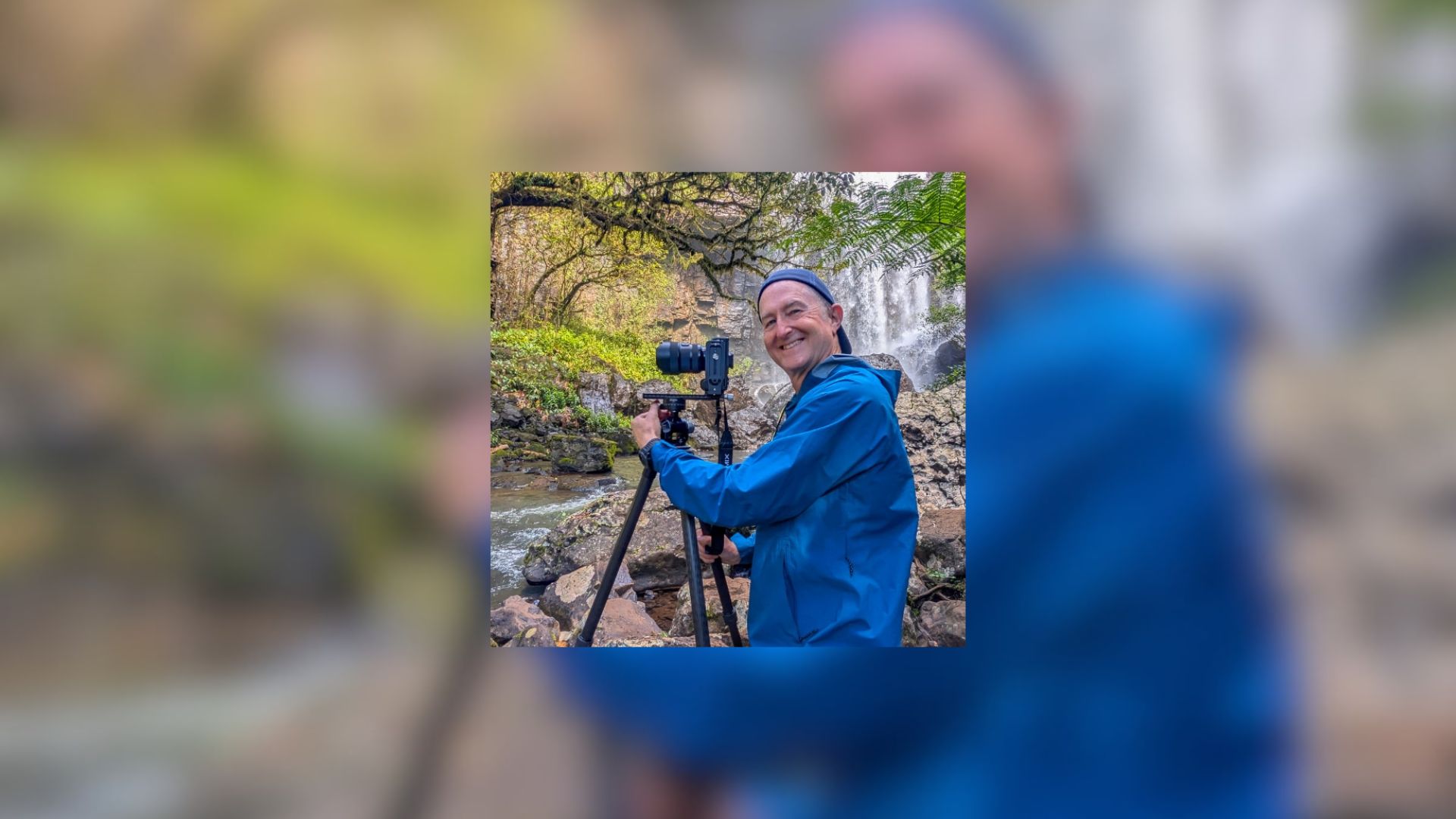
He Has One Roll of Film Left. John Shephard’s Panoramic Washington
Most photographs of Washington State are made in a fraction of a second. John Shephard’s are not.
One of his two cameras, a Noblex 135U built by hand in Germany, has a lens mounted on a cylinder that physically rotates during the exposure. At its slowest setting, that cylinder takes two minutes and twenty seconds to complete a single pass. The result is a frame 136 degrees wide. The cost is that everything in front of him has to hold still, and the light has to hold steady, for as long as it takes.
He has been working this way for 30 years. Two cameras. One film stock. Roughly 20 rolls a year.
In this episode, John sits down with Scott to talk about how a chance meeting in a Skagit Valley tulip field turned into a career. It was 1999, five in the morning, and there was a man standing on his camera case with a piece of equipment John had never seen before. That was Ken Duncan, an Australian panoramic photographer working on a book covering all 50 states. Duncan needed someone who knew Photoshop. John, a Spanish teacher who also taught photography, sent a resume.
Four years later he had carried gear across the American West, moved to Australia, sorted through a hundred thousand images, and stood at the launch party for America Wide at the US consulate in Sydney on September 5, 2001.
That apprenticeship shaped everything that came after. It also taught him what a book actually costs to make, which matters now, because he has finally made his own.
Washington Wide
Washington Wide is a panoramic portrait of the entire state, shot on Fujichrome Velvia 50, drum scanned on a 25 year old Heidelberg Tango, and self published after John decided he needed to understand every step himself rather than hand it to someone else’s team. The foreword is by Randy Lewis. The book arrives this fall.
The premise behind it is one that will sound familiar to anyone who has driven east over the Cascades. As John puts it, most landscape books of Washington treat everything past the crest as an afterthought. The Palouse, the basalt canyons of the Columbia Plateau, the dry pine of the Okanogan, the Blue Mountains: all Washington, all routinely left out.
The part where the gear disappears
There is a quiet countdown running underneath this whole conversation.
Both of John’s cameras are out of production. One of the manufacturers no longer exists. He has a single repair guy, a man in his eighties who moved from California to Texas and is training an apprentice. When John needed replacement battery contact points for the Noblex, the answer was that there were four left. In the field once, he improvised a contact out of a chewing gum wrapper to get the camera to turn on.
The film is going the same direction. Fujichrome Velvia 50 is made in small batches in Japan. When a batch reaches North America, it sells out. John is down to his last roll as of this recording, with more expected in October. On Amazon it goes for about $120 a roll against a normal price closer to $35.
So he has started exploring digital. Not as a betrayal, as he is quick to say, but as the obvious next thing. On a recent trip to Australia he left the film cameras home and shot with a full frame Panasonic Lumix on a nodal tripod setup, taking overlapping frames and stitching them in Photoshop afterward. A few of those shots he is genuinely happy with. The rest he is learning from.
Where he shoots, and when
Scott asks him to name a place for each season, and John immediately complicates the question in the best possible way by asking whether we are talking pre Instagram or post. He is not wrong. Maple Pass is now the most crowded fall trail in the state, and the larch on the Heather Maple Pass Loop draws hikers from every corner of Washington the last week of September.
Fall, if you want the honest answer, is the Salmo-Priest Wilderness in the far northeastern corner of the state, up past Metaline Falls in Pend Oreille County. Larch, real fall color, bear boxes at the campsites, and the only place in Washington John knows of with grizzly signage. Winter is remote snowshoeing in the Central Cascades, chasing aurora during a strong solar cycle. Spring is the camas fields on Joint Base Lewis-McChord, roughly 80,000 acres of it open to explore, plus arrowleaf balsamroot and lupine across eastern Washington. Summer is his least favorite season, but it sends him to the Palouse and out to Shi Shi Beach and Point of the Arches.
The one corner he admits he has underworked: the dunes out near Hanford and the Tri-Cities.
Also in this episode
Randy Lewis reading a landscape and pointing out which currants were planted deliberately for foraging and which rocks are discolored from sweat lodges. Why a scene with too much contrast simply cannot be shot on Velvia, and why John will stand next to someone admiring a beautiful view and tell them he cannot take the picture. The empty leather journal that started his photography career by staying empty. What it is like to open a 1.7 gigabyte TIFF on a five year old PC. And a spirited defense of huckleberry pie.
John also gives up his Woodinville picks, which is where the book launch party is happening. His coffee shop is Sidekick, his lunch is the Woodinville Bodega a block away, and if you want more options across the state, our coffee shop directory has them. He is also working his way through Washington’s independent bookstores trying to place the book, so if you run one, he is probably about to call you.
If you have ever wondered what happens when someone commits completely to a way of making things right as that way of making things is quietly disappearing, this is that conversation.
Links
- John Shephard Photography: johnshephard.com
- Washington Wide, preorder available: washingtonwide.com
- Sidekick Coffee, Woodinville
- Woodinville Bodega, Woodinville
- Alphabet Street, Bellingham
Related episodes
- Nick Zentner on the geology of Washington State, who comes up by name in this conversation
- Kate Rogers, Editor in Chief at Mountaineers Books, the traditional publishing side of the coin John chose not to take
John Shephard Panoramic Photographer Episode Transcript
Welcome to the Exploring Washington State Podcast. My name is Scott Cowan and I’m the host of the show. Each episode I have a conversation with an interesting guest who is living in or from Washington State. These are casual conversations with real and interesting people. I think you’re going to like the show, so let’s jump right in with today’s guest.
I am sitting down today with John Shephard. John is a photographer. Now, we’ve had photographers on before, but John’s specialty, as I understand it, is landscape photography with a specific film camera that I did a little bit of research on. So I’m that person who just does enough research to be dangerous now, John. So I’m warning you, I’m going to be dangerous. But John, welcome to the show.
John Shephard:
Thank you. Great to be here.
Scott Cowan:
Before I start peppering you with some questions, why don’t you let us know, and I joke when I say this, I’ll give you three minutes to tell us your life story. But what does the audience need to know about you so that the rest of this conversation will make sense?
John Shephard:
I should probably go back to the late ’90s. I had a traditional 35mm film camera and was falling in love with being able to document all of the hikes and places that I’ve been throughout my life. It was absolutely fantastic. And then in ’99, I went up into the Skagit Valley, Tulip Festival. I get up there at five in the morning and there’s a guy standing on his camera case with this very large camera. I’d never seen anything like it.
Turned out to be an Australian panoramic photographer who was doing a book on all 50 states of America. And so he and I start chatting and he says, well, what do you do? And I told him I was a schoolteacher and I taught Spanish and I also taught photography and worked a little bit in Photoshop. And he went, Photoshop? I am looking for somebody to help me do Photoshop. I’m actually looking for an assistant. And this is back when I didn’t have kids or anything else. I was far more footloose and fancy free, as they say. And basically he said, why don’t you send me your resume and I’ll get back with you and we’ll see what we can do.
A couple months go by and he says, let’s go on a trip, which was Montana and Idaho. And I just kind of got a feel for what it meant to be a photographic assistant, which was carrying a lot of gear, doing a lot of driving, a lot of hiking. And really just understanding the level of dedication one needs to find really great shots.
We ended up working together for about four years total. I worked two and a half years on the book and another two years living in Australia, processing all of the images and getting that ready for a book called America Wide, which was wildly successful. And one of the craziest things was we did the launch party at the US consulate in Sydney on September 5th, 2001.
Scott Cowan:
Oh.
John Shephard:
Right. So imagine a book that celebrates all 50 states of America at that time. It was unbelievable. And the book sold like wildfire. And for me personally to be a part of all that was incredible. I could never foresee what that would have looked like. This gentleman had 300 employees at the time I worked with him. Galleries, central headquarters, publishing companies, printing companies, framing company. Unbelievable. And so I really got to see into the belly of the beast, if you will. And it really helped shape the way that I approach photography now and have ever since.
Scott Cowan:
Was he using this style of camera that you now use?
John Shephard:
Great question. It was a larger format version, a more expensive version called a Linhof Technorama 617. It takes a piece of film that’s six centimeters by 17 centimeters. It’s a very, very large piece of film, four shots per roll. We had three bodies when we were doing the book on America, and my job was to keep film in the cameras.
Scott Cowan:
Wait a second. So he had three of these large formats? The most you could hope to accomplish is 12 shots. But if you had all three cameras going, you had to reload.
John Shephard:
All the time. And I could do it fast, because that’s just what I did. That’s just how it went down. It was a heck of a lot of fun.
The cameras that I use are different. They use 35mm film, which is a smaller form factor. My frame is about 70mm by 24. So it’s essentially a double frame 35mm shot.
Scott Cowan:
For perspective, in a roll of your film, how many shots can you get?
John Shephard:
Eighteen. That’d be traditionally a roll of 36 for a regular full frame 35mm camera.
Scott Cowan:
Back in the ’90s, when you got your first camera, you would then go out and shoot and then take it down to the Fotomat in the parking lot of the Kmart and they would develop this film for you perfectly. I think I was in a darkroom in high school, and that was a long time ago, back when it was tintype photos and things like that.
John Shephard:
That’s right. That’s right.
Scott Cowan:
You don’t have to agree so quickly with the tintype, you know. Come on now. My question though is, from a developing standpoint, same chemicals, same equipment, larger scale?
John Shephard:
It does take different techniques. They call the process E6, and it’s taking transparency. So where you were working with negatives, and you would see the negative image on there, I’m working with film where I see the positive. I see the actual shot that I took in all its color and everything else.
Now, E6 processing, way back when, I had learned that that’s pretty challenging to do. Leave that to the professionals. The last thing you want to do is be on a trip, take a bunch of shots, you’ve hiked miles, all these things, and then screw up your developing at home. I’m happy to pay for it. That process was something that I really just was happy to give to someone else, because I wanted to make sure the shots could look as best as they possibly could.
Scott Cowan:
Back in the ’90s, where were you sending your film to be developed?
John Shephard:
There was a company in Seattle called Ivey Seright. I can’t remember when they went out of business. It was quite a while ago. And then when I lived in Australia, we had our own developing company with the photographer I worked for. So I used them for years. I’d even ship my film to Australia, have them develop it, and they’d mail it back.
It became a little cumbersome and expensive, obviously. And so now I go through a couple of different companies, one in California and one in Oregon, and they hand process it. And it’s about the same as it’s always been, which is really nice.
Scott Cowan:
You said you were a schoolteacher, and then you also said you ended up for two years in Australia. How hard was it for you to make that commitment to go halfway across the globe to continue being this guy’s assistant?
John Shephard:
I love travel as much as anything on this planet. I feel it’s been my best teacher. The connections I’ve made with people, landscape, everything. I tease my girlfriend a lot and say we can just sell everything and just travel. I’d be fine with that.
And so to have an opportunity like that, I jumped at it immediately. I realized that was incredibly unique and special. And it wasn’t easy. There were plenty of challenges, a lot of work. But really worth it. I learned things I could never imagine. If you had said in the beginning, write down everything you want to learn, I couldn’t have come up with a list of how it went down.
Scott Cowan:
When your time as the assistant comes to its close and you come back to the States, did you come back to Washington?
John Shephard:
I came back to Woodinville and went back to teaching. I had like a four year hiatus, if you will. One thing I’ve always loved about teaching, I really do love the job. I love working with people. I teach Spanish as well, which is definitely not my first love, but something I absolutely love and kind of fits with the travel. And then photography too, just to get people to open their eyes and see beauty and find success, find joy in what they’re creating. That’s worth it.
Scott Cowan:
This camera now that you’re shooting with, they’re no longer being made. Is that correct?
John Shephard:
That’s right. And one of the companies doesn’t really exist anymore either. Both cameras that I have, one is a Noblex. It’s called a Noblex 135U. What makes it unique is it is a swing lens camera, meaning the lens actually sits on a cylinder and rotates when you take the picture. So you get a 136 degree angle of view. It’s very, very wide.
And it has a phenomenal lens. It was a small company in Germany, all hand built. When you buy the camera, they send it to you with the craftsman’s hand signature on his own notes when he made it. It was really special.
And then the other camera I have is a Hasselblad XPan 2. Pretty legendary for a number of reasons. This was also a beautiful camera, but very different, more like a traditional camera, fixed lens, and much more shallow. The field of view with the lens that I have on it is 71 degrees. So a much tighter angle.
Both cameras see a similar frame in that they’re both rectangular, but one is very narrow compared to the other one, which is very wide. And I love shooting with them both. Sometimes a scene will speak to you and say, oh, that’s the camera I’ve got to grab.
Scott Cowan:
These are precision instruments and you’re lugging them around. Things happen out in the field. Today I can call up B&H and buy a replacement and have it here in two days. One of the companies is no longer in business. Both models aren’t being made. Have you become a repair guy also, or how do you keep these going?
John Shephard:
I have one gentleman who’s in his eighties. He was in California for years, now he’s in Texas. He has an apprentice that’s doing it, and he fixes my cameras. They’re complex. He is just an expert when it comes to old, unique cameras. You have to understand, both these cameras, they didn’t make a lot of them. They were odd cameras. The swing lens can be a real pain to shoot. So people didn’t really gravitate towards them.
And it’s funny. The Noblex takes AAA batteries. There’s a little tiny contact point for the batteries, and one of them fell out when I was in the field. Which meant I couldn’t turn my camera on. Luckily, I had a piece of chewing gum in my pocket and I was able to take the metal from the wrapper and actually get it to work.
But I called Bob up and I’m like, hey, I’m going to need these contact points. He’s like, you better hurry up. I’ve got four left. That’s it. So it is something that I realize is going away at some stage. And that’s why I was so thankful that the book got done when it did. As time goes on, it gets harder and harder to tinker with these things, find the parts, find the people that understand how to repair them.
Scott Cowan:
When we talked on the phone, you also mentioned that the film itself now is harder. Something along the lines of, when the manufacturer releases the film, it sells out. You get your allotment of rolls for the year. How many rolls of film do you buy a year?
John Shephard:
I think this past year I had 20, which may not seem like a lot. But I am very intentional. I don’t shoot heavy. I never have. I want to make sure the shot makes sense. I want to make sure when I’m looking at a scene that I can hold everything together.
What I mean by that is you’ve got highlights and you have lowlights in a frame. For example, when you take a shot like the classic silhouette of palm trees in Hawaii, the palm trees themselves are silhouettes, they’re black. But when you’re standing there, they certainly aren’t black. You can see details in the bark, the leaves, the color, everything else. And then the sky is gorgeous.
Your eyes have this ability to find detail in the highlights and the shadows at the same time. It can do it masterfully. Film cannot. And the film that I shoot does it very, very poorly. So there are certain scenes that I’ll look at and go, I can’t hold it all together. Meaning I’m going to have something that’s way overexposed or way underexposed. And there’s no reason for me to shoot it. It can be frustrating with people around me. They’re like, that’s a beautiful shot. I’m like, yeah, but I can’t take it.
Scott Cowan:
Not with this gear.
John Shephard:
Not with this gear. And I have some old batches of film that got mixed in with some new, and I didn’t realize it at the time. So I’ve taken some shots where I’ve done six or seven shoots and come back and the film’s bad. The color has gone magenta, it’s just unusable. But that’s all part of the process. I am kind of making it hard on myself, in some ways.
Scott Cowan:
I like the fact that you’re being intentional with everything. When you say 20 rolls of film, I’m guessing that’s about 360 potential shots?
John Shephard:
And I would say probably 10% of those are ones that I would really use. There are certain situations where it’s sunrise and you’re in a beautiful spot and the sky is going nuts and you know it’s going to work as long as you don’t blow the exposure. And so I might take four or five shots of something like that just to make sure, and do what they call bracketing, where you would make it intentionally a little lighter or intentionally a little bit darker to try to find a sweet spot for the exposure.
Scott Cowan:
With the lens that’s moving, how long of a period of time is the exposure of the shot?
John Shephard:
That camera can shoot a 500th of a second to one second and about everything in between, every stop in between. So some of my shots will be more than a second. And what that means is I just do multiple shots. I’m using a cable release, of course. I’m on a tripod for everything, for maximum sharpness.
One of the cover shots of the book is a four second shot. It’s that same frame, literally, that I took over probably three hours, because there was a bit of wind that was messing with the scene and I waited till it died down. I just didn’t want the leaves moving in a long exposure. There’s some leaves that still are, but you get ideas of what you want.
Scott Cowan:
I’m on your site and I’m looking at a photo of water coming down moss covered rocks. How long of an exposure was that?
John Shephard:
Is there a rock on the right hand side as kind of an anchor? We’re talking about the same shot. That one was four seconds. And you’ll notice some of the vine maple, there’s a little bit of shake, if you will. It is what it is. I don’t care. But I’m trying to get as much sharpness as I can.
Let me go back to the other shot for one thing, because you asked the question, how long does it take? If you’re taking a shot at a 500th of a second, that lens cylinder spins very quickly. If you’re taking a shot at one second, it’s about two minutes and 20 seconds before it does a full rotation all the way around to expose that shot evenly. The lens actually starts behind where you think the lens would be, and the cylinder will slowly move around, and it’s slow. So you’re playing with time as well.
Scott Cowan:
So on the camera with the rotating lens, once again, you’re adding intentionality. That scene could have been interrupted by anything out of your control.
John Shephard:
Totally. And maybe that’s one of my favorite things about being a landscape guy, is that you recognize how little control you have. It’s a good lesson. If I find myself going, ah, I don’t like this sunrise, well, first of all, who are you? And second of all, you have no control over any of this. Why are you worried about it? Just keep coming back. Eventually it’ll work. Eventually it’ll hit.
Scott Cowan:
I wrote down some questions and I had this mental framework of how I thought the episode would go, and I think I want to mix this up. I’m looking on your website and you’ve got the wild, the sea, the land, and the city. I’m not going to ask you where your favorite topic is. That’s unfair. But I am going to put you on the spot about Washington State, and I’m going to say it’s fall. Is there a place that comes to mind?
John Shephard:
Great question. Are we talking pre Instagram or post? Do you know what I mean, though? That changed the game. I love the larch, as does everyone, and I love that we all do. So if we’re talking Maple Pass, places like that, pre Instagram, I would be North Cascades all over the place. Harts Pass, ridges that you could hike off that particular area, which are still really good because not a lot of people go out to that particular spot.
I think if I had to pick one spot now, it’d be the Salmo-Priest Wilderness, which is in the northeastern corner. And exactly why your face looks like that is exactly why I would do it. No one knows where it is.
Scott Cowan:
I’ve never heard of it.
John Shephard:
It’s in Pend Oreille County. Literally the northeastern corner of the state. You know where Metaline Falls is? There you go. That’s your big city out there.
But it is an untouched, incredible wilderness area. It’s absolutely stunning. They have larch, they have great fall color. It’s the only place I know in Washington where they have signs for grizzly bears. That is absolutely a thing that happens there. The campsites that are in that particular area all have bear boxes. It’s a very wild, rugged place. And I absolutely love it.
Lake Sullivan is right around there, and that’s known for the larch. And for the size of lake that it is, it’s unbelievably still. It blows me away. Usually big lakes, you’re not going to get a great reflection, but this one for some reason, maybe it’s not that deep, I don’t know, but I’m always stunned when I go there.
Scott Cowan:
All right, so now let’s move to winter.
John Shephard:
Winter for me now, I’m really having fun with more astrophotography and this cycle of the aurora that’s been happening over the last couple of years. Aurora cycles run every 11 years and they vary in intensity. And we’re at the tail end of, well, from 2024 on, it’s been one of the stronger cycles. So I check that every day. And I have an area that I go to in the Cascades that I absolutely love. I want to get stars and the aurora and all the rest of it. So remote mountain snowshoeing, Central Cascades.
Scott Cowan:
Spring, where are we going in spring?
John Shephard:
The tulip fields are a fun choice, but I don’t think I’d run there right away. One area that I haven’t done much work in and I’m really excited to go to is down near Lewis-McChord, that base. I know that sounds crazy to say. They have, I think it’s 80,000 acres that you can actually go on and explore. There are camas fields that are out there, and the idea of having Rainier with camas in the front would be incredible.
Scott Cowan:
The reason I’m smirking is that I grew up in that area. So I call it Fort Lewis because I’m old. Joint Base Lewis-McChord now, for those people who are recent to the area. But have you ever heard of the Mazama pocket gopher?
John Shephard:
I’ve not.
Scott Cowan:
So the Mazama pocket gopher is an endangered species. And its habitat is primarily Joint Base Lewis-McChord and Thurston County. And the reason, and this is me being sarcastic, but the reason it’s an endangered species is because it likes to be out in the artillery fields.
My day job is I’m a real estate broker. My specialty is I deal foreclosures, so I deal with murder scenes and meth labs and Mazama pocket gopher infested houses. I’ve literally had to deal with getting gopher studies done to get the permission to clean. So whenever somebody says Fort Lewis, my brain goes to these really ugly rodents. I have never seen a photograph anywhere that made them look at all like, oh, they’re cute. No. They’re ugly.
John Shephard:
That’s a good reason. Well, and that’s why I threw it out there, because I figured it’d be something that most people wouldn’t think of. I’ve got a ton of photos of the arrowleaf balsamroot, the big yellow daisy looking flowers. Beautiful. And they’re all over eastern Washington, as you know. Different elevations at different times are going to bloom. Beezley Hills outside of Wenatchee, there’s just countless areas. And then when the lupine starts, then you’re getting this beautiful purple and gold and all the rest of it. It’s just so fun to be a part of.
Scott Cowan:
What about summertime?
John Shephard:
Probably more in the Palouse. Summer’s my least favorite season because the skies don’t seem to be as dramatic. And everything is pretty much the same, usually a lot less rainfall. As you know, you live out in Wenatchee, the hills in the springtime there are stunning.
Scott Cowan:
For about two and a half weeks.
John Shephard:
There you go. It’s short, but it’s gorgeous. You go through Dryden and Peshastin and that area, and I just love it. But in the summertime, the coast can be a lot of fun. Shi Shi Beach and Point of the Arches and that sort of area.
That shot we were talking about, the green waterfall, mossy rocks, that was done in May. That’s my favorite time to be in Olympic National Park. It’s a beautiful time where your spring runoff is coming through strongly and snow has subsided enough to where everything looks clean, everything is green, the flow is strong. But two months later, that shot doesn’t look good at all. It’s yellow moss and a trickle of a river.
Scott Cowan:
You do a conscientious job of moving around the state. Is there a spot in Washington State that you haven’t gone to yet that you want to?
John Shephard:
I always laugh with my friends. How many lifetimes would we need to explore all these mountains? This place has everything. Although I’ve been in the Cascades a lot and the North Cascades a lot, there’s so much more I want to explore in that area. Those rugged, remote areas.
Maybe the dunes that are out by Hanford and that sort of area there by the Tri-Cities. That’s an area I haven’t spent a lot of time in, and I think there’s probably some gorgeous things to see out there if you’re willing to hike in.
Scott Cowan:
If I’m being fair, I did not appreciate the Tri-Cities area the first few times I went out there as an adult. I was like, I just don’t get this. In the last couple of years though, I’ve gone for business. A lot of the houses I have are down there. And so I go down there more now than ever before. I’m finding more and more things that are interesting.
The Hanford Reach is not going to be one of those. I drive that into Richland. That’s how I get there, through Vantage on down the Columbia. And honestly, that’s a boring stretch of road. But I don’t get off of it either, because, well, you can’t. Hanford.
But if you get down there and you go closer to the gorge, the Columbia Gorge is just jaw dropping. As you get out of Tri-Cities heading south before you go across to go into Umatilla, I go down there a bit now and I’m finding more and more things that are like, oh, this is kind of cool. There’s things to explore here that you just have to work a little harder for.
John Shephard:
That’s it. I treat this as like I’m looking for buried treasure, something I’ve loved to do since I was a boy. And I still feel that kind of energy around it, the excitement, the, gosh, what’s going to be around this corner? Or, oh wow, I didn’t expect that.
It doesn’t always work out that way. In fact, it works out less often that you find exactly what you’re hoping to find or something magical. But maybe that’s what makes it all the more special.
I do a ton of research using USGS maps, looking for old homesteads, for example, or waterfalls that may be in areas that I haven’t had trail access to, and just try to find unique features, because this state is full of them.
Scott Cowan:
How much gear are you packing in with you?
John Shephard:
My cameras weigh 35 pounds, and then I’ll take a front pack that I’ll use as well. That usually just has something that I could use if I need to spend the night or whatever else, just a little bit of food. But I’m probably carrying about 50 pounds worth of gear. It’s a lot, but it’s also part of it. It’s kept me in shape, which is good.
Scott Cowan:
What’s the vehicle that’s getting you there?
John Shephard:
I have a little Subaru out back.
Scott Cowan:
So you’ve got the official car of Washington State.
John Shephard:
I absolutely do. I’ve put skid plates underneath it, which have been really helpful. The ting of aluminum is way better than the cry of the credit card.
Scott Cowan:
I clicked on the city gallery, and it seems on the surface that this style of photography, especially with the rotating lens, might not lend itself to a city landscape where there’s going to be movement. Cars, lights, people. Am I accurate in that assessment that this is maybe its weak point?
John Shephard:
That’s a really good question. I guess it depends on what is moving. Let’s say I’m closer to the street and there’s some lovely curves in the road and I want that movement with the car lights and everything else. I think that can be a real beautiful look.
But as you can see from those two photographs, that was the exact same morning. It was a one off. I have a story in the book about that particular thing. Essentially, I was just looking for a vantage point.
One of the negatives I could say with my camera is everything is further away. Since it shoots so wide, everything is at a distance. So you can’t just go to the top of a mountain and shoot. If you have no foreground to kind of anchor that for the viewer, you just don’t feel that connection. I mean, I do, because I was there. But you show that to someone else, good luck.
For that particular one, I knew there could be some movement. I believe there’s a plane that was flying by, so there’s a contrail on there. But I didn’t feel like that would be problematic in that particular composition. There wasn’t enough that could move that would hurt the photo. And my gosh, the way the sky went off that day, it was just jaw dropping. I have really only three shots like that. And one when I lived in Australia. I shot 400 sunrises in Australia, and I have one where it looks like that kind of psychotic color kaleidoscope. It’s rare. I’ve got to calm myself down, because I get so excited when it gets like that.
Scott Cowan:
You’re shooting on transparency versus negatives. From a technology standpoint, can your cameras use regular negative type film, or does it have to be transparency?
John Shephard:
It can use any kind of film you want. The reason I stuck with one film, it’s Fujichrome Velvia 50. And the 50 is the ISO, and that has to do with the speed. It has a very tight granularity. So its sharpness is going to be very, very tight. The lower you go, typically you get better sharpness. Not always, it depends on the film.
That film, I love how it renders greens in particular. I think the greens in West Coast Washington forests are phenomenal. It does a beautiful job with blue and color. And so I stuck with it because I loved that formula. I tried other films early on and I just didn’t love the color rendition in the same way. And so I thought, I just need to get good with this one.
Scott Cowan:
The Australian guy, what did he shoot? Transparency?
John Shephard:
Ken Duncan. Same film, same everything. And today he still shoots some film. I’m not sure what, to be honest. But he also has a digital camera and is working on stitching panoramic shots together, which is becoming more and more popular. They call it nodal panoramic photography.
And that’s something I just started playing with. I just got back from a trip in Australia, and that was really my first foray into that. I didn’t take my film cameras at all. I just focused on, let’s see how this digital works. And it was pretty cool.
Scott Cowan:
What’s the preliminary result? Does it have potential for you as an artist?
John Shephard:
For sure. I’m down to my last roll of this Velvia film right now, and there’ll be more that’s coming in October, and I’ll get some more rolls, but I just see the writing on the wall. It’s going away. Eventually it’s going to be something that will be impossible to get. I imagine they’ll stop making it. They make it in small quantities in Japan. They ship some to North America and that’s that.
There’s a lot of advantage with digital from what I can tell preliminarily. Like I was talking about earlier, if a scene has too much of a contrast range, too bright, too dark in one scene, with my film I’m just not going to be able to do it. Now, sometimes artistically you can use that to your advantage. Maybe you do want something to silhouette and it’ll look cool. But usually I’m trying to find a way to balance it all out. Digital has a wider latitude, so it can do better with a higher contrast. And that is a very nice thing to play with. So I think there is definitely a direction I can go with this. And I’m excited to do it as well.
Scott Cowan:
When you went to Australia, what did you take equipment wise?
John Shephard:
I have a full frame digital camera. It’s a Panasonic Lumix. It can shoot up to 48 megapixels, which is really nice. And then I brought my tripod with what they call a nodal setup.
The idea behind that is, when you take a panoramic shot, I’m sure you have with your cell phone, you get some odd warping sometimes. They call that parallax. Well, with a nodal system, you calibrate the camera. The tripod head has a rail that’s on it. And you take the camera and you slide it back off the center of the tripod head. I used a couple of bamboo posts that I had to kind of align up and play with the parallax, moving the camera back and forth till I could eliminate parallax.
And so I’m just taking shots as I go across. I didn’t even take a computer when I was in Australia. I didn’t want to edit or do any of that. But you take them home, you drop them into Photoshop, it does a really nice job of assembling the photos, and then you see if your calculations are correct. How’s the parallax? How’s the focus? And like I said, preliminarily I felt really good about it. I think I have two or three shots that I’m very happy with, and the rest I can absolutely learn from.
Some weren’t wide enough, and I realized, oh, I like a much wider view than what I did. The difference with the film camera, I can look at the frame and I know what I’m going to get, at least in theory. When you’re stitching together, I’m not there yet in understanding exactly what it’s going to look like.
Scott Cowan:
Were you using a wide angle lens?
John Shephard:
I have a 14 to 24 millimeter lens and it’s a 2.8, so it shoots pretty wide open, and I had calibrated my camera at 20mm. So that’s all that I took the frames with. Again, I thought I’m going to keep this as simple as I can so I can understand what the heck I’m doing.
I’m not against digital really in any way, shape, or form. I love art, period. And if people want to go a digital route or they’re painters or whatever, I love that stuff. It’s so fun. And so I’m happy to embrace it.
Scott Cowan:
I’m not of the opinion that one is better than the other. If you can’t get the film to use your camera, are you going to stop taking pictures?
John Shephard:
I’ll play with other films that are in existence. I don’t feel that film will go away really ever. There’ll be somebody somewhere that makes it.
Scott Cowan:
Right, but yours is a niche film. My knee jerk reaction is, well, if they’re selling out, why don’t they make more?
John Shephard:
I’m not sure of the answer for that. I’ve talked with Fuji North America and they’re much more interested in their digital stuff. And I’m working on things with them on that as well. But I really am hoping to get a hold of somebody in Japan and be like, so what’s the real story? How much longer is this film in existence?
Scott Cowan:
Can I buy it on Amazon JP?
John Shephard:
You can buy it on Amazon, but it’s $120 a roll. So somebody is doing a severe markup. It’s normally around $35. But you can order it. And I’m not prepared to do that.
Scott Cowan:
What I’m taking away from a lot of this is you’re patient. You like the process of planning out where you’re going. Yes, you can’t control what the weather’s going to do that day. But you’re not just going, eh, I’ll run over here and take some shots. You come across as being far more methodical. That being said, what was the process for you to decide on taking on just an easy little task of putting together a book?
John Shephard:
Because books are easy.
Scott Cowan:
Yeah. They’re just so easy.
John Shephard:
Certainly when I was a photo assistant and we were working on a book about America, I was embroiled in that entire process. Watching everything from the taking of the photos to helping to sort the 100,000 photos that were taken. And just seeing the entire process from conception to launch party, if you will.
And I knew that would be the way that I want to do it, especially in a panoramic format. I don’t think a digital medium is a great way to show them, but a book, well, they open pretty panoramically most of the time. And so for me, it was something that I felt I just have to do, and I want to do it right. I didn’t put a real timescale on it. There was a large chunk where I wasn’t shooting all that much when my kids were younger. As you know, it gets busy. But it’s something that I’ve always loved and just hung on to.
And even the book process, it’s funny you bring that up. I called Ken Duncan a couple years ago and I said to him that I was ready to start building a book. He’s like, oh mate, that’s great. You can talk to my designer and I can get you all the contacts for printing and all the rest of it. And at the time I was super excited about all of that. Then I sat with it for a couple of months and went, you know what, I’ve got to do this. I’ve got to figure out how to do it. I need to understand the process fully.
And so for the last really eight months, I just dove into it and did all that I could. I’d never printed a CMYK before. That was never a thing. My prints are all done on high end art papers, and that’s a whole different beast than offset printing. It was trial by fire. I learned a ton. It exhausted me in a lot of ways, but I’m pretty darn happy about it. It’s fun to learn, as you know, Scott. It’s just so cool to empower yourself with that. And that’s really what this journey has been all about, trying to get somewhere to completion.
Scott Cowan:
The foreword of the book is written by Randy Lewis, who’s somebody whose name has come up multiple times across the years during the podcast as somebody I should have on. And I’ve never met Randy.
John Shephard:
You definitely should have Randy on.
Scott Cowan:
I’ve never heard anybody say anything other than a very kind, enthusiastic word about him. So why did you pick Randy and how is he connected to the project?
John Shephard:
First and foremost, I don’t think there’s anyone that loves the state as much as Randy, who knows about the state from coast to plains to all the rest of it. He is so intelligent. He is one of the most learned people I’ve ever been around, and giving as well.
How I met Randy was through mutual friends. One of my friends is a geologist and was working out in the Plain area, and he likes to understand how the tribes interacted with the landscape. So he wanted to learn more information. He went to the Wenatchee Valley Museum and saw a couple of books written by Randy, ended up buying them. And as he’s checking out, he said, hey, I’d really like to meet Randy. And he hears a voice behind him: I’m right behind you.
And they started talking, and that turned into a four hour conversation, an exchange of phone numbers. And the next thing you know, Randy’s part of our crew, or we’re part of his. I don’t know how else to put it.
He leads all sorts of museum tours. Whether it’s to Stehekin or he’ll team up with Nick Zentner and do geology. It’s incredible what he does. And so he just started taking us out and around and saying, well, this is where Chief Moses had his winter camp, for example. What do you notice about it? He’s a teacher.
I’m like, wow, I see a lot of currants here, a lot more than usual. That’s exactly right. They planted those there so they could forage. What do you see with this area right here? I’m like, well, why is the rock all discolored? He goes, well, we had our sweat lodges here.
I saw the landscape with eyes I could never imagine. Somebody who’s been connected to that landscape for thousands of years. You should definitely have him on the show. He’s amazing.
Scott Cowan:
I’m aware of him through Nick Zentner. Nick is quite prolific. He was one of my very first guests on the podcast. And there’s a terrifying story of that. Nick was, yep, let’s just go push the button. Let’s go. He was no nonsense. And Nick just launched into being Nick and it was great. And I just kind of hung on for dear life. Nick was very kind.
So the book now, it’s my understanding, is currently being printed?
John Shephard:
It’s being printed. I’m getting my first box of 10. I’ll get them in the next couple of weeks, and then the shipment should arrive at the end of September for the rest.
Scott Cowan:
And how are you planning on promoting, and what’s your distribution strategy?
John Shephard:
As of right now, obviously through my website. That’s a real easy way to do it, and I’ll fulfill all of those orders. And I’m reaching out to different areas. So Elliott Bay Books, Third Place Books in two locations. I have a place, Auntie’s Bookstore in Spokane, and then Books and Games down in Walla Walla. But I’ve literally just started this outreach process. I had a meeting with WSU yesterday as well, and I’ll be doing a talk there, it looks like, in November, which is exciting. So I’m hoping to really do lots of artist talks. I mean, a schoolteacher forever. I enjoy speaking. I enjoy talking about all sorts of things.
Scott Cowan:
If you haven’t reached out to Village Books in Bellingham, you should try.
John Shephard:
Yeah, they’re awesome. They want me to deliver books in person, which is great. They seem amazing. So I’ll wait until September, when I have the bulk of the books. The 10 that I have are already gone.
Scott Cowan:
One of the things that Village does very, very well is they have very frequent author presentations. Almost daily they’ve got authors talking about their books. So they’ve obviously built an audience that likes that. And Bellingham’s not that far from Woodinville.
John Shephard:
Not at all. I love Bellingham.
Scott Cowan:
And then there’s a bookstore in Olympia whose name is escaping me. Browsers Books. Don’t quote me on that. So you’re self publishing, right? You’re doing this yourself.
John Shephard:
Yes, exactly.
Scott Cowan:
At this moment, you’ve released it. It’s to the printers now. You can’t go back and say, hey, I need to change something. That’s going to live in the book until the second edition. So I don’t want to say your project’s done, because you’ve got a lot of heavy lifting to do. But what’s next after that?
John Shephard:
I want to keep shooting Washington for a while. I really do, because there are certain areas I need to explore more. So we do another edition of this book, or when I do a rerelease, there’s more images. That seems to be a route that I’d really like to go. And exploring the digital, the stitching, the nodal panoramics I was talking about. I think that’s going to be really important as well. And then promotion of the book, that’ll take up a lot of time, I imagine.
Scott Cowan:
That to me, I would have a love hate with. I’m perfectly comfortable sitting here with a microphone in my face talking to you. But put me in front of an audience of three or four people or more, I’m not so comfortable. But you’re teaching. You stand up in front of a room of distracted human beings all the time.
John Shephard:
Maybe not always the most receptive audience.
Scott Cowan:
You’re learning how to deal with hecklers. You could maybe go do stand up. You grew up in Washington, right? When did you pick up a camera for the first time?
John Shephard:
I was 26. I was teaching already, teaching Spanish then at the time. And one of my parents at the end of the year, she knew I was going to Mexico for the summer. I’d spend nine weeks down in Mexico or Spain or wherever and work on my Spanish.
And she gave me this beautiful journal, this leather wrapped, gorgeous handmade paper. And she said, you do have all these great adventures. Why don’t you write about it? And so I packed that into my backpack and brought it home the exact same way that I had received it, with nothing in it. I did nothing.
But it got the wheels turning. Like, yeah, I do want to document these sorts of things. And so I talked to the photography instructor at my school at the time, because I wasn’t into photography, and he recommended a beautiful little point and shoot, a Yashica T4. It has a Carl Zeiss lens on it, beautiful little compact camera. And I started to take pictures with that and kind of fell in love with the results. And that prompted me to put more energy and more money and more time into that hobby.
Scott Cowan:
Yeah, photography is so inexpensive.
John Shephard:
Oh my gosh. I suppose every hobby is, but you’re exactly right.
Scott Cowan:
Where did you grow up?
John Shephard:
Woodinville. Really, the Cottage Lake area of Woodinville, at a time where there were more horses than people.
Scott Cowan:
I was going to say it’s changed.
John Shephard:
Just a little bit. The addition of Microsoft and Redmond certainly changed everything. But I was surrounded, my folks, we lived on a lake, which was fantastic. And then I was surrounded by probably 700 acres of woods. It’s now county land, most of it, which is still accessible and it’s great. But that’s how I spent almost all my childhood. Get out of the house and come back at dinnertime. Very classic. You probably can relate.
Scott Cowan:
I can. It just seemed like a much simpler time, didn’t it?
John Shephard:
I dove into it wholeheartedly, because I love travel, like with Spanish and languages. I worked at a Mexican restaurant as a kid. I was a host back in the days where you’re like, hello, table for two, smoking or non?
Scott Cowan:
There you go. I haven’t heard that in years.
John Shephard:
But that was a thing. And it was a Mexican family. Everybody that worked there was related in some way. And I fell in love with that culture, just seeing how everyone interacted. And I got yelled at a lot, in Spanish, not in a bad way, but like, get two waters to table three.
And then I started being invited to, why don’t you come down to Mexico for a quinceañera? And I just really love the culture, and it helped to really fuel my desire to see other parts of the world. I had grandparents that lived in Europe as well. So I think as a boy, when it was, oh, we’re going to fly to go see grandma and grandpa, 10 hours on a plane was just what you did. It wasn’t challenging. And so I’d fly to Sydney for lunch. I love seeing things.
Scott Cowan:
Where did you go to college?
John Shephard:
WSU, Washington State. And that was another big part of my photographic life. I wasn’t doing photography then, but the eastern part of the state, I had no idea that really existed, if you know what I’m saying. It looked like an entirely different planet than Western Washington. How many photos could you show of the Palouse and give to somebody and say, where are we? And they’re like, Kansas?
Scott Cowan:
My daughter’s now ex husband is Austrian, and the first time that they came over, they flew into Sea-Tac, so he saw Seattle, and he’d seen Seattle in pictures before. We were living on the west side of the state at that time. So the second time he comes over to visit, we’d moved over here to Wenatchee. And I think he thought he was on a completely different planet. We jokingly took him to Leavenworth so he’d feel at home.
But we took him to Moses Lake, not because he’d been bad, but just to keep going east. And he was like, I had no clue that this part of the state, that this is Washington State. No clue.
And I think media doesn’t do the state a good justice by focusing on the west side. I mean, the west side of the state’s beautiful. Don’t get me wrong. There’s nothing wrong with Puget Sound. But cross the Cascades and travel east, and the Missoula floods, what it did to the landscape of the state, is radically different than where you’re living. And the needs of this region are very different than the needs of Puget Sound.
You can get to Mount Rainier in about two or three hours.
John Shephard:
Two and a half, yep.
Scott Cowan:
So if you drew a three hour radius around your house, you get to the Pacific, you get to Mount Rainier, you could get over here. How many other places in the world have that diversity?
John Shephard:
You’re exactly right. It doesn’t exist. Randy and I were talking about this exact thing. I had gotten back from Alaska and was saying how diverse Alaska is. He’s like, yeah, but maybe not as much as Washington. I don’t know if any state in the US has as much diversity. We have the largest glaciers in the lower 48. We have over 100 10,000 foot peaks. And you talked about the scablands and the coulees, and that geologically is just outrageous. The fact that that was made almost immediately, not in geologic time, but in massive floodwater time.
Scott Cowan:
We have a rainforest. And then if you go down to the Tri-Cities, I heard the stat, and I haven’t validated it, so I don’t want to speak it as if it’s completely factual, but I do believe it, because I heard it from a good trusted source. Tri-Cities gets less annual rainfall than Phoenix.
John Shephard:
Whoa. I could see that.
Scott Cowan:
When you think of Phoenix and you think of Arizona, you think hot desert. You don’t think rainforest and glaciers. We’re such a wide range. And here you are going out and documenting it with your cameras.
As we wrap this up, I’ve got some questions I ask everybody. This one’s probably my most important question, and it’s really around Woodinville. Where’s a great place for coffee?
John Shephard:
Sidekick Coffee. Have you been there before? I think for me, that’s the best. It’s always crowded, but they tend to get through things quickly, and I just like the space. In fact, I’m having a launch party there, and I’ll send you an invite for that. You’re welcome to come if you feel like making the trek into bad traffic.
Scott Cowan:
The east side’s easier than getting into Seattle for me. So when you’re at the Sidekick ordering coffee, what’s the go to coffee drink?
John Shephard:
After coming back from Australia, and when I had lived there, I was in love with cappuccinos. So I’m in a cappuccino fix right at the moment. But they also had a coffee that had like a tonic, which I didn’t even know what that was. It was like a blood orange, a blend of things, a matcha coconut with coffee. It was interesting. I’d never heard of it.
Scott Cowan:
You can look at my face right now.
John Shephard:
I get it.
Scott Cowan:
Well, no, but here’s the thing. I was up in Bellingham, and this is something I’m trying to do more of. I was at a coffee shop, Alphabet Street, which is a great little coffee shop in Bellingham. They are not a sponsor of the show, but you should go there.
I was visiting a bunch of coffee shops in a couple days while I was up in Bellingham. The goal was to write a piece of content on it. Somebody has to drink coffee and I guess it’ll be me. And I know me, and I know what I’m going to order, and I’m pretty consistent, and that can translate to being pretty boring. If you’re reading about, oh, he had black coffee again, again.
So I went there and I said, hey, I’m going to barista pick. What’s your best drink? And they go, well, we have this and it has lavender. And I’m going, okay, I would not have ordered that drink. And it was delicious. It was amazing. So it’s like, I’ve got to try to remember that. So you’re telling me about this and I’m instantly reacting, I don’t know. But you know what, I’ve got to be more open to allowing experiences.
John Shephard:
I’m more like you with that. I’m real happy to have traditional coffee flavor. Like Colombia. If you ever get a chance to go to Colombia, you can get little teeny tiny cups. It costs about 20 cents. They’ve got coffee everywhere. It’s unbelievable. And the coffee there is unbelievable. It’s a whole other world. I’ve never been to a place like that for coffee.
Scott Cowan:
There’s a great coffee shop in Seattle where one of the owners is a former Seattle Sounder, Fredy Montero. And it’s Colombian coffee. They’re trying to replicate the Colombian coffee experience in Seattle.
John Shephard:
Oh, thank you. I definitely didn’t know that.
Scott Cowan:
All right, so how about let’s mix it up just a little bit. What about lunchtime? Where’s a great place to grab lunch?
John Shephard:
Okay, this is one you probably don’t know, and I really love it. It’s called the Woodinville Bodega. It’s basically Korean inspired dishes. Different types of kimchi and fish. They’re a small store. There’s a coffee shop within it. They have all sorts of different Asian products from all over the place. The owner is fantastic. He really likes to get to know people. It feels like a hometown restaurant, if you will. And he usually sells out pretty quickly. So if you like Korean food, it’s not a bad place to go. And it’s near ish Sidekick. It’s about a block away.
Scott Cowan:
Sidekick adjacent. Okay. Now, I prefaced this one with you and you’ve agreed to play along. So here it is. Once again, I must establish the rules. You’ve agreed to answer the question. Correct?
John Shephard:
Deal. Yeah, I did. You’re right.
Scott Cowan:
So here’s the question. Cake or pie?
John Shephard:
Pie.
Scott Cowan:
Okay. Why?
John Shephard:
Huckleberry. Huckleberry pie. I would choose that over anything. I’m in love with huckleberries. I love them both, though. Don’t get me wrong.
Scott Cowan:
No, no, no. I see you’re waffling now. You’re waffling.
John Shephard:
No, you’re right. Huckleberry pie. Fine. There you go. Final answer.
Scott Cowan:
You want to phone a friend? All right. But let me ask you this question, because I refuse to give up this thesis. As a kid growing up, did you guys have more cake or more pie?
John Shephard:
More pie, definitely, just because of the abundance of berries that we have around Washington. There was a blueberry farm that was down the street from where I lived. The funny thing is, it was a pretty good sized blueberry farm, I want to say 20 acres, and it is now long since abandoned, but the blueberries are still there. So you get blueberries all the time.
Scott Cowan:
See, my working premise is that what you grew up with is influencing your answer as an adult. But most people don’t back me up.
John Shephard:
I did. Totally. Fresh berries. It was fresh.
Scott Cowan:
And huckleberries. The unofficial count is pie is probably in the lead, although I will say cake people are more passionate about pleading their case. Huckleberry, I don’t think anybody’s said huckleberry though.
John Shephard:
Well, if you get Randy on the show, it’ll be huckleberry. We like going to Apple Annie’s, and the huckleberry cafe inside there, and get a huckleberry shake. That’s the go. That’s something we do all the time. Anytime I’m on that side of the mountains.
Scott Cowan:
We’re going to bring this home. So, this is the interviewer’s cheat card. What didn’t I ask you that I should have asked you?
John Shephard:
Honestly, Scott, I thought your questions were great. I really do. And I can’t think of anything off the top of my head that I wish you’d asked me about. I love the direction that it went.
Scott Cowan:
The check is in the mail. Thank you for that. But I will say this, and regardless if you’re listening to this at the end, in the show notes, we’re going to put links back to your photography website and to the website Washington Wide for your book, because that’s the title, Washington Wide. We didn’t even give your book a proper title. And it’s going to be released to stores, I’ll just say October is probably safe, right?
John Shephard:
October is absolutely safe. Maybe a little earlier, but preorder on the website is available.
Scott Cowan:
You were kind enough to send me a link so I could download the massive files. I actually think I heard my hard drive groan.
John Shephard:
I will say with the images, I have them all scanned by a guy who’s using a drum scanner that’s 25 years old, which was at the pinnacle of scanning film technology. Back then it was a $120,000 scanner, just to give you an idea. Each file is 1.7 gigabytes that I get back.
Scott Cowan:
This is where the show always, we’re about wrapping it up and then, oh, but wait, we’re going to go off on this that we should have talked about. I did look up the drum scanner. It’s a Heidelberg. And I know them as a letterpress printing company.
But do you know that there’s one on eBay right now for $5,000?
John Shephard:
I believe it.
Scott Cowan:
And I was looking at this thing going, hmm, looks like medical equipment. But two things popped up to me. Number one, from a computer standpoint, it doesn’t have the depth of bits that modern technology has. It’s only, I want to say, 12 bit. It’s not 32 bit or whatever it is now. But then the other thing that got me, and I didn’t realize it was quite that old, what do you plug the thing into that works anymore?
John Shephard:
You need a SCSI card in order to do it.
Scott Cowan:
Good luck finding a computer these days that can take a SCSI format card, much less has a driver that’ll drive the thing. And now you’re telling me that these files are one gig plus.
I used to work at Egghead Software in Bellevue in the ’90s. And I remember when we got a gigabyte hard drive and it was like, we don’t need that much space. And now my phone has a terabyte. So you’re telling me this drum scanner is providing you with raw gigabyte files. Are these TIFF format?
John Shephard:
I get them as TIFFs. That’s right. They literally come as the piece of film with all the black bits and everything else on it. And then I crop it down and get it to the size that I need to work with, because it’s a massive file. I could do as high as about 80 inches for a print at 400 DPI. So it’s really, really nice.
Scott Cowan:
You’re running Photoshop. Are you on a Mac or a PC?
John Shephard:
PC.
Scott Cowan:
So you get the raw image and you’re bringing it into Photoshop for the first time. How beefy is the hardware that you’re running?
John Shephard:
It’s surprisingly not as crazy as you’d think. My computer is five years old. But it was specced to do this kind of work then. I have a NAS, a network attached storage, that has been a godsend. So I think I have 20 terabytes of used space and then another 20 terabytes worth of drives that are just waiting for one of those drives to fail.
The files can take a little bit of time to open, but not that bad. Exporting the PDFs out, I had to do it in three chunks or my computer would just be like, I’m sorry, I don’t have memory to do what you’re trying to process here.
Scott Cowan:
What monitor do you edit your photos on?
John Shephard:
It’s a ProArt series monitor. So I have color calibration and I calibrate every three weeks, just to make sure, and I keep my lighting the exact same in the room. Because that’s the hard thing. How do I make these shots look like the transparency, onto CMYK, which doesn’t have the gamut? I’m working at a deficit, if you will. But working with the printers, we were able to get it to where I’m pleased. I was very, very pleased with the whole process. It took a long time, but that’s okay.
Scott Cowan:
Now, this is the last question, I promise you. You’re saying some of your prints can go 80 inches. Your monitor is not that big. So how big is the monitor that you’re working with?
John Shephard:
It’s a 32 inch.
Scott Cowan:
So what’s it like when you see an 80 inch print show up, because you sell your artwork. He’s got photos for sale on his website that are museum grade. What’s the experience like when UPS delivers a fully framed, ginormous print?
John Shephard:
The person that does my scanning, he also does my printing. And then I do my framing here in Ballard with a friend.
There’s a setting on Photoshop where you can view print size. And that at least gives you an idea of what you’re going to be looking at for level of detail. Obviously on the monitor, it’s a blown up version of it, but at least it gives me an idea of what I’m dealing with. And so having done this long enough, I feel I’m pretty comfortable in understanding what I’m going to get.
And then the guy that I use, his name is Michael Strickland. He’s out of Kansas and he is a grandmaster. I read an article that he wrote about the Heidelberg Tango a few years back and you could just feel the love in his writing. And it was like, I have to use this guy. This person is beyond a technician. He is wanting to do this at the highest possible level. And I’m honored to be using him, to be quite honest with you.
Scott Cowan:
But here’s the thing. You’re using old tech.
John Shephard:
Old tech.
Scott Cowan:
And what’s sad is it’s not old. It’s younger than we are, man. Come on. But the computer technology adapts and changes. And the fact that you said a SCSI card, I haven’t heard that term in I don’t know how long. My first computer that I owned was a Commodore Amiga. And the first hard drive that I bought was like 84 megabytes, and I had to find a SCSI card. That’s why I’m going, oh, I haven’t had to do that since the ’80s.
John Shephard:
And the drivers, like you were talking about. What a pain that could be.
Scott Cowan:
And so I’m betting he’s running this thing on Windows 95 or XP.
John Shephard:
He’s doing it all on Macs.
Scott Cowan:
Well, that’s even better. I’m a Mac guy now.
John, thank you so much. Like I said, I got to look at the proofs, and I’m not on an art monitor, but I’m on a decent monitor, and they were beautiful. Your website has some great, great images. So I love the fact when somebody is willing to take their art and find ways of sharing it with people that aren’t just digital. As much as I spend most of my life on a computer, professionally and hobby wise, physical books are wonderful. I think they’re underrated. I love the fact that you’re shooting on film and not digital. No shade to digital. I just love the fact that you’re making the effort to keep this art form going.
I do think it’s funny that Polaroid cameras are kind of making a comeback.
John Shephard:
I know. They’re cool. I get why people like them.
Scott Cowan:
I have students that have them. And film is kind of coming back. And vinyl records, come on now. I think vinyl outsold CDs last year, which is as it should be.
John Shephard:
Wow, no kidding?
Scott Cowan:
Well, CDs, that format’s just died.
John Shephard:
In my old Subaru, I can play them and that’s it.
Scott Cowan:
Right, on my Honda, I can play them in my Honda and that’s it. I don’t even have a CD drive on any of my computers anymore. I’m looking on my desk at the three machines that are here. No, none of them have CDs or DVDs.
John Shephard:
Exactly. It’s crazy, isn’t it?
Scott Cowan:
Anyway, thank you so much. I’m looking forward to seeing the book when it comes out. And thanks for being a great guest.
John Shephard:
I really appreciate being here. It was a blast.
Scott Cowan:
Hope you enjoyed the show. You can reach me on Twitter @ExploreWAState. I’d love to hear your comments. You can also visit our website at explorewashingtonstate.com. If you know anyone who would like the show, it’d be amazing if you’d share the show with them. This is the biggest way that we grow this show. Good old word of mouth. Glad you were here with me today, and I hope to have you listening to the next episode. See you then.
Before you go
That is the whole idea behind the Explore Washington State Card. Free to carry, with a little something waiting at participating places when you visit. Your zip code is a vote for which towns we sign up next, and our weekly Washington travel newsletter starts landing right away.
Get your free card- About the Author
- Latest Posts

Founder and editor of Explore Washington State, which he started on Anderson Island in 2010. A lifelong Washington resident who has lived in Tacoma, Ellensburg, Olympia and Seattle and now calls Wenatchee home, Scott curates every place we recommend and answers reader questions himself. He also hosts the Exploring Washington State podcast.