Can I Float Down the Fish Tube? Inside Rocky Reach Dam with Chelan PUD
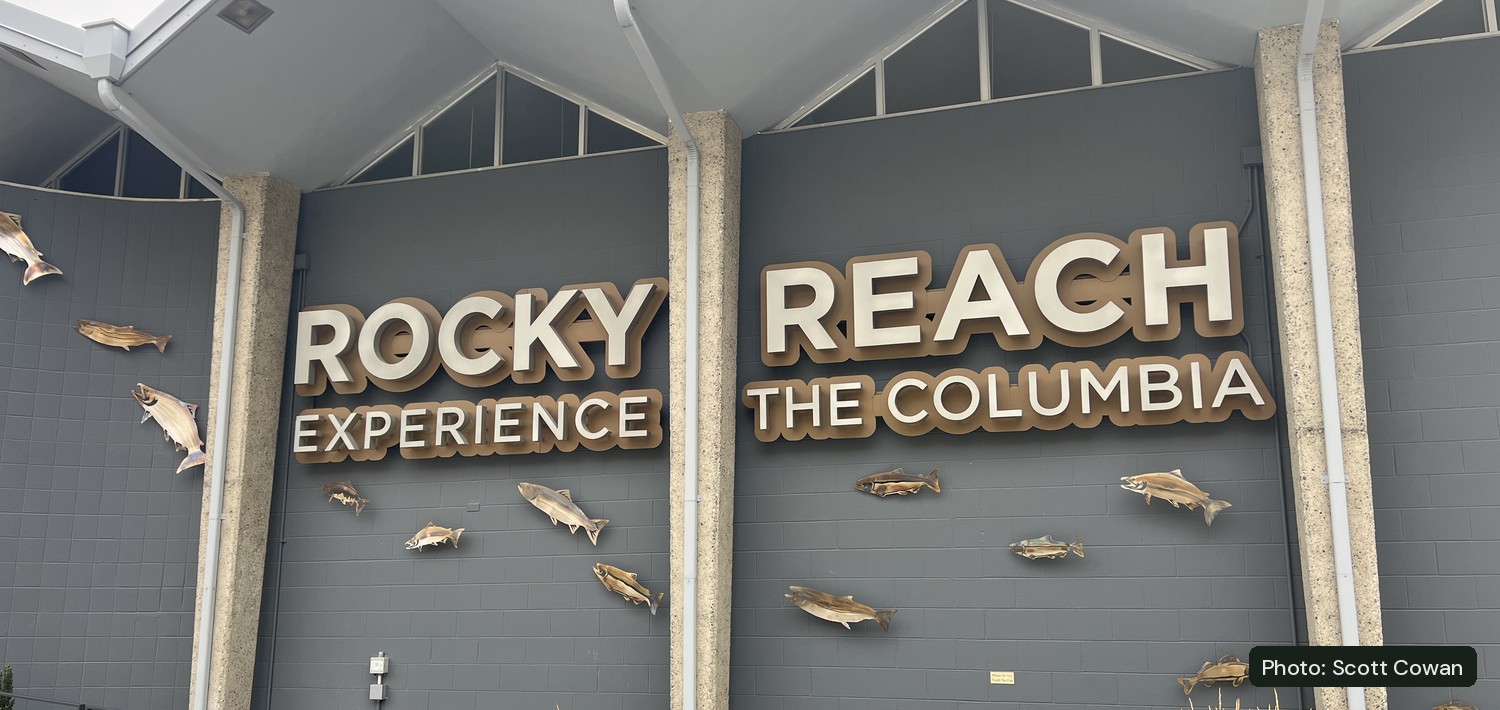
Photos by Scott Cowan, taken on a tour of Rocky Reach Dam in October 2026.
James Webber gives tours of Rocky Reach Dam for Chelan County PUD, and one question beats all the others: can I float down the fish tube? The answer is no. But the tube is a good place to start an hour at a dam most of us have driven past a hundred times on the way up 97A.
Scott sat down with James, the PUD’s Education and Outreach Specialist, and Kristin Lodge, who runs the Rocky Reach Discovery Center as Visitor Services Manager, right after James’s hard hat tour. Kristin grew up in Wenatchee and came over from the Wenatchee Valley Museum. Her office looks straight down on the fish ladder.
The fish tube, and the fish
The tube is the juvenile fish bypass, finished in 2003: a pipe 9 feet across and 4,600 feet long that carries young salmon past the dam. It is a big part of how the PUD holds Rocky Reach to its “no net impact” standard for salmon and steelhead, and it saves water that would otherwise go over the spillway instead of through the generators.
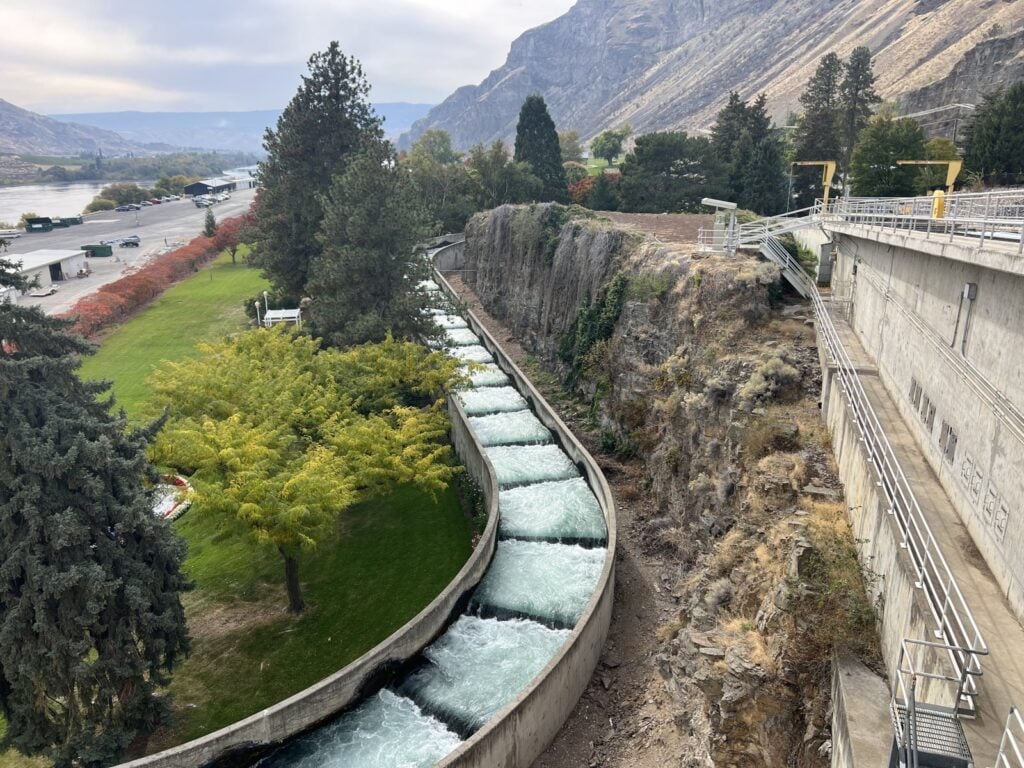
Adult fish go the other way, up the ladder. Every one that passes is counted, by species, by people watching a camera feed. James turns that into a counting game for visiting kids, and there’s a catch: you count the lamprey too. You can watch the ladder yourself on the PUD’s live fish cam.
A dam the voters paid for
Chelan County voters created the PUD in 1936. Instead of tax money, its early commissioners sold future power to pay for Rocky Reach. Construction began in 1956, and the first seven generators came on in November 1961, six months ahead of schedule. Kristin’s point is that the county is still living off that decision.
Scott wanted to know about the concrete, how Rocky Reach compares with Grand Coulee upriver, and the families who came to build dams up and down the Columbia and stayed. And what it feels like to stand in the turbine pit while a generator spins over your head. Kristin’s description: “It’s the hum of electricity.”
Data centers, and who gets the power first
This is the part people in the valley are asking about. Kristin explains how the PUD looks after its own customers first, why a data center has to pay for its own studies and grid upgrades, and what Helion’s planned fusion plant near Malaga means. They also cover why the Columbia is built for hydropower, how the dam handles the morning and evening peaks, and what your smart meter tells the PUD.
Before you go
- Rocky Reach Discovery Center: 5000 State Hwy 97A, Wenatchee, about 7 miles up the Columbia from town. Admission is free.
- Open Tuesday to Saturday, 9:30 a.m. to 5 p.m. The park and playground are open 9 a.m. to 5:30 p.m. through March.
- Powerhouse tour: free. Ask about tour times at the front desk.
- Free Discovery Days, 10 a.m. to 3 p.m.: Nov 7 and 21, Dec 5 and 19, Jan 9 and 23.
- Details change: check Chelan PUD’s Rocky Reach page before you drive up.
Also in this episode
The 17 parks the PUD runs, from Walla Walla Point Park to Beebe Bridge, which is becoming a state park. James’s disc golf pick, Rotary Park. Why a power utility builds fiber internet, drones and the high school STEM Academy, and their Wenatchee picks: coffee at Caffe Mela for Kristin, the beef brisket sandwich at Sweetwood BBQ for James, and lunch at Pybus Public Market. Then the question every guest gets: cake or pie.
Links
- Rocky Reach Discovery Center: our Discovery Center page
- Things to do in Wenatchee: our Wenatchee guide
- Chelan PUD: visit Rocky Reach
- The card from the mid episode spot: the Explore Washington State Card
Related episodes
- Pybus Public Market: a story of community and an iconic landmark, more from Wenatchee’s riverfront
- Joel Myrene on Wenatchee’s next generation of musicians, another Wenatchee story
- Scott Griffith, Washington State Parks, on the Palouse to Cascades Trail, recorded across the river in East Wenatchee
Remember, there’s always more to explore.
Rocky Reach Dam and Chelan PUD Episode Transcript
James Webber:
It’s this amazing feat of engineering to get juveniles past our dam, but it’s also a mile long, 10 foot diameter tube [Editor’s note: The juvenile fish bypass is 4,600 feet long and 9 feet across.] that looks like it would be amazing to throw an inner tube in and zoom through. Even after I explain that it’s a 30 foot drop and it’s filled with spiders and we don’t put people down there, almost everyone asks, but can I go down it anymore?
[Sponsor message: the Explore Washington State Card]
Scott Cowan:
This episode is all about disc golf, no I’m just kidding. I’m sitting down today at the Rocky Reach Dam with Kristin Lodge and James Webber. Welcome and my condolences in advance. James just gave me, what was that, about an hour and a half tour of the dam. So we’re gonna start with James.
Kristin Lodge:
Great.
Scott Cowan:
What brought you here? How did you, not your car, but how did you end up working here for Chelan PUD at Rocky Reach down.
James Webber:
Yeah sure so I’ve loved education and teaching for as long as I know and when I moved here with my partner in 2020 I first started talking to people around town and anyone and everyone who worked for or knew someone that worked at Chelan PUD told me this is awesome place the people are great the jobs are awesome so when I had the opportunity to do some teaching to local students around the about hydropower I jumped at the chance and I met Kristin and my predecessor Bob who just were amazing outreach people here. I just kind of fell in love with the energy and what we could provide students in this area. So when Bob retired last year I applied and ended up being able to come out here and talk to kids about hydropower and cool clean energy and hydro dams and anything you can imagine.
Scott Cowan:
Kristin how did you end up at Rocky Reach now?
Kristin Lodge:
So I’m a hometown girl. I’m from Wenatchee and my husband and I left for a dozen or 15 years, but we’re back in the valley now with our daughters, raising them, surrounded by grandparents and I was working at the Wenatchee Valley Museum, and museums are really special. They’re a place where people come to us on, on field trips or play dates or vacations they’re exploring, they’re wanting to learn. And there’s just something really special about that. Um, there’s a lot of joy there. So when the job opened here at the Discovery Center, I knew it’s where I wanted to be.
Scott Cowan:
So what’s your official title?
Kristin Lodge:
I’m the visitor services manager.
Scott Cowan:
Okay. And which James, what’s your official title? I’m the, if you can see his face right now, outreach education specialist. Okay.
Kristin Lodge:
Did you make me to make that sound like it had a period at the end?
Scott Cowan:
So we’re sitting in Kristin’s office, which if her monitors weren’t blocking, I would have this really cool view of the dam. And earlier I’m putting you on the spot and you said you have the best, best view in the company.
Kristin Lodge:
That’s supposed to be the best kept secret.
James Webber:
Oh,
Scott Cowan:
we’re gonna, we’re gonna, we’re gonna,
Kristin Lodge:
I’ve got a 180 degree view of the river. It’s pretty fantastic. All right.
Scott Cowan:
So put you on the spot.
Kristin Lodge:
Sure.
Scott Cowan:
Best season to be sitting here working from a view of the dam. standpoint?
Kristin Lodge:
You know there’s something really special about spring. When the spring Chinook come through they actually come up the fish ladder kind of right underneath my office and exit just right out on the forebay and I’ve pictured them jumping for joy almost like a whale like breaches the water and jumps and I do find myself a bit distracted by how gorgeous it is but man when that blue sky comes out and the rivers just looking gorgeous it’s it’s a pretty space to be.
Scott Cowan:
For outreach when you have groups coming through here, what seasons kind of for you, what do you think’s the best season?
James Webber:
Oh, I mean, spring is great because you can see some of the fish. The temperature’s not so hot so that after the kids come and learn some STEM stuff, they can go out to one of our shelters and have lunch outside and play in our playground. So you want that perfect time where it’s warm enough that they can play outside and see all the fish and have fun here, but then still enjoy that lunch outside.
Scott Cowan:
So how many people come through the center annually?
Kristin Lodge:
We see anywhere between 70,000 to 75,000 people a year.
Scott Cowan:
Do you keep track of where they’re from? I mean are they mostly local Chelan County folks or do you get people from the west side or?
Kristin Lodge:
We keep really good counts of our visitors and what type of experiences they have while they’re on site but we don’t necessarily track where they’re from except for to say we love to greet people as they’re coming in. We track our field trips for sure. And when we bring visitors on public tours, you got to go on a really special hard hat tour today, but we do public tours all throughout the day. And we’re always asking our guests, where are you from? We do find that the majority of our visitors are from here in Chelan County, but it is not unusual to speak to a family from Germany and someone’s visiting from India and we’ll see people from all around the world. And it’s really fun to chat with and learn from guests as they come in too.
Scott Cowan:
So why do you think somebody from Europe is coming to this dam? I mean, what do you what is it? I get why I mean, I’m I drive by this. I’ve seen this, you know, it’s in it’s in my backyard. I take it for granted. I got a whole new whole new set of scale and today when I was inside, I mean, totally completely. Wow. But why? Why do people say that? The reasons are that they’re coming here.
Kristin Lodge:
I think museums tend to see cultural travelers And there’s lots of different things people are interested in when they go on vacation But it’s a really special place to be where someone’s curious and wants to learn We see a lot of retired engineers We see a lot of people that just have general curiosity about the world and then we see a lot of Families a lot of kids want to come see the fish play on the playground and the adults are looking for something fun to Do and learn about while they’re here too.
Scott Cowan:
So okay putting you on the spot with the question is probably gonna be impossible so I’m going to ask it. I’m going to ask a couple other questions, but I want you to think about this one, why we’re doing it. So what is the most unexpected question you’ve been asked by a visitor when you’ve given these tours? So think about that for a second, because I’m going to behold you to that. I want you to answer it. But I, yeah, I’m curious. 70,000 people come through here. It’s a free tour, Chelan PUD’s a great neighbor in our community, since I live here in Wenatchee, I can say a great neighbor, I mean they really are. I learned a lot about hydroelectricity production and all that, and we’re gonna talk, we’ll geek out on numbers here in a little bit. But what do you think, in your opinion, Kristin, makes this dam special to our, the Wenatchee Valley?
Kristin Lodge:
I think if you talk to anyone in the hydropower community they would say each dam is unique. But one of the things that we’re really proud of here is our successful fish passage programs. We have a really special habitat conservation plan. And with the mitigation measures of our juvenile fish bypass program and our adult salmon fish ladder. We’ve got a 99.99% survivability, and we call it a no net impact dam. [Editor’s note: Chelan PUD publishes no survival percentage. Its standard is no net impact on salmon and steelhead.] So when we talk to visitors, we say it’s like fish can swim by as if it’s invisible. And that’s really important to us and something that we’re super proud of here.
Scott Cowan:
So earlier, James was telling me about the fish ladder that he’s aware, I’m not gonna say he observed, he probably has, I don’t wanna put words in his mouth, but something along the lines of fish going up the ladder And sometimes they even go back and like they do it again, like it’s an amusement park ride. I thought that was a pretty, pretty interesting thing because I was asking how long it took them to go to the ladder. And then he brings this up that they’ve observed that.
Kristin Lodge:
How playful are they?
Scott Cowan:
Some are very lackadaisical and they hang out and you know, they.
Kristin Lodge:
Check out our fish cam. You can see for yourself. Right.
Scott Cowan:
And then you didn’t tell me about a fish cam.
James Webber:
Yeah, it’s a live fish cam we have too.
Scott Cowan:
Really? Is that online? So I’ll link to it so that people can check that. That’s kind of cool. All right. So you give tours, people ask questions, anything?
James Webber:
Well, I think the one that’s probably the weirdest, but I also get asked it the most, is can we flow down the fish bypass tube?
Scott Cowan:
I kind of asked that. I asked you if you had gone it. Yeah. Okay.
James Webber:
So it’s this amazing feat of engineering to get juveniles past our dam, But it’s also a mile long, 10 foot diameter tube, that looks like [Editor’s note: The juvenile fish bypass is 4,600 feet long and 9 feet across.] would be amazing to throw an inner tube in and zoom through.
Scott Cowan:
It does.
James Webber:
Even after I explain that it’s a 30 foot drop and it’s filled with spiders and we don’t put people down there, almost everyone asks, but can I go down it anyways?
Scott Cowan:
I’ll be honest with you, I was a little disappointed when I heard you hadn’t done it. But you also said no humans have done it. So that’s, I was like, so it’s a mile long, 10 foot diameter tube that the fingerling [Editor’s note: The juvenile fish bypass is 4,600 feet long and 9 feet across.] size salmon go through. So annually, well that sounds like a feat of engineering of, you know, if you and I were talking about this, then there was some tests and we were doing this and this was added onto the dam in what year was it added?
James Webber:
2003.
Scott Cowan:
Okay, so the dam had been open for 50 years at that time, approximately 50, we’ll round it to 50. We’re amongst friends, we don’t have to be Totally accurate. But 50 years, they went through the spillways then, correct? Is that how, okay. So now this new tube, how much water did this save? I mean, you were talking some amazing numbers.
James Webber:
Yeah, so just, I was looking up, when the spillway is fully open, it can let out 80,000 cubic feet of water per second, whereas this tube lets out 360 cubic feet of water per second, which we estimate to save somewhere in the range of a trillion gallons a year using this system, which is also much safer for the fish. So it’s win win.
Scott Cowan:
So it’s safer for the fish. We use a lot less water that we can convert into electricity. Approximately a trillion gallons is how much electricity?
James Webber:
I tried to do this. My back of the napkin math was that’s about enough to power Wenatchee for three months.
Scott Cowan:
That’s crazy. That’s crazy that that tube is a benefit to the fish. I mean, 99.9%. [Editor’s note: Chelan PUD publishes no survival percentage. Its standard is no net impact on salmon and steelhead.] I’m going to guess that’s an improvement from the previous system and that it can cover, let’s say a quarter of Wenatchee’s power. Let’s just round it down, be conservative, a quarter. Wow. All right. I think I’m, well, maybe I didn’t warn you guys, but I bounce around a lot. So let’s go back to when the dam was built. Who’s going to play historian? Okay.
James Webber:
Oh boy. Here we go.
Kristin Lodge:
So, rock, paper, scissors. Rock, paper, scissors.
Scott Cowan:
Okay. So, um dam was built in the early sixties but. Completely.
James Webber:
Yeah.
Scott Cowan:
Yeah, we don’t uh just start building a dam and then, you know, how long, when was this dam conceived and how long approximately from when it was, you know, hey, let’s put a dam on the Columbia. This in this area cuz there’s already dams here before us. So we’re gonna put the Rocky Reach Dam in. Who came up with this idea? Was it the Army Corps of Engineers, Chelan County?
James Webber:
Chelan County PUD, we have in our Discovery Center a host of visionaries who made all this come true. First from coming up with the idea that we need a public utility in this area to get affordable electricity,
Scott Cowan:
to
James Webber:
all the people that campaigned for putting a hydro dam in here, to raising the money to do this kind of project, to engineering and designing the whole thing. There’s a number of people that were here to do that.
Scott Cowan:
Okay.
James Webber:
Our PUD was founded in 1934. [Editor’s note: Chelan County voters created the PUD in 1936.] We purchased Rock Island and then actually built this one. I don’t know if I know exactly when they started.
Scott Cowan:
So Chelan PUD, was Rock Island already in place? So the three dams that Chelan PUD has Well
James Webber:
three three nine,
Scott Cowan:
huh
James Webber:
three and a quarter
Scott Cowan:
three three four
James Webber:
Rock Island right here already Chelan Falls was here already also,
Scott Cowan:
but it’s a mystery to me.
Kristin Lodge:
But fun fact, they were owned by others
James Webber:
by others
Scott Cowan:
Okay,
Kristin Lodge:
so when Chelan PUD when the Grange bill was passed and PUDs became possible Chelan PUD was voted by a vote of the people in 36. And we could have spent decades just stringing power lines and connecting customers. But our commissioners and James alluded, we’ve got these innovators here at the Discovery Center hanging on banners outside my office, but we have these innovators who looked in our backyard and said, you know what? This feels like these resources belong to the people of Chelan County. And so they conceived of this payment method rather than charged taxpayer dollars. They conceived of this bond repayment program. So essentially they would sell future power to people who would help them finance the building of Rocky Reach and the purchase of Rock Island and Lake Chelan dams. So in a short period of time, they went from no resources to three. And I think where we’re now, Chelan County is really reaping the benefits of those early innovators.
Scott Cowan:
Okay, so who built Rock Island? Was it Army Corps of Engineers?
James Webber:
No.
Scott Cowan:
I don’t know why I keep thinking that they would be involved.
Kristin Lodge:
Army Corps did conceive of this location in the early 1900s. [Editor’s note: The Army Corps of Engineers first studied this site in its 1934 report.] So this was a known location and I think they had identified that the bedrock is really strong here. The strength of the river, there are a number of different factors, but they were doing reports in the early 1900s. So that was…
Scott Cowan:
So, Chelan PUD decides we’re going to build a dam. Basically here. When did they break ground? 1956 1956 and when did the lights go on? If you will,
James Webber:
1961 61. Yeah,
Scott Cowan:
61. So basically five years.
Kristin Lodge:
Yes.
Scott Cowan:
Five years. Okay.
Kristin Lodge:
Under or above schedule. Yeah. Five months ahead of schedule. [Editor’s note: The first seven generators came on six months ahead of schedule, in November 1961.] Yeah. 10 million dollar budget, which never happens.
Scott Cowan:
Well, and I heard I think you shared with me before somebody here in no fatalities.
Kristin Lodge:
That’s right.
Scott Cowan:
Okay. How much concrete’s here?
James Webber:
Four billion pounds.
Scott Cowan:
Four billion pounds.
James Webber:
That’s a lot of concrete.
Scott Cowan:
Okay so the listener probably they might have heard of Hoover or Grand Coulee. Do you know about how many pounds of concrete’s at Coulee to give us perspective?
James Webber:
I don’t. That’s a cool question.
Scott Cowan:
Well, let’s go from a power generation. What’s the maximum capacity here?
Kristin Lodge:
1300 megawatt capacity.
Scott Cowan:
And what is Grand Coulee’s maximum? About 60. Yeah, 60. So Coulee’s three times larger, three and a half times larger. [Editor’s note: Grand Coulee is about five times the size of Rocky Reach.]
James Webber:
Yeah.
Scott Cowan:
So could one assume that physically it’s double the size?
James Webber:
Yes and no. No, the hydropower comes from stacking up the water in a very tall column.
Scott Cowan:
Okay.
James Webber:
So you could have a really narrow dam that’s really tall that could generate more power. And Rocky Reach is kind of weird in the way it’s built in the Z shape in order to have a spillway, a powerhouse, and then a forebay. Whereas the next dam upriver, Wells Dam, all of it’s kind of smushed together. So every dam is a little bit different. Grand Coulee definitely has more concrete in it. But I don’t exactly know. I have to, this is my favorite thing is about doing
Kristin Lodge:
part tours.
James Webber:
I talked to so many interesting people that come up with questions that I would never think to look into and then I get to go look them up and I have a new fact next time.
Scott Cowan:
Well, I just think, I mean, I think the general public, I think we think of Grand Coulee cause it’s got stories and it’s, you know, sorry, it’s more famous.
Kristin Lodge:
Sure, that’s all right. We’ll allow it.
Scott Cowan:
But you said something when we were talking about that Rocky Reach is, would you say the seventh largest dam in North America?
James Webber:
Hydroelectric producer dam.
Scott Cowan:
Seventh largest hydro producing dam in North America. Yeah.
Kristin Lodge:
We should make ourselves a banner.
James Webber:
I know, right? We’re number seven.
Kristin Lodge:
I mean,
Scott Cowan:
I mean,
Kristin Lodge:
come on.
Scott Cowan:
But you did say, I mean, to poke fun at you, it’s what, the fourth largest on the Columbia?
James Webber:
I think so.
Scott Cowan:
So it’s got Grand Coulee and what was it?
James Webber:
Chief Joseph is number two.
Scott Cowan:
Chief Joseph and then?
James Webber:
I think there’s a couple down in Oregon. Yeah, we’re talking about that behind the show,
Scott Cowan:
so that doesn’t really count. Okay, we ignore Oregon. Yeah. Sorry folks. Okay.
James Webber:
It’ll be fifth, yeah, I think it’s fifth.
Scott Cowan:
Okay, so this dam was built, who built it? And what I mean by that is, there wasn’t a construction company in Wenatchee that goes, Oh, yeah, we can build you a dam, no problem. I mean, who, how did this thing get? Where did the workers come from? What company? Was there a company that was the lead on this?
Kristin Lodge:
James had alluded to this earlier, but we we learned a lot from our guests, we learn a lot from their questions. And one of the things that we hear a lot is, my grandpa worked on this project, or my dad worked on this project. There’s a lot of community pride in this. And when I ask more, you know, what did he do? What did he work on? How did that work? They, they describe this engineering and construction background. And essentially it sounds like they were going project to project to project all around the country, but really here along the Columbia building dam after dam. So it sounds like there was an incredible conception and the innovators here at Chelan PUD, but a lot of work was brought through this project.
Scott Cowan:
So kind of a transient workforce during the during the decades where these dams were all being constructed.
Kristin Lodge:
What I love hearing from our customer owners and from our visitors is that so many of them settled here because of this. They came maybe for this project and they recognized how special the valley is how beautiful this place is and it became their home a place they wanted to raise their own kids and families and there’s something need about that.
Scott Cowan:
All right. James earlier, you said something that I think the one thing you’ve shared with me that just, I still haven’t wrapped my brain around. And there’s a lot actually is the concrete’s not fully cured. So this dam is approximately 60 years old. And you’re telling me the concrete’s not completely cured.
James Webber:
Yeah, when it turns out, if you pour 4 billion pounds of It takes a while for that center to fully cure, but yeah, they estimated that it should take about a hundred years for the dam to fully harden, which means it’s been holding strong for 60 years and it’s only gonna get stronger. So,
Scott Cowan:
when the dam was open that concrete wasn’t cured. So how do we test the… How do you know? Is there… How does one test concrete in a dam? I mean, how do we know?
James Webber:
That is an awesome question. I have no idea.
Kristin Lodge:
We talk about the pucks in this.
James Webber:
Yeah, so we measure all the time how the dam is expanding and moving through basically a laser system and a bunch of reflective pucks on our dam to make sure that, right, four billion pound dam, you think it would move around a little bit, but the water changes temperature quite a bit and cause expansion and contraction. So they’re measuring that they’re measuring how big or how much the dam is moving all the time. It’s make sure it’s within a certain tolerance so there’s We talked a little bit of early about every and anything you think about at something like the Schlein PUD is Infinitely more complicated than you would ever think it actually is but even so you have to measure
Scott Cowan:
So if memory serves me, I think the space needle moves like six feet to keep it in the wind. So it.
Kristin Lodge:
Whoa, really?
Scott Cowan:
Yeah. And so.
Kristin Lodge:
We’re hoping our tolerances are smaller than that Harry. Well,
Scott Cowan:
it’s 600 and some feet up in the air and the wind and
James Webber:
all of that.
Scott Cowan:
So the fact that you’re saying that this is moving didn’t make me look for the nearest exit. I’m like, I expect that, but it’s more the idea that this is curing, concrete is still curing, and yet it was strong enough. How long, they started, so five years, that concrete, some of it, the oldest, it was five years old, right? So it obviously was cured enough to support stopping or slowing down the river
James Webber:
type thing,
Scott Cowan:
okay. One question you didn’t answer, or I didn’t ask you before, how thick is the dam? What’s its thickest place? Well,
James Webber:
it’s okay. So you have the last spaces that are hollow that have concrete on either side of it. That would be thick if it was filled, but they’re not. I think the thickest parts are down at the bottom, like through the intake channel where the water is at the highest pressure coming through and then underneath below that. So we’ve got center dam where there’s nothing there. There’s a lot of concrete at center dam. We kind of saw where that gantry crane was usually parked, which is very thick. It’s where the dam turns 90 degrees. And then there’s a lot of spaces where you need a lot of reinforcement because there’s a lot of high pressure water coming through. But there are also a lot of places that are hollow. Like the powerhouse is really thick, but it’s empty because there’s stuff inside of it.
Scott Cowan:
Yeah, I mean. So you said something, and this is why I’m so glad we went through it because, so there’s 11 turbines, but only eight were original, correct?
James Webber:
Seven.
Scott Cowan:
Seven so so when this opened there was seven turbines.
James Webber:
Mm hmm
Scott Cowan:
We’ve added four over the years and those turbines are pretty small There are only how many tons did you say that thing was? Was 400 and sometimes
James Webber:
400 440 thousand pounds is what each
Scott Cowan:
40,000 just the turbine.
James Webber:
Yeah.
Scott Cowan:
Yeah,
James Webber:
cuz there’s one Below at the very bottom of each one of the units, right? Which is a turbine a shaft and a rotor Yeah.
Scott Cowan:
And all those were… One’s out, exposed right now for maintenance. So I was able to kind of see all the parts in
Kristin Lodge:
That’s fun.
Scott Cowan:
Yeah, no, it was very cool. And he actually let me go up closer than probably normal. And it’s, I didn’t touch anything.
Kristin Lodge:
We’ll hear about that later. Yeah.
Scott Cowan:
There was no maintenance guys around. We didn’t bother anybody. It’s easy. And it was like, it’s, I don’t think the public is looking at it through a window looking down.
Kristin Lodge:
It was a really neat observation deck, but it’s true. You did get to go on a really special tour. It’s very cool.
Scott Cowan:
But when we went down there, it changes the scope,
Kristin Lodge:
right? The perspective.
Scott Cowan:
And he took me down to the where the shaft in the things are turning and that’s creepy. I’m just going to tell you guys, I was, I mean, it was very cool. Don’t get me wrong. It was super, super cool, but It was also like, yeah, I don’t want to work here. I don’t want to work in that area. Let’s put it that way. It’s like, oh. And those, just the scale of it is hard to put into words. It’s just crazy.
James Webber:
We tell every guest that down there is a two and a half million pound unit spinning 90 times a minute, saying that does not cover what it’s like to be actually standing underneath it within that turbine pit feeling that heat and hearing what it sounds like down there.
Kristin Lodge:
The vibration under your feet.
James Webber:
It’s not even close to.
Scott Cowan:
But the vibrations not, the vibrations not, I mean you feel it but it’s not like, I still have my feelings. I mean I’m not being, I’m not. It’s not a jackhammer.
Kristin Lodge:
You know,
Scott Cowan:
it’s not a jackhammer,
Kristin Lodge:
but it’s a hum of electricity. There’s this sense of power.
Scott Cowan:
I mean, no pun intended, but it’s like it’s it’s magnificent. It’s it’s really very cool.
Kristin Lodge:
And, you know,
Scott Cowan:
to think that this facility is 60 years old. You also said 95 percent hydroelectric. The turbines are 95 percent efficient.
James Webber:
Effectively, yeah. Effectively,
Scott Cowan:
okay. Which is crazy to me.
James Webber:
Yeah, hydropower is really special. One going down there, you can feel that the Columbia River is really, really powerful. And hydropower is great because it’s directly converting kinetic moving stuff into electricity. So it bypasses all the conversion that has to go on in a lot of other systems. So we’re able to capture basically 95% of that energy from the river and transform directly into electricity which is awesome unlike any other kind of energy producing around.
Scott Cowan:
So I want you to talk shade about the Mississippi. Why isn’t the Mississippi a good river for hydro?
Kristin Lodge:
Yeah James.
James Webber:
Yeah so I love talking with guests about this that the Columbia really has all three things you need for hydropower. It has a ton of water. Seems obvious you kind of need that. It’s really steep so the Columbia river drops about two and a quarter feet per mile. And it’s also contained in a really strong valley so that when you back up that water, you’re not flooding an entire huge environment. Mississippi has a lot of water, a little over twice as much flow, but it only drops three inches per mile. [Editor’s note: The Mississippi falls about 8 inches per mile on average.] So it’s really, really shallow. And then that area around it is really, really flat. So if you create a hydro dam, you create a reservoir, you end up flooding an entire enormous amount of land. So Columbia River is super special. It’s why we get more hydropower out of this than any other river. I believe in the world right now that has all the things that you need. Water drop and containment.
Scott Cowan:
How many dams are on the Columbia?
James Webber:
14.
Scott Cowan:
14 dams. How many are producing electricity?
James Webber:
All 14.
Scott Cowan:
All 14. So we’re recycling the water at each dam, basically. I mean, what’s at the Grand Coulee comes down to Joseph, comes down to Wells, comes here, goes down to Rock Island,
James Webber:
Is it Wanapum next?
Scott Cowan:
Okay, cool. And for that I know.
James Webber:
Priest Rapids.
Scott Cowan:
Okay, and all those blur together after that down there.
James Webber:
John Day is that next?
Scott Cowan:
John Day. Okay, so there’s all these… So it’s the same water being reused through all of these dams. I don’t think you guys are going to know the answer to this question, but this is the way my brain works. How much hydroelectricity do all these dams generate combined?
James Webber:
Oh, I did know this at one point. So we all have a maximum capacity. We’re never almost never at full capacity and having all 14 running at max capacity, very unlikely.
Scott Cowan:
Very unlikely.
Kristin Lodge:
But six,
James Webber:
I don’t even know, 35,000 megawatts.
Kristin Lodge:
Is it trying to come up
James Webber:
with
Kristin Lodge:
all the other stuff?
James Webber:
We’ve got it here.
Scott Cowan:
But not, but like you said, today, So when we were when you showed me the the control for one of the turbines it was running at about 56 percent Right,
James Webber:
what’s about 56 megawatts out of about 114
Scott Cowan:
so about 60% You know a little little lower than that little I can do some math
James Webber:
about just about 50%
Scott Cowan:
about 50% So it was operating about 50% which is fairly normal. I guess I’m in the range of normal.
James Webber:
Sure. Yeah, okay,
Scott Cowan:
so So would that be safe to assume that all the dams are running at about that range probably right now?
James Webber:
It’s a nice time of year right now and the time that we were looking at it, everyone’s at work. So you have kind of peak load happens twice a day just before everyone goes to work and then once everyone comes home.
Scott Cowan:
So I want you to explain that because this is something I didn’t, this is odd to me. My brain didn’t process it. So, Kristin, you said in the morning, I think it was you, when I first got here, we were talking about this, that in the morning is the heaviest usage. Correct. Okay. And then after work hours, we have another.
Kristin Lodge:
Sure, yeah.
Scott Cowan:
How fast, so you’re producing, I’m just gonna make up a number, everything’s spinning at 35%. Now, I don’t know, let’s say morning time, we say it’s 6 a.m., the lights go on in the valley, in Chelan County. How fast does it, do you guys spin up to produce enough electricity to handle that increased projected load? Is it, I didn’t realize it could be, I don’t want to say instant, but quick.
James Webber:
Yeah, I mean we can get one of the generators up to full speed in three minutes from stopped. But we have enough data at this point to know that in the morning people are going to start using more electricity. and we’d already have some generators running with the capacity to meet that load. I was telling you down there, if we knew exactly what every single human and factory and workplace was gonna do at any given second, it would be 100% efficient at all times, but it’s not really how that works.
Scott Cowan:
So is this why Chelan PUD put a smart meter on my house? What was that?
Kristin Lodge:
I thought you might go there next. Yeah, so I mean, the more, we’ve got a lot of data analysts that work for Chelan PUD, But the more we know about our customer owners, the better we can serve them. So James had alluded to the more we can kind of understand the habits and the timing, then we can prepare for that. But hydro is responsive. So if there’s, you know, if the wind is blowing, that’s great, the wind turbines are running, if the sun is shining, that’s great, the solar’s producing on the grid too. But we’re kind of the foundation of that clean energy team.
Scott Cowan:
So I never thought about the variable. So when I say you put the smart meter on my house, I didn’t think it was to forecast demand. I thought it was to modernize so that somebody didn’t have to come and read my
James Webber:
meter.
Scott Cowan:
I thought it was, you know,
Kristin Lodge:
like… And that too. But that was…
Scott Cowan:
I didn’t… Never did I think that that data was being aggregated across all the households, right? I mean, now it makes like, oh, this is really cool. Like,
Kristin Lodge:
so when you think about it at a commercial or an industrial scale, though, taking that, the information, um, there’s actually a really neat class that’s being taught at the high school right now in a community group that’s been put together to help analyze power use of large companies and to help them analyze, man, if you could really power down your computers overnight, or if you could turn off those lights or if those thermostats could get turned off overnight or down overnight, you could gain so much efficiency. And so that data is being used in a lot of really interesting ways to improve power consumption and conservation.
Scott Cowan:
So the whole smart home thing is…
Kristin Lodge:
There you go. Yeah.
Scott Cowan:
Two questions come out of that. Number one, I don’t know that we know the answer. You probably do, but let’s see. Who’s the largest consumer of power here in Chelan County?
Kristin Lodge:
I don’t know that I know that off the top of my head.
Scott Cowan:
I mean, it used to be,
Kristin Lodge:
I would say it would have been Alcoa.
Scott Cowan:
You know, they would have been the
Kristin Lodge:
That would have been a natural answer.
Scott Cowan:
I’m just, but I’m curious now, it’s like, who, what industry do we have that’s, I’m guessing it’s industry.
Kristin Lodge:
Certainly our, you know, our fruit packing sheds and our fruit storage takes a certain amount of energy. Although I, even those I think aren’t enormous when you think about it at a large scale.
Scott Cowan:
I think it would be relatively…
James Webber:
Yeah.
Scott Cowan:
So, but now that we, I don’t know who’s our biggest industry here. I was thinking about this, like who’s the big consumer. Now I am kind of going in a direction because there’s going to
Kristin Lodge:
be two
Scott Cowan:
words that we’re going to say here. Um, and before I say those two words, I really want to know, because I was told something and I want to make sure I say it correctly. Schlamp UD has a policy, I guess, maybe not, you’re gonna correct me on the wording, about ensuring that the residential households have power, right? And you sell off power to other locations. I learned that there’s the Western grid, so we’re not selling power to New York because we don’t speak to New
James Webber:
York.
Scott Cowan:
The grid doesn’t work that way. So we’re selling to the Western, let’s say West of the Rockies, maybe is safe. I might not be completely accurate, but Oregon, California, you mentioned New Mexico, maybe. Okay, so we’re selling our surplus power.
Kristin Lodge:
That’s right.
Scott Cowan:
But the county’s guaranteed a percentage of the power generated. Is that accurate?
Kristin Lodge:
We guarantee that we’re serving the needs of our customer owners first. So that’s really special. Let’s talk about that for a second. And that’s really special about Chelan PUD is we have these incredible generating assets, right? We’ve got Lake Chelan, we’ve got Rocky Reach and we’ve got Rock Island and we’re putting more power on the grid than our customer owners here in Chelan County need. So our local residents use about 30% of the power that we’re generating, which means we have the opportunity to sell the excess through power sale agreements. So that’s what you’re talking about. So those, there’s a mix of long term and short term power sale agreements. What’s great about those is those rates are what keep our customer owner rates very low. And we’re a not for profit. So we don’t take the excess from those sales and put it in our pocket. We invest it in our community. And that’s what we get to invite our customer owners here to visit us at the Discovery Center. We’ve got 17 parks. We’ve got low rates for our customer owners. So all sorts of benefits, including water, waste water, generation transmission, high speed fiber. So all of those go back to our customer owners, but you’re right, yeah.
[Sponsor message: the Explore Washington State Card]
Scott Cowan:
So the 800 pound gorillas, the word data centers. And I think if you read the media, you know, there’s this kerfuffle globally, but Let’s just, you know, about data centers and raising rates and all of this stuff. And we’ve got a new data center in Chelan County, Microsoft center. But you said something to me that I thought was really interesting that with the surplus power that we have, there’s long term commitments that you’ve already pre sold, uh, December’s surplus to XYZ. Like they’re already, they’re already going to buy those kilowatts at a, at a set rate. So it’s not like Microsoft’s jumping in and grabbing a bunch of power. That’s right. Okay. So, and what another thing you said was that they’re paying the when we’re selling power, they’re paying more than our residential rate.
Kristin Lodge:
Correct. The wholesale market rate is different. Yeah.
Scott Cowan:
So would would Microsoft be paying more per kilowatt than I’m paying at my residency?
Kristin Lodge:
Well, that’s a good question. Microsoft is going, is intending to come in with their own power. So large data centers are beginning to operate here in Chelan County. And like many utilities throughout the nation, and we’ve seen that in central Washington in particular, we’ve received requests from data centers to seek siting in Chelan County. So we’ve developed large load policies. And first and foremost, we evaluate those requests, but first and foremost, we want to keep our rates stable for our customer owners. We want to maintain reliable electric service for all of our customers. We want to preserve that local control. We talked about how special that is to have public power available and what that means for our community. And we want to treat all of these requests comparably and consistently. So our commissioners have put together metrics for evaluating these large load requests. So your question about Microsoft, they’re siting the Helion plant down in Microsoft or down near Microsoft which is really exciting right? That could be incredible to have a new generation source in Chelan County. It would be the first in the world if it started if we were able to capture that that generation capacity that’s available with fusion so that’s really exciting our job is transmission and distribution [Editor’s note: Helion aims to run a fusion plant near Malaga by 2028.]
Scott Cowan:
right
Kristin Lodge:
so microsoft has said that they’ll come in with their own power and and our job Chelan PUD is to build the substations and switch yards to safely transmit that on the grid within our county
Scott Cowan:
So everybody’s just gonna be called Microsoft. Okay, so Microsoft says we wanna spin up a data center. They, it’s not like you just go plug in. It’s not like you drag an extension cord across the street and plug in the data center. So they’re negotiating and they’re working with, we’ll say PUDs, but there’s lead time on these
Kristin Lodge:
things.
Scott Cowan:
And there’s infrastructure build out that has to,
Kristin Lodge:
Because we don’t have,
Scott Cowan:
we have no need, we didn’t need a switching yard or whatever over there because there wasn’t any consumption. So it’s not like our grid is
Kristin Lodge:
Ready to handle that capacity. Yeah, because we didn’t,
Scott Cowan:
it handles the capacity we have. That’s one thing about living here I love is like, I don’t think in eight years, I think I’ve lost power once. And that was kind of creepy to be honest because like what happened?
Kristin Lodge:
Where are my linemen?
Scott Cowan:
Well, I lived in the Coleman, we lost power all the time. There’s no shade on that, but we had a lot of trees. When bulls…
Kristin Lodge:
Literal shade.
Scott Cowan:
Yeah. So here, you know, our grid, I’ve never had a problem. And I mean, my friends that live in Seattle are shocked when we talk how much my electric bill is and how…
Kristin Lodge:
It’s incredible.
Scott Cowan:
And how, you know, it’s like, and I did the math to figure out if I got a Tesla, how much it would cost me to charge at the Tesla. And it’s, it’s, it’s embarrassing. It’s awesome. The parks are awesome. We’re going to talk about that in a little bit. But how long, if I want to open Scott’s data center, how long in advance would I have to call Solan PUD and say, hey, I want to be a large load customer? That’s, I’m guessing, many months.
Kristin Lodge:
Yes, I’d have to venture a guess at that too, but there is a process and a procedure and there is a large load request form.
Scott Cowan:
Triplicate, press hard, we’re making copies.
Kristin Lodge:
Triplicate.
Scott Cowan:
Yeah, I’m old. If you staffed on carbon paper, you had to make copies.
Kristin Lodge:
Oh, sure. Okay. Well, and what were… I’m sure those requests are unique. You discussed Microsoft and I know that they have a plan for where they would get their power. Now, not all do. So some of them might be looking to serve their data centers from the wholesale energy market. So we talked about those long term sales agreements. And because we have those long term sales agreements, that’s really the best that we could do is help facilitate that type of marriage in finding wholesale power.
Scott Cowan:
So James has already booked a bunch of kilowatt hours and he’s got a long term contract with it. James has got the market cornered and I want to open my data center. You might introduce me to James to see if he’ll sell me power.
Kristin Lodge:
There you go. Okay.
Scott Cowan:
Right. Would that be a reasonable assessment?
Kristin Lodge:
I think one of the important things that we need to think about too is the infrastructure and you’d alluded to that earlier. So we would be asking if Scott’s data center is wanting to come in, you’d pay for the studies and the equipment and the system upgrades needed to connect to the electrical grid and to the system.
Scott Cowan:
And so that’s so in with on we’re only speaking about Chelan PUD, everybody’s a little bit different how they’re handling it. But is it am I correct in assuming that if Scott’s data center wanted to go in, Intiat, let’s just go up. And I wanted to be a customer of Schlamp PD that you’re gonna say, okay, the infrastructure build out is on Scott’s data center’s dime. I have to bring, I pay for the, I’m gonna guess that you guys are building the equipment to your specifications, but my company would be.
Kristin Lodge:
That’s correct, yeah. The only exception might be if we see a benefit to our existing customer, there may be some cost sharing. If we’re ensuring that this infrastructure is also benefiting reliability upon the line, you talked about the great reliability of our customer owners, that’s really important to us. So that would certainly be something to consider.
Scott Cowan:
Okay. No, I think that’s all. I mean, growth is going to happen. You grew up here, town looks a little different than when you were a kid.
Kristin Lodge:
It’s a little different, yeah.
Scott Cowan:
You’ve been here five or six years, it looks a little different. I’ve been here about eight years, it looks a little different. The area of the region is growing and in changes inevitable, not always good. Sometimes it’s great.
Kristin Lodge:
Change is constant.
Scott Cowan:
Yeah, changes. Yeah. So I like I like hearing that because I think people get worried that, you know, Scott’s data center is going to jack up my rates and that’s just does not appear to be the case.
Kristin Lodge:
The number one point that our commissioners have made with these large load considerations is they want to make sure our rates remain stable for our existing customer owners.
Scott Cowan:
That’s awesome. That’s awesome. Okay. Let’s talk 17 parks.
Kristin Lodge:
Let’s talk parks. Yeah.
Scott Cowan:
Totally shift. Totally shift.
James Webber:
Seven hundred acres.
Scott Cowan:
How many?
James Webber:
Seven hundred acres.
Scott Cowan:
Okay. James, what’s the best disc golfing park we got?
James Webber:
Unfortunately, it’s not a Chelan PUD park, but here we’re going to have to go check out Rotary. It’s beautiful.
Scott Cowan:
Okay. Rotary?
James Webber:
Yeah.
Scott Cowan:
Okay. How about you? Do you have a favorite park? For of Chelan PUD’s.
James Webber:
Yeah, that doesn’t have to be disco for you.
Scott Cowan:
So
Kristin Lodge:
I play soccer at Walla Walla. Walla Walla is my favorite. I feel like it’s just a hub of activity and fun. It’s always nice to take a walk down to Pybus and I can incentivize my kids to go for a run or a walk with me with some gelato at the end.
Scott Cowan:
All right. All right.
Kristin Lodge:
Now, Park here is pretty special, too. I don’t know if you did any exploring.
Scott Cowan:
I did not. I have not. As I drove through this time, I was trying to be, because I knew where I was going the first
Kristin Lodge:
time.
Scott Cowan:
When I drove in the first time, I’m like, follow the tracks. And I’m like, is this?
Kristin Lodge:
We have a beautiful Arboretum walk, so we could give a brochure out to people who visit and they can wander the park, 17 acres of just gorgeously, lushly landscaped.
Scott Cowan:
17 acres park there?
Kristin Lodge:
That’s right. Yeah. And there’s so much fun to behold, but we did get to bring a student group in and we learned from our parks and lands, our landscaping team. And I learned that every flower that goes into all the 17 Peyote Parks are grown here in our greenhouse. So this is really kind of the jewel of the Peyote here at Rocky Reach.
Scott Cowan:
You didn’t show me the greenhouse.
Kristin Lodge:
Well, dang it.
James Webber:
It’s a little bit of a walk from the dam.
Scott Cowan:
We just walked through the dam.
Kristin Lodge:
We did the power side, yeah. That’s part two.
Scott Cowan:
So there’s a greenhouse here. And that greenhouse?
Kristin Lodge:
There is, yeah.
Scott Cowan:
greenhouse supplies, the perennials and the annuals for the 17th.
Kristin Lodge:
Pretty cool.
Scott Cowan:
That’s very cool. All right. When the commissioners kind of envisioned all this, I see signs and they might be Douglas PDS is a benefit of public, you know, benefit of public power and things like that, you know, so I may be quoting the another Douglas County.
James Webber:
But
Scott Cowan:
what are some of the other benefits of the PUD to the I mean, I think of things like, okay, the parks are cool, right? Beebe Bridge Park is soon to be a state park. [unclear] is having this Washington State Parks to take over the management.
Kristin Lodge:
That’s right.
Scott Cowan:
The reservation system is now that, but that’s a really cool park. That’s a really cool park. Yeah, it’s probably, I like Beebe. I do.
Kristin Lodge:
It’s beautiful.
Scott Cowan:
It’s a great park.
Kristin Lodge:
You’re allowed to have your favorite.
Scott Cowan:
Well,
Kristin Lodge:
okay, thanks. But
Scott Cowan:
I think of and I want to know, so I do have a question. High speed fiber.
Kristin Lodge:
Yeah.
Scott Cowan:
How what was the impetus for that? How did the PUD get involved with high speed fiber?
Kristin Lodge:
It predates me, Scott. So I would be having to take a guess.
Scott Cowan:
You can make something up.
Kristin Lodge:
I don’t want to make something up. We’re not going to fact check anything.
Scott Cowan:
It’s okay.
Kristin Lodge:
Just
Scott Cowan:
make something up.
Kristin Lodge:
So what I think is really special about Chelan PUD is we have a mandate to provide utility services, right? But I think of power, when I think of power during the early days of Chelan PUD in the forties, that there were Chelan PUD or Chelan County residents did not have power, but they did see power in big communities. So they’re looking at Seattle and Tacoma and they’re seeing lights on downtown, but no lights in their own home. So when you think about how that changes, if you work on a farm, if you’re preparing dinner, if you’re trying to study at night, maybe you’re a student, not having lights, not having electricity is a really big deal. So being able to bring power to our customer owners meant a refrigerator, a stove, right? Industrial uses, all sorts of really great things besides just the light bulb. And I think that’s true of high speed fiber. When I think about students who are able to study, people who are able to work remotely, just even connectivity at home, we’ve got a lot of really rural canyons and areas here in Chelan County, right? It’s really special that our customer owners are able to stay connected to their loved ones or connected to their work. And that’s an incredible benefit.
Scott Cowan:
Yeah, I mean, so you know, my story is when we moved over here, I know what I was paying through Comcast. And I know what my electric bill was with Tacoma PUD. And I know what my internet bill is now. And I know what my electric and water bill is now. And it’s like…
Kristin Lodge:
Another benefit of hydropower, right?
Scott Cowan:
another benefit of hydropower. It’s just like, just crazy how, um, I just want faster internet. Can we,
Kristin Lodge:
can we get more internet,
Scott Cowan:
please?
Kristin Lodge:
So fast internet, we’ve got water waste for water. We’ve got the PUD park service. We’ve got transmission distribution in addition to hydropower. So it’s pretty an incredible resource.
Scott Cowan:
Right. And approximately how many people does the shine PUD employee?
Kristin Lodge:
We’ve got between 800 and 900 employees depending on the season.
Scott Cowan:
I would guess that that makes Chelan PUD one of the larger employees?
Kristin Lodge:
One of the largest, yeah. I think we’re second.
Scott Cowan:
Maybe Confluence has got more.
Kristin Lodge:
Confluence is first, yeah.
Scott Cowan:
And maybe county government or city. But I would say that you’re probably, well you’re in the top 10 for sure, but maybe the top five.
Kristin Lodge:
That’s what’s special about James and my job. And we’re certainly not experts in every career here at Chelan PUD, but we get the opportunity to talk to students about that, those future careers in clean energy. And it’s exciting, right? Do you want to take care of the earth? Do you want to take care of our, you know, our community? Are you, what are you interested in and to make those connections is really special.
Scott Cowan:
Well, so on my tour, James and I were over there.
Kristin Lodge:
I’m
Scott Cowan:
pointing and nobody can see me point, but over there. And they were dredging up some debris that gets caught in the grates.
Kristin Lodge:
Sure.
James Webber:
Trash racks, yeah.
Scott Cowan:
Trash racks. And then you started, we went inside and you pointed out the old diving helmet along with the new diving helmet. And you were explaining…
Kristin Lodge:
There’s a few differences.
James Webber:
Yeah,
Scott Cowan:
just a few. But it was also explained that the PUD has divers.
Kristin Lodge:
That’s right.
Scott Cowan:
Which seemed odd to me. I was like, really? But then it makes sense when you explain it. So I mean, there’s a really wide range of jobs throughout.
James Webber:
Oh, I talk with students all the time about, you know, are you interested in law? We have lawyers. Do you like money? We have finance people. Do you want to fly a drone? We have people that fly drones to check on the dam. We have hydro mechanics and divers and linemen, graphic designers, educators. Is it almost anything you can imagine? We’re like our own little micro city here where we employ almost every type of job with Schleim PUD.
Scott Cowan:
So let’s talk drones. That’s actually interesting. So you’re using drones to go out because it’d be a whole lot easier to fly a drone out in front of the dam and look at it from a hundred feet away versus getting out in a boat.
Kristin Lodge:
I think even further, are all the transmission and distribution lines, right? Line inspections. But
Scott Cowan:
I’m just thinking just that that’s not your little DJI Mavic Pro drone.
James Webber:
That’s these are very nice for high quality, awesome drones during our STEM Academy.
Kristin Lodge:
High school STEM Academy for ninth through 12th graders. We invite students in the first week of summer to come get hands on and learn about careers and clean energy. So if students want to join us, they can check out the Rocky Reach Discovery Center website.
Scott Cowan:
I’ll put a link up for that.
Kristin Lodge:
There you go.
James Webber:
We bring out sometimes our drone operators and they bring this, we have them play with the little tiny ones just to get some experience. And then we bring out the real big ones that we use here, which are awesome and super high tech looking. So it’s really fun for students to get to see that and think about using drones in interesting ways rather than just flying around and doing flips with them.
Scott Cowan:
Right. Right. I mean, they’re, yeah, I mean, we could go down that rabbit hole. But okay, so 900 people delivering hydropower services to Chelan County. I think, you know, I’m here at the dam and I feel like I want to talk more about the dam and James, I’m gonna put you on the spot. 11 turbines. They’re kind of massive. I mean, I’m trying to come up with the right word to, but what’s the diameter?
James Webber:
Yeah, so the whole thing that you don’t get to see, we go on a public tour, you’ll see our powerhouse. What you’re not seeing is beneath that floor, there’s a 30 foot diameter rotor, which is 84 magnets and about 400 tons. And it’s all spinning, cause it’s connected to a three foot diameter shaft that goes down to that 440,000 pound turbine that’s being pushed by the Columbia River. So you’ve got two and a half million pounds of metal down there spinning 90 times a minute.
Scott Cowan:
90 times a minute. Now what you said was that’s about because of the diameter, would you say about 120 miles an hour?
James Webber:
Yeah, about 125 at the surface at the outside edge of that rotor. So it’s spinning speed.
Scott Cowan:
And you say that that can go from stop to full speed in three minutes?
James Webber:
About three minutes. Yep.
Scott Cowan:
So it’s getting up there with the Tesla.
James Webber:
It’s pretty quick, right? Zero to 90 in three minutes.
Scott Cowan:
Yeah. I mean, a whole lot.
James Webber:
No, I started at 125.
Scott Cowan:
Yeah, that’s crazy. And so if this dam is spinning at full capacity, how much electricity?
James Webber:
It’s at maximum capacity of about 1300 megawatts.
Scott Cowan:
I’m making air quotes around average, but what’s the range that we’re running at on average, if you will?
James Webber:
All from like, I mean, 200 to 1300? 200 to 1300.
Scott Cowan:
So at 200, how much does the city of Wenatchee need? Or, how much do we need to power the city of Wenatchee?
James Webber:
Oh, how much we need for just the city of Wenatchee?
Scott Cowan:
Yeah, if you can. Or, how about all the…
Kristin Lodge:
Yeah,
Scott Cowan:
Chelan County.
James Webber:
So, Chelan County is about 30% of 2,000, 600, 500 ish megawatts. [Editor’s note: Chelan PUD’s three dams total about 2,000 megawatts, and nearly 30 percent of the power serves Chelan County.]
Scott Cowan:
500 megawatts.
James Webber:
For the entire county of Chelan County, yeah.
Scott Cowan:
And that’s something at max.
James Webber:
Yeah.
Scott Cowan:
Okay.
Kristin Lodge:
So you talked about what it felt like to be in the powerhouse and our guests who come and visit us at the Discovery Center. They get to experience three floors of interactive exhibits, they learn about hydroplow, they learn about natural resources, they learn about indigenous people, right, and along the Columbia River, and then they have the opportunity to go into the powerhouse. So three times a day, 11am 1pm and 3pm. And they can join our tour guides on a guided tour of the powerhouse. And what’s amazing is they get to walk across the deck like you did. They get to see the juvenile fish bypass. They get to see the fish ladder. They get to go into the powerhouse down to the fourth floor. So that means they’re underwater under that four bay deck.
Scott Cowan:
And there’s a neglected to tell me,
Kristin Lodge:
okay, well maybe I’m teasing him.
Scott Cowan:
He’s like, Oh, we’re about, what’d you say about 15 feet under a walk? like, Oh, I didn’t.
Kristin Lodge:
It’s incredible. There’s this observation deck where you can look out across the generation floor, you can see those 11 generators putting power on the grid right now. You can look over to the spillway gates, you can look down the tailrace to where the juvenile fish bypass pipe looks out. There’s lots of fun learning to be had. And you talked about what it feels like that hum of electricity, the vibration under your feet. It’s really special. Yeah,
Scott Cowan:
it’s it’s very powerful and I mean that in the sense of like when you’re the best
Kristin Lodge:
literally and figuratively It’s
Scott Cowan:
like when you’re next to a car that’s you know, if you’re somebody’s got a hot run It’s just idling and it’s rumbling and you feel
Kristin Lodge:
like there’s a Ferrari in our backyard and I think people should come see it No,
Scott Cowan:
it’s more like no it’s not a Ferrari it’s more like it’s like
Kristin Lodge:
a What are we we’re gonna put you on this
Scott Cowan:
it’s more like it’s a
Kristin Lodge:
If you don’t say Porsche, I’m going to be upset.
Scott Cowan:
It’s more like it’s like a…
Kristin Lodge:
Oh, is it a jet engine?
Scott Cowan:
It’s more like a giant earth mover that is just sitting there because it’s massive. There’s nothing sporty about
James Webber:
it.
Kristin Lodge:
I
Scott Cowan:
don’t mean that in a bad way, but it’s just, it’s massive.
Kristin Lodge:
I think hydropower is sexy, but all right. Well,
James Webber:
but it’s,
Scott Cowan:
you
Kristin Lodge:
know,
Scott Cowan:
now if it had thrusters and could do a flip like the new Roadster, then maybe… Okay, all right, no flips happening. No, I’m just kidding. But it’s, it’s, it’s, I don’t, I don’t know. It without, I just don’t think that this audio is trans,
Kristin Lodge:
translating just how special it is.
Scott Cowan:
Yeah. And how I would encourage people to come and listen to it. So we’re going to wrap this up, but I have to ask you both some questions. I don’t think you were prepared for this. So I have three questions. I’m going to make him go first,
Kristin Lodge:
the third one,
Scott Cowan:
just just to throw you under the bus. But here’s the two questions. I’m a coffee drinker. We’re in Wenatchee. Where’s a great place for coffee?
Kristin Lodge:
You can go first You know my favorite place to meet friends is anywhere down on the [unclear] downtown But I I tend to be a Caffe Mela fan that said I’m happy to try anything And it sounds like you might do this more than we do. We’re out here at Rocky Reach
Scott Cowan:
I don’t drink coffee and Wenatchee very often. That’s the weird I live here,
Kristin Lodge:
but I don’t ever leave my house.
Scott Cowan:
But, okay, so we’re gonna put you on Caffe Mela. How about you? Are you a, see, I don’t even know if you’re a coffee drinker.
James Webber:
Yeah, right, so every weekend my partner and I go down to the Apple Loop Trail to run. And afterwards we go to Cafe Columbia to get coffee. So they do different drinks every month, which is fun, and that’s our spot. Every
Kristin Lodge:
Monday James tells me about some sort of breakfast bun that he’s had that he’s excited about.
James Webber:
Yeah,
Kristin Lodge:
that’s… Okay,
Scott Cowan:
so to put you both on the spot, what’s the coffee drink of choice right now?
Kristin Lodge:
I’m a chai tea latte girl.
Scott Cowan:
Okay.
James Webber:
I’ve been going with the matcha latte actually.
Scott Cowan:
Okay. There’s no wrong answer. We just [unclear] coffee.
Kristin Lodge:
So I don’t know if that really counts. Go ahead and discredit what we’ve said. As long as you
Scott Cowan:
didn’t say pumpkin spice, we’re fine.
Kristin Lodge:
No pumpkin.
Scott Cowan:
I like zebra.
Kristin Lodge:
Sure.
Scott Cowan:
You know, that’s kind of a cool little place to go.
Kristin Lodge:
It’s got a fun vibe in there, doesn’t it?
Scott Cowan:
Kind of fun to sit there.
Kristin Lodge:
How about La Vie En?
James Webber:
I
Scott Cowan:
haven’t been in there.
Kristin Lodge:
Oh, you gotta go. Go for the pastries. I mean, go for the coffee for sure. But man, those, yeah, it’s like a French patisserie. Absolutely. Now,
Scott Cowan:
so now you’re, but you’re both out here at the dam. So this next question is a little harder, but lunch. Where’s a great place for lunch in Wenatchee?
James Webber:
My favorite place in Wenatchee is Sweetwood BBQ. This place is amazing.
Scott Cowan:
What do you get?
James Webber:
I get the beef brisket sandwich because they always have extra barbecue on the table for you that I just slathered the whole thing in.
Scott Cowan:
They’re great people there. They’re really cool. How about you?
Kristin Lodge:
It’s hard to go wrong, but I’m a Pybus fan.
Scott Cowan:
Okay.
Kristin Lodge:
If I get to get out, I’d love to…
Scott Cowan:
So where do you go to Pybus?
Kristin Lodge:
Well, Fire’s probably my favorite, but it’s hard to go wrong.
Scott Cowan:
All right. So at Fire, what are you getting?
Kristin Lodge:
I like to get the … If I go with someone, I’d love to share a salad and a pizza, but you can’t go wrong with their manager’s special. Usually it’s some buckboard bacon and apple with a honey drizzle and delicious.
Scott Cowan:
Okay. All right. So normally I build this up that you promised that you were going to answer this question.
Kristin Lodge:
James promised. He told me. James promised.
Scott Cowan:
Now we’re cheating because I’m going to ask you the question and you’re going to get the same question and you’re going to get to formulate your answer.
Kristin Lodge:
I love it. So
Scott Cowan:
I’m throwing you under the bus. James.
James Webber:
To see them like years mashed together here in a second.
Kristin Lodge:
Story of your life.
James Webber:
Yeah.
Scott Cowan:
All right. Here you go. It’s very important.
James Webber:
Yeah.
Scott Cowan:
Cake or pie and why?
James Webber:
My gosh. I think pie because you can add vanilla ice cream to it and apple pie with a little cinnamon and vanilla ice cream.
Kristin Lodge:
Can you not add ice cream to cake?
James Webber:
But it’s like cold on top of kind of cold. I want like the warm apple pie that’s gonna melt the ice cream to make it combine into its own thing.
Kristin Lodge:
I’m gonna say pie and here’s why. You can eat it for breakfast and pretend it’s a health food. There’s like three meals a day you can cover with pie and I love it.
Scott Cowan:
And what type of pie?
Kristin Lodge:
Well, oh, I feel like Apple. Tried and true. We are the Apple capital of the world. Did I have to say that? Yeah.
Scott Cowan:
No, no, that’s okay. And there’s no, well, pumpkin’s the wrong answer, but there is no wrong answer. And it’s just always interesting to hear people. Some people are like, I’ve asked you, I’m going to cut off one of your hands, which one’s a good one? And they’re like, oh, and other people are like, it’s pie and I will fight you You guys are both enthusiasts but not committed to it. All right.
Kristin Lodge:
You could talk me into cake any day. Yeah,
Scott Cowan:
see, that’s just it.
Kristin Lodge:
She’s not fully
Scott Cowan:
into the pot.
James Webber:
No, I’m just kidding,
Kristin Lodge:
it’s all right.
Scott Cowan:
What didn’t we bring up that we should have? And I’ll leave you with the last word. So James, what didn’t we bring up that you want to share? And then Kristin, I’ll give her the last.
James Webber:
I’d like to say thanks to all our stakeholders, community members that really value this outreach and education that we do. I think Rocky Reach is a really special place where people can come and learn about what we do right in their backyard. We’ll take you on that tour, just go see what we do. And then we get to reach so many kids for like free, fun, hands on STEM education. I just think that’s a really special thing about this location and this kind of job that I have.
Scott Cowan:
Okay. Great.
Kristin Lodge:
And I’d say James and I and the team are always having fun dreaming up new things. We just finished Salmon Festival. Gosh, to piggyback on what James said, thanks to so many community partners. We had what, 45 education stations and tons of exhibitors and artisans. And it was just an incredible experience to share with what, nearly 3,500 students. And then the next day for community day, another 3,300 people came to visit. So that was awesome.
Scott Cowan:
I’m looking at this board with how many events are up there? It seems like, well,
Kristin Lodge:
a dozen or so. Yeah. I think in February,
Scott Cowan:
guys, it looks like you’re slacking in February.
Kristin Lodge:
Don’t worry. We’ve got discovery days in February. So over the holidays, we’ll, we’ll put together some
Scott Cowan:
something happening literally multiple times every week.
Kristin Lodge:
That’s right.
Scott Cowan:
Five times in April, twice in May, June, July, September. I mean, it’s, there’s always stuff going on here. I didn’t realize.
Kristin Lodge:
We’re hustling. Yeah. So it’s fun. We’ve got tons of activities for people of all ages over the winter. We’ll have discovery days,
Scott Cowan:
which
Kristin Lodge:
are kind of makerspace days where people can come and explore different topics And we’ll have different activities and learning opportunities, but it’s just a really special place We’re really excited to share it with the community.
Scott Cowan:
Okay, I lied. I’m gonna put him on the spot for the last question What’s one thing about this place that the public should know about what they probably don’t?
James Webber:
That it’s I don’t know but it’s we’re here It’s free and we give tours every single day. [Editor’s note: The Discovery Center is open Tuesday to Saturday.] I think we still have people that will come in and ask, you know, do I have to buy a ticket or how much does this cost? And no, this is free for everyone to come and learn about what we do here. So I just, yeah, and I want them to know that we’re here and we’re ready to show you and we’re happy to show you what we do.
Scott Cowan:
Give me something trivia about the dam.
James Webber:
Trivia about the dam.
Scott Cowan:
Well, what I know is you brought it in, not you, but it was brought in under budget. Yep. I had a schedule. Sure. No fatalities.
James Webber:
Right. 4 billion pounds of concrete. We count every single sockeye, Chinook, coho, steelhead and lamprey that comes past our dam.
Scott Cowan:
Okay. How do we do that? Because that’s a pretty bold statement. We count every.
James Webber:
Yeah. So there used to be a person who would sit two floors beneath where we are right now with a board full of clickers that would count every single one that came by. Now there’s someone who sits in a room across the street in a different building that watches the camera and counts every single salmon that comes past.
Scott Cowan:
Approximately how many salmon, and I know it’s a range, but I think you said 600,000 was a really large number and it’s two, three hundred thousand. Okay, they’re not counting one salmon, two salmon, three salmon. I mean, come on, that’s not a human doing that job.
James Webber:
They’re not even, they’re doing more than that. It’s that’s a sockeye. That one’s a juvenile or not juvenile. I Jack, they’re looking at how big they are. The clipped or not. This they’re tracking a huge amount of data all at the same time.
Scott Cowan:
It’s is it literally one person
James Webber:
that are multiple
Kristin Lodge:
people and they’re actually counting yesterday’s data today and they’re able to stop and start. So they’re using yesterday’s recording, but yeah, count.
Scott Cowan:
See, I was taking it that they were looking out a window, counting salmon as they crossed in real time. Not
Kristin Lodge:
It’s how it used to be. Yeah, yeah. We’ve migrated a bit.
Scott Cowan:
So now you’ve got security camps, basically.
James Webber:
Fish security camps.
Kristin Lodge:
Basically, yeah. Fish security camps.
James Webber:
CTC, CTC? Yeah, closed circuit. Yeah. So,
Scott Cowan:
they’re tracking by species and they’re basically going through a, I’m kind of like, if you watch like Law and Order or something where they’re watching the closed circuit cameras to see the guy break in. They’re like going, wait, wait, stop.
Kristin Lodge:
It’s the same view that customers get on YouTube. So we’ve got that live fish cam set up. It’s a different feed, but that’s recording the same thing that our fish counters are seeing. So in peak season, what, there’s?
Scott Cowan:
How many can imagine that?
James Webber:
Yeah,
Kristin Lodge:
a thousand fish coming through a day? More?
James Webber:
20,000 fish.
Kristin Lodge:
20,000 fish a day.
Scott Cowan:
I’m gonna run out of fingers and toes. I mean, I’m sorry, that’s mind boggling. Go ahead and soak
James Webber:
it down.
Scott Cowan:
That does sound honestly stressful in a non stressful sort of way.
Kristin Lodge:
So James actually has an activity set up for kids where he’s got kind of an easy, medium and hard fish run. And he has them trying to identify the species and the count. And I’ll admit, I can nail easy, but even you get to medium and you get a little confused. He’s got some different species coming through. And so it’s fun, fun for all ages.
Scott Cowan:
Did you like slip in something like a sturgeon or something to throw them off?
James Webber:
There’s a lamprey that goes through one, so I tell them to count every salmon and one of them is a lamprey. So even if they get it right, sorry you count them to lamprey, I didn’t tell you to count the lamprey this
Kristin Lodge:
time.
Scott Cowan:
Oh my gosh.
Kristin Lodge:
Oh no, now they know the secret.
James Webber:
I know. Oh shh, don’t tell the kids.
Kristin Lodge:
Yeah,
Scott Cowan:
alright. Well my show’s not big with school aged kids. Probably be just mom and dad.
Kristin Lodge:
We’re gonna be okay.
Scott Cowan:
Mom and dad will tell little Tommy though that
Kristin Lodge:
he…
Scott Cowan:
don’t get that… okay. So I do, okay, last, last question, because when you’re hiring for that job,
James Webber:
the fish counter job,
Scott Cowan:
are you testing them with your, with your stuff? I mean, how do you, how do you find somebody’s aptitude?
Kristin Lodge:
Believe it or not, they don’t ask James and I to do the hiring for that job.
Scott Cowan:
How do you determine somebody’s fish counting aptitude?
James Webber:
I have no idea. That’s a good question. I go talk to my fish counters.
Scott Cowan:
Like we
James Webber:
put three blocks in front of them and if they can count, I know it’s a super complicated They did a really hard job and to me, they all, I watch them every day. They look like fish to me, but that they can pick out in a second what species that is and if it’s come back early or not,
Scott Cowan:
that’s crazy.
Kristin Lodge:
James and I feel this way about every job we get to look at. You think, oh sure, fish counting, right? That sounds on its face pretty easy. And then you learn about the complexities and the numbers, the sheer volume.
Scott Cowan:
Just the sheer volume doesn’t sound easy.
Kristin Lodge:
But I feel this way about every career. Sure. Licensing, permitting, how hard could that be? It turns out really complicated. Times every job across the district. I’m so in awe at the wealth of knowledge and expertise.
Scott Cowan:
What do you want to be when you grow up? Fish counter. Thank you both. Thank you, James, for the tour. That was, I really appreciate that. That was nice of you to set some time aside for me. Thank you, Kristin, for putting this together. I hope, I hope I wasn’t too much of a pain for both of you.
Kristin Lodge:
No, we got to learn. James and I have some homework to do too, yeah. I know,
Scott Cowan:
every day. I appreciate you both sitting down with me.
James Webber:
Thank you.
Kristin Lodge:
Thanks for your time.
Before you go
That is the whole idea behind the Explore Washington State Card. Free to carry, with a little something waiting at participating places when you visit. Your zip code is a vote for which towns we sign up next, and our weekly Washington travel newsletter starts landing right away.
Get your free card- About the Author
- Latest Posts

Founder and editor of Explore Washington State, which he started on Anderson Island in 2010. A lifelong Washington resident who has lived in Tacoma, Ellensburg, Olympia and Seattle and now calls Wenatchee home, Scott curates every place we recommend and answers reader questions himself. He also hosts the Exploring Washington State podcast.