Best Time to Visit Pike Place Market (And When to Skip It)
The best time to visit Pike Place Market is a weekday morning between 7 and 10am. Second best is a weekday afternoon after 3pm. The worst is a weekend between 11am and 3pm, when the aisles stop working as aisles and become a slow moving line you are stuck in.
That is the answer. The reason it is the answer is older than the crowds, and it starts with a shipment of onions.
When to go, hour by hour
7 to 8am. Fresh produce and seafood stalls open at 7, and so do the breakfast counters. The fishmongers are shoveling ice and building their displays. This is the hour the Market looks like a job rather than an attraction, and it is the best photograph you will get all day.
8 to 10am. Coffee and breakfast are running. Farm tables open at 9, so the produce side fills out through this window. You can still move at walking pace.
10am to noon. The Market fills. The crafts market runs 11am to 4pm and many of the DownUnder shops open later in the morning, so this is when the place is most complete and also when it stops being calm. The Market’s own guidance is that most activity happens between 10am and 5pm, which is a polite way of saying this is the busy part.
Noon to 3pm on a weekend. Avoid it. This is the window everybody warns you about and they are right.
After 3pm on a weekday. Underrated. Vendors are still trading, the day crowd is thinning, and the light coming off Elliott Bay late in the afternoon beats anything you get at midday.
Seasonally, summer is peak and it is not close. Shoulder months are the sweet spot: April, May, September and October give you real produce and a walkable building. A winter weekday morning is the quietest the Market ever gets, and if you do not mind a gray sky it is arguably the best version of the place.
Individual vendors set their own hours and a good number close a day or two a week, so if you are going for one specific stall, the vendor listings on pikeplacemarket.org are worth two minutes before you leave the house.
So is it a tourist trap? No. It is a working public market where several hundred small businesses make an actual living, and there is a rule that every business in the Market has to start there. Chains cannot buy their way in. What makes it feel like a trap is not the Market, it is the hour you picked. If you want the unfiltered version of a first visit, one of our contributors wrote up her family’s first time through the Market coming in from Pennsylvania.
Why the Market opens early
Before 1907, Seattle farmers sold to commission houses, and the commission houses ran them over. They quoted a farmer a price, then paid less on delivery. They claimed spoilage to avoid paying at all. They imported California produce to undercut local growers and dumped surplus to keep prices propped up.
Then onions went from ten cents a pound to a dollar, and the city noticed.
Councilman Thomas P. Revelle introduced an ordinance in July 1907. On August 5, the Seattle City Council passed Ordinance No. 16636, authorizing farmers to sell direct to the public on Pike Place. Twelve days later the Market opened.
On the morning of August 17 1907, a farmer named H. O. Blanchard drove in from Renton early and found about 50 people already waiting for him. He sold out fast. Roughly eight farmers came that day, and by 11am hundreds of shoppers went home with nothing.
Ten farmers came on the 19th. Twenty on the 20th. By the 24th there were something like 70 wagons filling Pike Place. John and Frank Goodwin built the first permanent arcade that autumn and it opened on November 30 1907 with more than 120 farmers in covered stalls. By 1909 the Market averaged 64 farmers a day and 300,000 visitors a month. Stall rent in 1912 was ten cents a day.
Seattle’s first coffee bar opened here in 1908, which is worth knowing mostly because it means the coffee habit at this Market predates the company everyone queues for by 63 years.
Here is the part that matters for your visit. Every one of those numbers describes a place built around farmers arriving before dawn to sell food. That has not changed. The Market still fills from the inside out in the early morning, which is why 7am is not a crowd avoidance trick. It is the hour the building is doing the thing it was built to do.
The farmers who are not there
This part is not on the tour.
By 1941, Japanese American farmers held roughly two thirds of the farmer stalls at Pike Place Market, outnumbering white farmers two to one, and they grew about 75 percent of the fruit and vegetables sold there. They did it from a disadvantage: stalls were assigned by race, with the preferential spots going to white farmers. The Japanese community petitioned Seattle City Council four separate times during the 1910s to change that. They were ignored every time.
Then in February 1942 Franklin Roosevelt signed Executive Order 9066. That spring, Market families of Japanese ancestry were removed, held without charge, and imprisoned for the duration of the war. Their stalls sat empty.
The Pike Place Market Foundation puts the outcome in three words. Two thirds of the stalls in 1941, and then: “Today, none.”
The institution that existed because farmers needed somewhere to sell directly had lost most of its farmers, not to market forces but to its own government. The Market never rebuilt that farming base, and the long decline that nearly got the building demolished twenty years later starts here. If you want the fuller version, Densho and the Wing Luke Museum both hold it, and the Market Foundation marks the Day of Remembrance every February.
The fight that saved the Market
By 1963 the Market was run down and the city had plans. The Central Association of Seattle proposed clearing it for high rise offices, hotels and a seven story parking garage. The Mayor was behind it. So was the City Council, and so was federal urban renewal money.
Betty Bowen, Victor Steinbrueck and Ibsen Nelsen led the opposition. Friends of the Market gathered 25,000 signatures in three weeks. On November 2 1971, Seattle voters passed Initiative 1 by a three to two margin, creating a seven acre historic district and putting the Market back in public hands.
The Historical Commission followed immediately. The Preservation and Development Authority was created in 1973 and large scale restoration began in 1975. Victor Steinbrueck Park, at the north end above the water, was named for him in 1985.
Read that vote count again. A city was told by its mayor, its council and the federal government that the sensible thing was to knock the building down, and it voted three to two to keep a farmers market instead. That is why the building you are standing in still has produce in it.
How long to spend at Pike Place Market
Commit to a number before you go, because the Market will take whatever you give it.
One hour gets you the Main Arcade. Fish, flowers, produce, a look at the sign, a walk to the end and back. That is enough if the Market is one stop on a longer day in the city.
Two to three hours is a proper visit. Arcade plus the lower levels plus one sit down meal or a couple of things eaten standing up. This is the right answer for most people.
Four hours or more if you are treating it as a food crawl or you actually want to shop. Eating your way along the Arcade takes longer than it looks, because the good places have lines by mid morning, and it helps to go in knowing which five things are actually worth eating.
Most people underestimate the lower levels and run out of time before they get down there.
Parking at Pike Place Market and getting there without a car
The one thing nobody tells you: the Market garage has an early bird rate. Enter before 9am, exit by 9pm, and it is currently $17 for the whole day, seven days a week. Roll in at 10am instead and four hours runs $32, with the four to ten hour rate at $36. Going early does not just get you a better Market, it roughly halves your parking bill.
The garage has over 800 spaces and three entrances: 1531 Western Ave, 1901 Western Ave, and 1530 Alaskan Way. Hourly rates currently run $8 for the first hour, $16 for two, $24 for three and $32 for four. After 5pm there is a $10 evening rate, though anything left past 2am reverts to the daily hourly rate. A lost ticket is $40, so keep it. Clearance is six feet eight inches.
The Market does not publish a merchant validation program, so do not plan around one.
Light rail. Westlake and Symphony stations both sit about a third of a mile from the Market, and either works. It is downhill on the way there and uphill coming back, which matters more than the block count.
From the airport. Take the 1 Line from SeaTac to Westlake or Symphony. It is roughly 40 minutes on the train and then a walk of a few blocks downhill, which makes it the cheapest and usually the fastest way in from the airport. Fares are distance based, so check Sound Transit for the current one.
From the Space Needle. The monorail runs Seattle Center to Westlake in about three minutes, then it is the same third of a mile on foot. Or walk the whole way in roughly half an hour. The monorail is more fun and the walk is not unpleasant, so pick on weather.
By boat. The ferry terminal at Pier 52 is about 0.6 miles away and the West Seattle water taxi at Pier 50 about 0.7. Both are an easy walk, both uphill on the return. The Bainbridge boat leaves from Pier 52, which makes the Market a workable first stop on a day trip out of the city.
What to see, level by level
Pike Place is built down a hillside, which is the single most useful thing to understand about it. What you see from the street is the top.
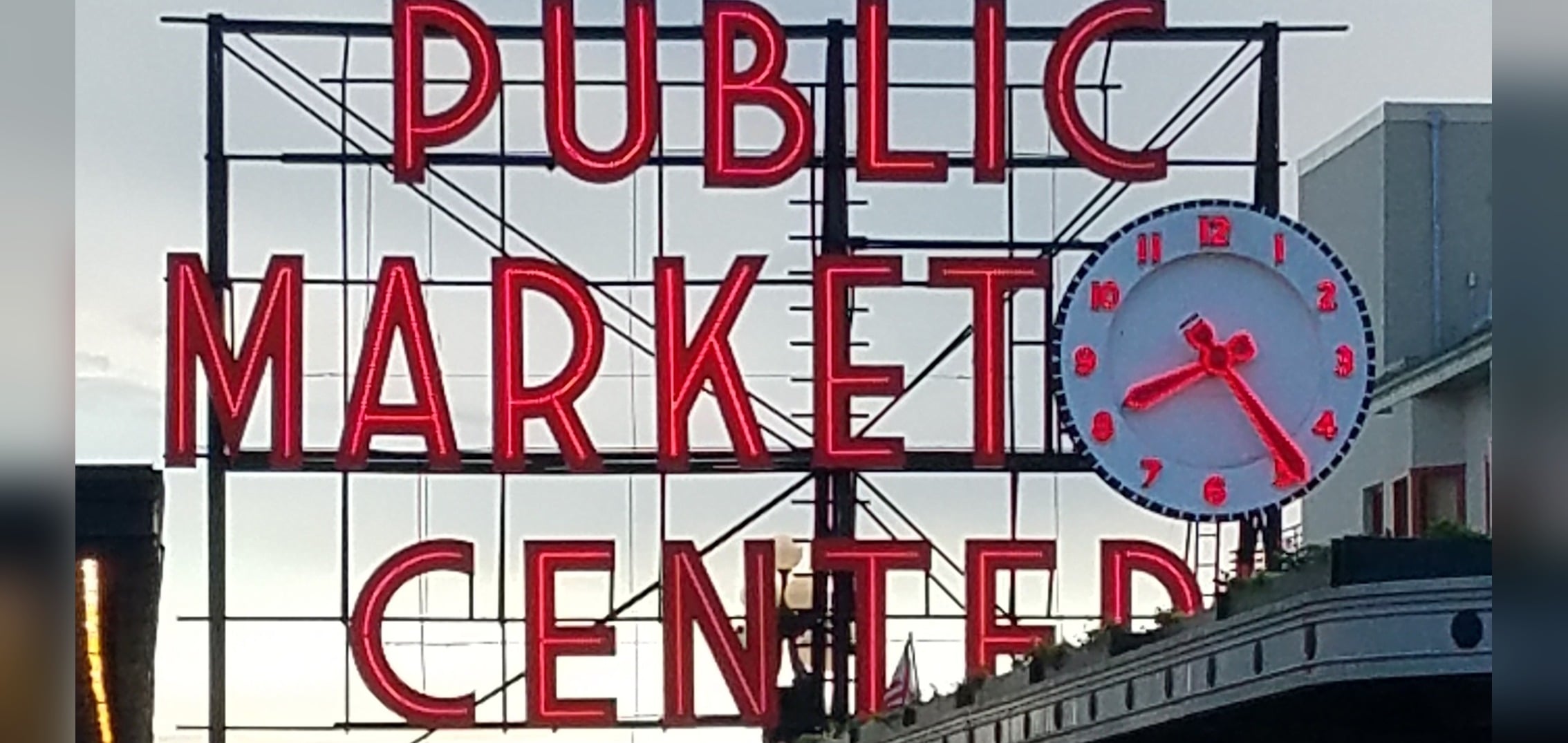
The Main Arcade is the level with the clock and the neon Public Market Center sign, and it holds the fish, the flowers and the produce. The North Arcade beyond it is the open shed where the daystall tables sit.
Pike Place Fish Market at 86 Pike Street is where the fish get thrown. Stand across from the counter rather than beside it. More on the timing of this below, because it is the one thing that argues against going early.
The DownUnder is three lower levels of small shops reached by ramps and wooden staircases, and it is where most visitors never go. Magic shops, comics, maps, a barber, oddities. Many of these open later in the morning than the food stalls above them. If you only have two hours, spend forty minutes down here anyway.
Post Alley below the Market holds the gum wall. It was last cleaned in November 2024, the first cleaning since 2019, and crews deliberately left a heart shaped patch. The gum was back within days and there is no cleaning schedule now. It is free, it is on your way to the waterfront, and it is a thing you walk past rather than a thing you go to.
Rachel is the bronze pig at the corner of Pike Place under the clock, and she is a genuine Washington State object rather than a gift shop prop. Whidbey Island sculptor Georgia Gerber cast her and she arrived in 1986. She is named after a real pig, a 770 pound prize winner at the 1985 Whidbey Island County Fair who happened to be Gerber’s neighbour. She is also a working piggy bank: the coins dropped into her fund social service agencies inside the Market, roughly $20,000 a year.
MarketFront, finished in 2017, is the newest piece and it connects the Market down toward the waterfront with terraces and open space. It has the best view in the complex and almost no crowd, because most visitors never walk that far north.
Three Girls Bakery at 1514 Pike Place opens at 7am, which makes it one of the answers to what to do at that hour. It was founded in 1912 and is believed to hold among the first business licenses granted to a woman in Seattle, two years after Washington women won the vote. The Crumpet Shop at 1503 First Ave also opens at 7am and has been there since 1976. Two places, both open when you should be arriving.
What to skip
The Starbucks line. The store at 1912 Pike Place reopened in June 2026 after a refit, and entry now runs on a timed reservation rather than a queue on the pavement, which is an improvement. It is still a line for a coffee shop. There is also a wrinkle worth knowing while you decide: Starbucks dates its own story to a narrow Pike Place storefront in 1971 and treats this as the original location, but that first storefront was at 2000 Western Avenue, opened on March 30 1971, and the company spent five years there before moving to 1912 Pike Place. So the address you are queuing at is the second one. Both things are true, which is why the argument never quite dies.
Eating at midday. The food in the Market is genuinely good and the lines at midday are genuinely long. The same counters an hour or two earlier cost you a fraction of the wait for exactly the same food.
Trying to see the fish throw on a schedule. Here is the honest trade off in this whole article. There is no fish throwing show. Pike Place Fish throws a fish when a customer buys one, any time between 7am and 5pm. Staff will toss one back and forth to work a crowd, but a crowd has to be there first. Which means the one thing that genuinely works better in the middle of a busy day is the fish. If that is your priority, come at 11am on a Saturday and accept the rest of it.
Driving in and hunting for street parking. Do not. The early bird rate exists and street parking around the Market is a bad use of a morning.
How early should I go to Pike Place Market?
Aim for 7 to 8am if you want to watch the Market wake up. Fresh produce and seafood stalls open at 7, and so do the breakfast counters, while the fishmongers are still building their displays. Farm tables open at 9. By 10am on a summer weekday the aisles are already filling.
How much time should I spend at Pike Place Market?
One hour if you just want to walk the Main Arcade and say you were there. Two to three hours for a proper visit that includes the lower levels. Four hours or more if you are eating your way through it and stopping to shop. Most people underestimate the DownUnder and run out of time.
What time do they throw fish at Pike Place Market?
There is no schedule. Pike Place Fish Market throws fish when a customer buys one, any time between 7am and 5pm daily. Staff will sometimes toss a fish back and forth to work up a crowd, but there is no set show time. A busier hour means more sales and more throws.
Is Pike Place Market a tourist trap?
No, though it can feel like one at noon on a Saturday. It is a working public market where farmers, fishmongers and small businesses actually make their living, and every business in the Market had to start there. Go on a weekday morning and it reads as a workplace rather than an attraction.
Why is Pike Place Market so famous?
It opened on August 17 1907 so farmers could sell directly to the public and cut out the commission houses that were underpaying them. It is one of the oldest continuously operating public markets in the United States, and in 1971 Seattle voters saved it from demolition by public initiative.
What did Pike Place Market used to be?
A muddy street where about eight farmers parked wagons and sold produce off the back of them. Roughly 50 people were already waiting on opening day in 1907 and the farmers sold out fast. A permanent arcade opened that November with more than 120 farmers in covered stalls.
Pick a Tuesday. Set an alarm you will resent. Park before 9 and pay the seventeen dollars instead of the thirty two, get a crumpet, and walk the Arcade while the vendors are still setting up and nobody is asking you to move. For about two hours on a weekday morning, Pike Place Market is not a landmark. It is a few hundred people going to work in a building their city voted to save, and you are allowed to be standing in it.
Before you go
That is the whole idea behind the Explore Washington State Card. Free to carry, with a little something waiting at participating places when you visit. Your zip code is a vote for which towns we sign up next, and our weekly Washington travel newsletter starts landing right away.
Get your free card- About the Author
- Latest Posts
Explore Washington State has been covering the real Washington for more than a decade. State parks, small towns, back roads, rest stops, and the people who make this place worth exploring. What started as a hyperlocal project covering individual communities grew into a full media project with more than 340 podcast episodes, a weekly newsletter with over 6,200 subscribers, and coverage of all 146 Washington State Parks. The content here comes from people who have actually been to these places: locals, regulars, and lifelong Washington residents who care more about getting it right than getting clicks.


