How to Chase Morel Season Across Washington State
Most people think morel season is a two week window. In Washington, it can last four months if you know what you are doing.
If you want to make the most of morel season Washington has to offer, patience is the single biggest advantage you can give yourself. I have been chasing morels across Washington for years, and the one thing I can tell you is that most foragers give up too early. They hear “morel season” and think it means a narrow window in late April or early May. They check their local spot, find nothing or find a handful, and call it done for the year.
That is leaving months of hunting on the table.
Washington is one of the best morel states in the country, and it is not because of any single forest or any single week. It is because of elevation. From the low river valleys on the east side to the high passes of the Cascades, morel season starts in late March and does not wrap up until July. The trick is understanding how to follow the season up the mountains.
This article is the playbook for doing exactly that. We will cover the elevation progression framework, where to hunt by region, how to identify what you are picking, the regulations you need to know, and what to do with your haul when you get home.
Table of Contents
What Makes Washington a Great Morel State
Washington has something most states do not: dramatic elevation changes packed into short driving distances. You can go from a river bottom at 500 feet to a mountain pass at 5,000 feet in less than an hour. That range creates a staggered growing season that stretches morel production across months instead of weeks.
Add in the diversity of habitat and Washington becomes a forager’s dream. The state has old growth forests, managed timber lands, river corridors lined with black cottonwood, alpine meadows, and recent burn areas. Each of these habitats produces morels on its own schedule with its own species. If you are new to mushroom hunting in Washington State, our beginner guide covers the full range of species and where to find them.
The east side of the Cascades is where most of the action happens. The Okanogan Wenatchee National Forest alone covers nearly 4 million acres and is widely considered the most productive morel forest in the state. But the west side has its own game too, especially in landscaped areas and woodchip beds where landscape morels fruit reliably in early spring.
And then there are the burn areas. Morels fruit explosively in forests that burned one to two years prior, a pattern well documented in USDA Forest Service research on morel ecology. Washington has had significant fire seasons recently, and those burns create temporary goldmines for foragers who know where to look.
Morel Season Washington: Following Mushrooms Up the Mountain
This is the core concept that separates a casual forager from someone who hunts morels all spring and into summer. The season does not happen all at once. It moves uphill as temperatures warm.
Morels need soil temperatures to reach about 50 to 53 degrees Fahrenheit before they will fruit. Once the soil hits that range, add some moisture and a stretch of mild weather with daytime highs in the 70s and nighttime lows in the 50s, and the flush begins. That temperature threshold gets met at low elevations first and works its way up over the following months. South facing slopes hit that threshold first because they receive more direct sun. Start your early season hunting there, then shift to north facing slopes as the season progresses. They warm up later and keep producing after the south facing spots are done, which can extend your window at any given elevation by two to three weeks. Later in the season, moisture takes over as the key variable. Exposed burn areas dry out fast in June, and a late spring rain can trigger a whole new flush in ground that is already warm enough. A spot that looked finished after a dry stretch may be worth revisiting after rain.
Here is how the season typically plays out across Washington:
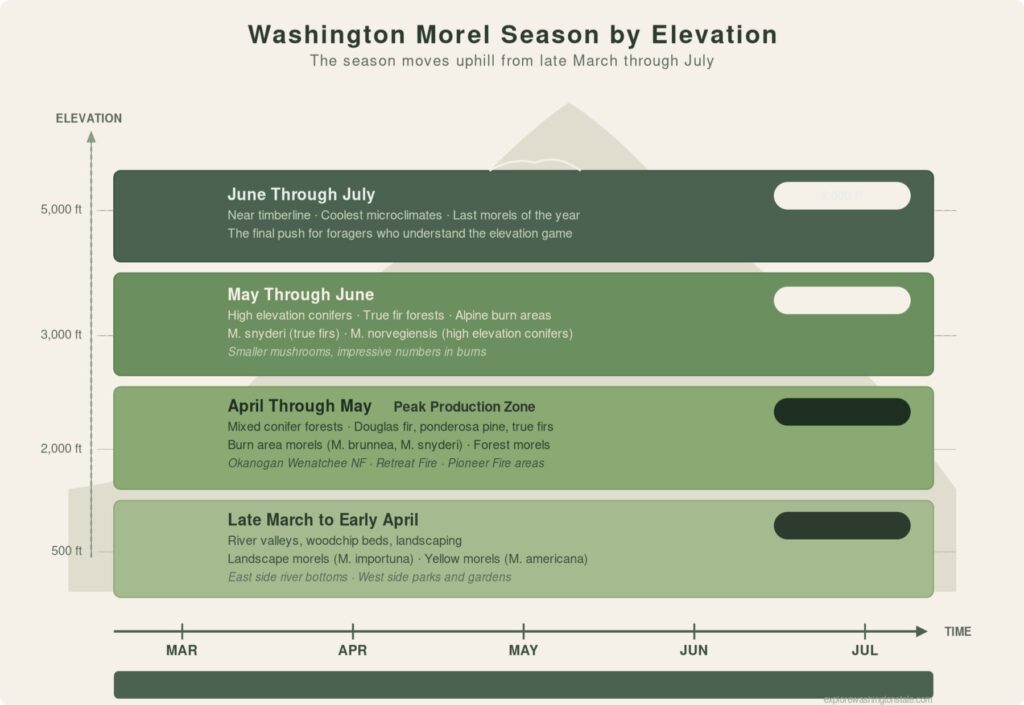
Late March Through Early April: Low Elevation
The earliest morels of the year show up at low elevations on the west side of the state. Landscape morels (Morchella importuna) fruit in garden beds, park paths, and commercial landscaping wherever wood chips or fresh mulch were laid down the year before. These are not the forest morels most people picture, but they are legitimate morels and they are the first ones available.
On the east side, river bottom areas in Kittitas, Chelan, and Yakima counties start producing yellow morels (Morchella americana) associated with black cottonwood and ash trees. These riparian areas warm up faster than the surrounding forest and can produce as early as late March in a warm year.
April Through May: Mid Elevation (2,000 to 3,000 Feet)
As April progresses, the action shifts to mid elevation forests on the east side of the Cascades. This is where the season really opens up. Mixed conifer forests of Douglas fir, ponderosa pine, and true firs start producing, and burn areas from recent fires come alive.
For most foragers, this mid elevation window is the heart of morel season Washington delivers each year, and it is the most productive stretch for volume. If you are only going to hunt one period all year, mid May at mid elevation is your best bet.
May Through June: High Elevation (3,000+ Feet)
By late May, the low and mid elevation spots are winding down, but the high country is just getting started. Morels at 3,000 feet and above on the east side of the Cascades produce from late May through June, with some areas peaking in early June.
This is where species like Morchella snyderi (associated with true firs) and Morchella norvegiensis (high elevation conifers) show up. The mushrooms at this elevation tend to be smaller but can appear in impressive numbers, especially in burn areas.
June Through July: The Highest Elevations
The final push of the season happens at the highest elevations and in the coolest microclimates. Near timberline, morels can still be fruiting into July. These are usually the last morels of the year anywhere in the state, and the foragers who find them are the ones who understand the elevation game.
If you started in late March at sea level and finished in July at 5,000 feet, you just hunted morels for four months straight. That is the Washington advantage.
What to Pack for a Morel Hunt
You do not need much, but a few things make a real difference.
A good field guide is at the top of the list. I keep a copy of Beginner’s Guide to Safely Foraging for Wild Mushrooms by Karen Stephenson in my pack. Having clear photos of both true and false morels in your hand while you are standing in the forest is worth more than any app on your phone.
A small knife makes harvesting cleaner and easier. I use an Opinel No. 8 Mushroom Knife with a curved blade and a built in brush for cleaning caps in the field. Cut stems at ground level rather than pulling, and you will protect the mycelium network that produces next year’s crop.
A mesh bag or onion bag is the right way to carry your haul. The mesh lets spores drop through as you walk, effectively reseeding the forest behind you. Plastic bags trap moisture and speed up deterioration.
A lightweight day pack keeps your hands free and your gear organized. The REI Co-op Flash 22 is a solid choice at 22 liters — right sized for a water bottle, layers, lunch, and a full mesh bag on the way out.
Beyond that, bring water, layers (mountain weather changes fast), a GPS app or printed map for forest roads, and a cooler in the car for the drive home. If you are heading into burn areas, wear sturdy boots because burned terrain is uneven and full of debris. If you are planning to make a weekend of it, check out our guide to camping in Washington State for site recommendations near prime foraging zones.
Where to Hunt by Region
Okanogan Wenatchee National Forest
This is the big one. Nearly 4 million acres of national forest land stretching along the east side of the Cascades from the Canadian border down to the Goat Rocks Wilderness. If you are serious about morel hunting in Washington, you will spend most of your time here. The town of Leavenworth makes a great base camp for accessing the central portion of the forest.
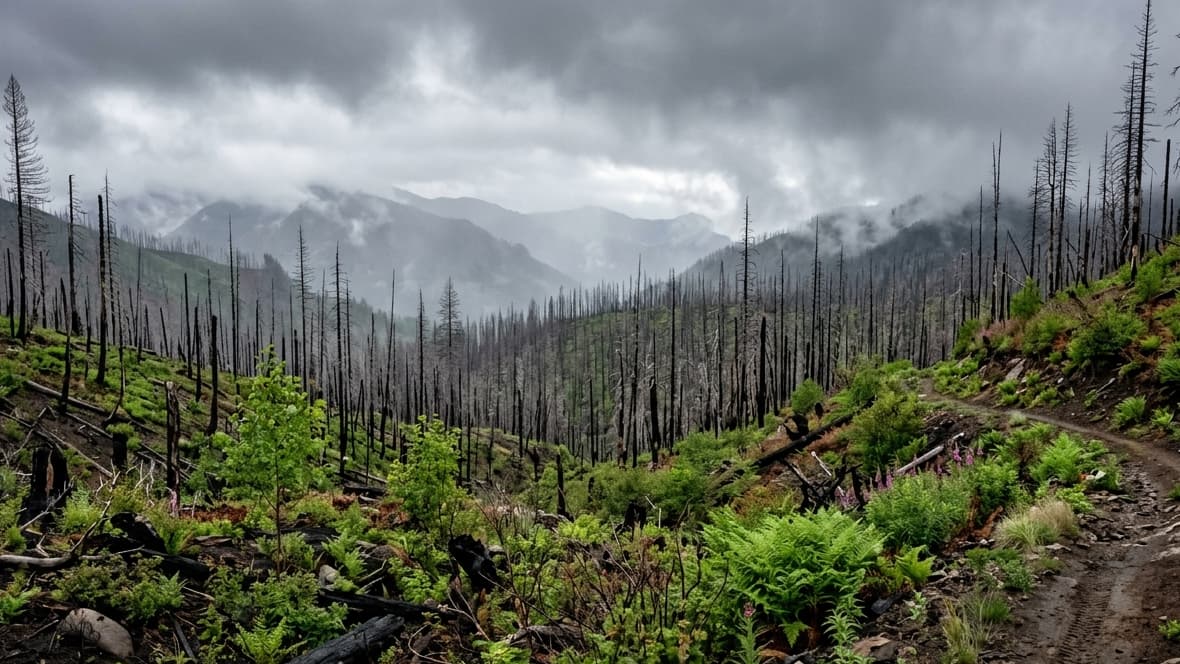
The forest has everything: river bottoms, mixed conifer stands, high elevation alpine zones, and recent burn areas. For 2026, the most promising burn sites include the Retreat Fire area southwest of Naches (45,600 acres, burned July 2024) and the Pioneer Fire area on the north side of Lake Chelan (39,000 acres, burned June 2024). Both of these fires are in the sweet spot at one to two years old, which is when burn morel production peaks. University of Washington researchers have studied this pattern extensively and confirmed that morel abundance spikes dramatically in the first two years after a fire before dropping off. When scouting a burn, look at the edges where some trees survived. Moderate burn severity often outproduces total incineration because the dying root systems at the burn perimeter are what trigger the fruiting response.
Personal use harvest is allowed up to 5 gallons per person per day. You will need to fill out a free Incidental Use Mushroom Information Sheet, which is available at ranger stations. No cost, no appointment needed, just fill it out and go.
Leavenworth makes a natural base camp for hunting this forest. Find vacation rentals in Leavenworth or browse all lodging in Leavenworth.
Mount Baker Snoqualmie National Forest
The west side has its own morel opportunities, and Mount Baker Snoqualmie is the best of them. The Suiattle River Valley, the Stillaguamish River corridor near Granite Falls, the Mountain Loop Highway area, the Baker River drainage, and the shores of Lake Shannon have all produced morels in season.
The timing here runs later than the east side due to cooler temperatures and higher rainfall. A free use permit is required from the ranger district, and there is a 200 foot buffer around nature trails where picking is not allowed.
Gifford Pinchot National Forest
South central Washington, shaped by decades of volcanic activity from Mount St. Helens. The forest has productive morel habitat in its own right, and the Williams Mine Fire area near Mt. Adams (13,100 acres, burned August 2024) is a strong prospect for the 2026 season. A free foraging permit is required.
The river corridors in the forest are also worth exploring. Cottonwood and alder riparian zones along the Lewis and Cispus rivers produce morels in spring as the river bottoms warm ahead of the surrounding forest. These follow their own timing, typically April through early May at lower elevations, and are a different early season opportunity than the burn morels the forest is known for.
Packwood Area (South Cascades)
Packwood sits in the southern Cascades and hits its stride in May. It is a good option for mid elevation timing if you want to work the south end of the range instead of making the longer drive to the Okanogan country. Find vacation rentals in Packwood or browse all places to stay in Packwood.
West Side: Landscaped Areas and Parks
Do not overlook the urban and suburban game. Landscape morels (Morchella importuna) show up in woodchip beds, garden borders, commercial landscaping, and park paths throughout western Washington. They tend to fruit the year after new mulch is laid down and can appear as early as late March. I have found them in parking lot medians, apartment complex landscaping, and city park borders. Keep your eyes open when you are walking around town during early spring.
Morel Identification: What You Are Looking For
True Morels
There are several morel species in Washington, but they all share the same key features that make identification straightforward once you know what to look for. Washington State University has a solid overview of safe mushroom identification practices that is worth reading before your first outing.
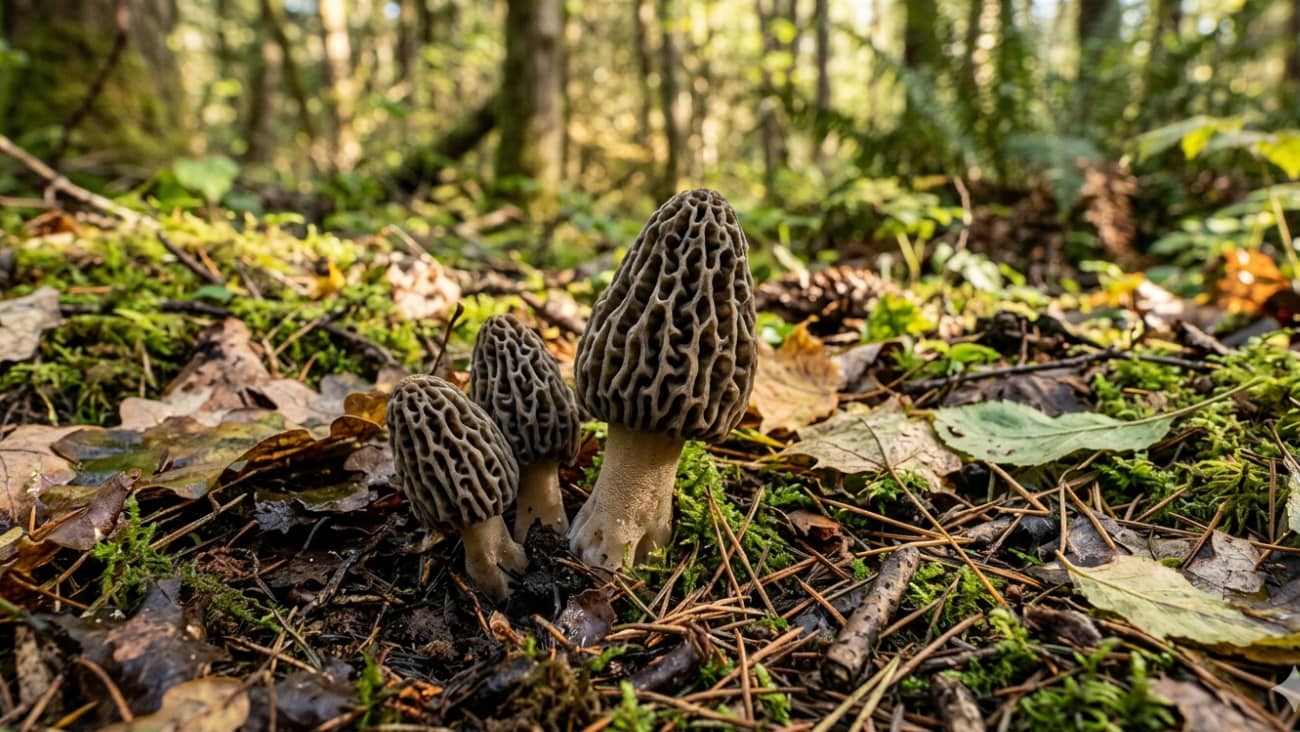
Yellow Morel (Morchella americana): The classic. Pale golden to light brown with a large honeycomb pattern of pits and ridges. This is the most common culinary morel and the one most people picture when they hear the word “morel.” What was historically called Morchella esculenta in North America is now recognized as a distinct species — M. americana is the correct name for the yellow morel found in Washington and throughout North America.
Black Morel (Morchella elata): Gray to nearly black caps that can grow up to 7 inches tall. These tend to appear earliest in the season, often in early to mid May at appropriate elevations.
Burn Morels (Morchella spp.): These are the big prize. Morels fruit explosively in forests that burned the previous year, sometimes by the thousands in the right conditions. First year burns are the most productive, with diminishing returns in years two and three. South facing slopes warm first and produce earliest. Look near partially burned conifers where the dying root systems trigger fruiting.
Natural Forest Morels (Morchella brunnea, M. snyderi, M. norvegiensis): These fruit in an ongoing relationship with living trees and return to the same spots year after year. M. brunnea associates with hardwoods, particularly Oregon white oak, in woodland edges and oak savannas. M. snyderi associates with true firs at mid elevation. M. norvegiensis associates with conifers at higher elevations. Fruitings are smaller than burn morels, but a known spot produces reliably season after season.
The Three Things That Make a Morel a Morel
Every true morel shares three features:
- Honeycomb pattern. The cap surface is covered in distinct pits separated by ridges. It looks like a honeycomb, not wrinkles or folds.
- Completely hollow inside. Cut any morel in half from cap to stem base and the interior is one continuous hollow chamber. No fibers, no filling, no compartments.
- Cap attached at the base. The cap connects seamlessly to the stem at its base. It does not hang free from the top.
If all three of those check out, you have a morel.
False Morels: Do Not Get This Wrong
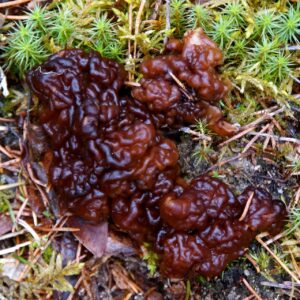
This is the section I take the most seriously, because getting it wrong can make you seriously ill or worse. False morels (Gyromitra species) grow in the same forests, at the same time of year, and at a glance they can look similar to someone who has not studied the differences.
If you packed a field guide (and you should have, see the gear list above), now is the time to use it. A book like Mushrooms of Cascadia by Michael Beug is excellent for Pacific Northwest species. Study the photos of both true and false morels before you start picking.
Here is how to tell them apart:
Cap surface: True morels have a honeycomb pattern with clearly defined pits. False morels have a brain like surface with irregular wrinkles and folds. The difference is obvious once you have seen both side by side, but if you are new, study photos before you go out.
Interior: Cut the mushroom in half from top to bottom. A true morel is completely hollow inside, one open chamber from the stem base all the way through the cap. A false morel has cottony fibers or chambered tissue inside. This is the definitive test.
Cap attachment: On a true morel, the cap is seamlessly attached to the stem at its base. On many false morels, the cap hangs from the top of the stem like a skirt.
The Cut in Half Test
This is the single most important thing I can tell you about morel safety. Every single mushroom you pick should be cut in half before you eat it. Not some of them. All of them.
True morel: completely hollow, one clean chamber. False morel: cottony, fibrous, or chambered tissue inside.
If there is anything inside that hollow chamber, it is not a true morel. Put it down.
Why This Matters
False morels contain gyromitrin, a compound that converts to monomethylhydrazine in the body. According to the National Institutes of Health, symptoms of poisoning include vomiting, diarrhea, severe abdominal pain, and in serious cases liver and kidney damage that can be fatal. Some false morels remain toxic even after cooking.
There is an old saying among foragers: when in doubt, throw it out. That applies nowhere more than it does here.
How to Harvest Without Wrecking Next Year’s Crop
Morels grow from underground mycelium networks that persist from year to year. How you harvest directly affects whether those networks keep producing.
Cut, do not pull. Use your fingers or a small pocket knife to cut the stem at ground level. Pulling the mushroom rips out mycelium and damages the network that produces next year’s crop.
Use a mesh bag. A mesh bag or onion bag lets spores fall through as you walk, effectively seeding new areas as you hike. Plastic bags trap spores and moisture, which can cause your harvest to deteriorate faster too.
Do not rake or disturb the forest floor. Morel mycelium lives in the top few inches of soil and duff. Raking destroys it. Walk carefully, cut what you find, and leave the ground undisturbed.
Cut every mushroom in half in the field. This serves double duty: it confirms identification and it allows more spores to release.
Get low when you are searching. Morels blend into leaf litter and dappled shade more than most foragers expect. Crouching down and changing your angle of view makes a real difference. A mushroom that is invisible standing up will often pop out clearly from a lower vantage point.
Permits and Regulations by Forest
Regulations vary by National Forest and they change. The information below is current as of early 2026, but you should always verify directly with your specific ranger district before heading out. I cannot stress this enough. A quick phone call or website check takes five minutes and can save you a fine. The Puget Sound Mycological Society maintains a helpful compilation of Washington State harvest rules that is worth bookmarking.
Okanogan Wenatchee National Forest: Personal use harvest up to 5 gallons per person per day. Free Incidental Use Mushroom Information Sheet required (available at ranger stations).
Mount Baker Snoqualmie National Forest: Free use permit required from the ranger district office. No picking within 200 feet of designated nature trails.
Gifford Pinchot National Forest: Free foraging permit required.
Washington DNR Lands: Different rules than National Forest land. Check with the specific DNR region you plan to visit.
Commercial harvesting: Completely separate permit system with different fees, limits, and requirements. If you are harvesting to sell, the personal use rules do not apply to you. The Washington State Department of Agriculture has guidance on the requirements for selling foraged mushrooms.
General rules that apply everywhere: Do not rake or disturb the forest floor. Cut stems at ground level rather than pulling. Use a mesh bag to allow spore dispersal. Stay on existing roads and trails to access harvest areas. Pack out everything you bring in.
What to Do With Them When You Get Home
You did the work. You drove the forest roads, hiked the burn areas, and filled your mesh bag. Now comes the best part.
Cleaning
Check every mushroom for insects. Small bugs love to hide in the honeycomb pits, and if you have been carrying them in a mesh bag through the forest, you will likely have some hitchhikers.
Start with a dry pastry brush to knock loose dirt and debris out of the pits. Then soak the mushrooms in hot salt water (about 1 cup of salt per gallon of water) for 4 minutes. This drives out any remaining insects. Blot dry on a clean towel before cooking.
Sauteed (The Classic)
Melt butter in a cast iron pan over medium heat. Place morel halves cut side down and cook undisturbed for 2 to 3 minutes until they start to brown. Stir, then cook another 2 to 3 minutes. The edges should be golden and slightly crispy. Finish with a pinch of salt.
This is the purist approach and honestly the best way to taste a morel for the first time. Once you have the basic saute down, try adding minced shallots, a splash of dry sherry, or fresh thyme.
Pan Fried
Dredge morel halves in seasoned flour (salt, pepper, maybe a little garlic powder) and fry in butter until golden and crispy on all sides. This gives you a crunchier texture and works great as an appetizer or side.
Roasted
Toss halved morels with a light coating of oil, salt, and pepper. Spread on a sheet pan and roast at 400 degrees until lightly browned, about 12 to 15 minutes depending on size. The dry heat concentrates the flavor.
A Note on Cooking Before Eating
Always cook morels before eating them. Raw morels contain compounds that cause gastrointestinal distress. The FDA investigated a morel related illness outbreak in 2023 that underscored the importance of proper preparation. There is no good reason to eat them raw when they taste so much better cooked anyway.
Frequently Asked Questions
When is the best time to hunt morels in Washington? There his no single best time because morel season Washington moves with elevation. Low elevation spots can produce as early as late March. Mid elevation forests peak in mid May. High elevation areas produce into June and July. The “best” time depends on where you are hunting.
Do I need a permit to pick morels in Washington? On National Forest land, yes. The specific permit type varies by forest, but most require a free personal use permit or information sheet. Always check with the ranger district for the forest you plan to visit. DNR lands have separate rules (a Washington State Discover Pass is required for parking at DNR trailheads).
Where is the best place to find morels in Washington? The Okanogan Wenatchee National Forest on the east side of the Cascades is the most productive overall. Within that forest, recent burn areas (one to two years old) are the highest yield spots. For 2026, the Retreat Fire area near Naches and the Pioneer Fire area near Lake Chelan are strong prospects.
How do I tell a real morel from a false morel? Cut it in half. A true morel is completely hollow from stem base through the cap. A false morel has cottony or chambered tissue inside. True morels also have a honeycomb pit pattern on the cap, while false morels have irregular brain like wrinkles.
Can I find morels on the west side of Washington? Yes. Landscape morels (Morchella importuna) fruit in woodchip beds, garden borders, and park landscaping throughout western Washington in early spring. Forest morels also grow in the Mount Baker Snoqualmie National Forest, particularly along river valleys.
What do I do if I am not sure whether a mushroom is a true morel? Leave it. The rule is simple: when in doubt, throw it out. Never eat a mushroom you cannot positively identify. Consider joining a local mycological society like the Puget Sound Mycological Society or the Kitsap Peninsula Mycological Society and taking a guided foray before hunting on your own.
When to look for morels in Washington? Morel season runs from late March through July depending on elevation. Landscape morels at low elevations start in late March. Mid elevation forests on the east side peak in May. High country above 3,000 feet produces into June and July. The simplest trigger to watch: soil temperatures reaching 50 degrees Fahrenheit at your target elevation. When the ground hits that threshold, the season is on.
What is the trick for finding morels? Follow the soil temperature, not the calendar. Morels fruit when soil hits 50 degrees Fahrenheit and they fruit fast once conditions are right. Start on south facing slopes because they warm first and produce earliest at any elevation. Once those spots wind down, shift to north facing slopes, which hold cooler soil longer and keep producing after the south facing areas are done. That one tactical shift can add weeks to your productive season.
Why are morels so expensive? Morels cannot be commercially cultivated, so every morel in a restaurant or grocery store was foraged from the wild by hand. The harvest window is short, the habitat is remote, and the mushrooms are fragile and highly perishable. Commercial foragers might hike miles of rough terrain to fill a single basket. There is no off-season supply and no farm equivalent. Fresh morels typically run $30 to $60 per pound, and dried morels cost even more.
How fast do morels pop up overnight? Faster than most people expect. Under the right conditions, soil at 50 degrees Fahrenheit or warmer, adequate moisture, and mild weather, morels can go from invisible to full size in 12 to 24 hours. This is why experienced foragers revisit productive spots every two to three days during peak season rather than waiting a week between visits. A spot that looked empty Tuesday can have a pound of morels by Thursday.
Recommended Books and Gear
If you are serious about morel hunting, these are the resources I recommend keeping in your pack and on your shelf.
Field Guides and Books
Mushrooms of Cascadia, Second Edition by Michael Beug. The best Pacific Northwest focused mushroom reference available. Detailed species descriptions, regional habitat info, and excellent photography. This is the book I recommend for anyone foraging in Washington.
Beginner’s Guide to Safely Foraging for Wild Mushrooms by Karen Stephenson. A practical starting point for new foragers covering identification, safety, and sustainable harvest practices. Great to keep in your pack.
Morel Support: A Beginner’s Guide to Harvesting, Preserving and Cooking Morel Mushrooms by James Phares. Morel specific from start to finish. Covers finding, harvesting, preserving, and cooking morels with a focus on getting the most from your haul.
Go Forth and Forage by Whitney Johnson. A broader foraging guide that goes beyond mushrooms into wild edibles. Good for foragers who want to expand their range beyond morels.
As an affiliate, we earn from qualifying purchases at no additional cost to you.
Foraging Gear
Opinel No. 8 Mushroom Knife: A curved blade with a built in brush for cleaning caps in the field. Cuts stems cleanly at ground level to protect the mycelium underneath.
Podcasts
Exploring Washington State with Daniel Winkler: A conversation with one of the Pacific Northwest’s most respected foraging experts on mushroom hunting culture, where to look, and why Washington is one of the best places in the country for wild mushrooms.
Explore Washington State is committed to providing accurate, practical information for exploring everything this state has to offer. Morel hunting regulations and fire area conditions change frequently. Always verify current rules with your local ranger district before heading out. Happy hunting.
- About the Author
- Latest Posts

Founder and editor of Explore Washington State since 2017. A lifelong Washington resident who has lived across Tacoma, Ellensburg, the west side, and now Wenatchee, Scott curates the most comprehensive guide to experiencing Washington State. He also hosts the Exploring Washington State podcast.


