Exploring Washington State with Daniel Winkler: Foraging, Mushrooms & The Grateful Dead
Daniel Winker, a passionate treasure hunter, embarks on a journey to explore the captivating and often overlooked world of mushrooms in the Pacific Northwest, a place of great abundance, but also of hidden dangers and cultural heritage.
You will learn:
1. What is the impact of colonial powers on native cultures and their foraging knowledge?
2. How does one safely identify and forage for edible mushrooms?
3. What is the history and culture of the Grateful Dead, and how has it influenced Daniel Winker?
Daniel Winker is a mushroom travel researcher, author and photographer born in Munich, Germany and living in the greater Seattle area. He is the founder of the website Mushroaming, which focuses on the exploration of mushrooms and their ecology.
Daniel Winkler Mushroom Episode Transcript
Hello, friends, and welcome to the Exploring Washington State podcast. My name is Scott Cowan, and I’m the host of the show. Each episode, I have a conversation with an interesting guest who is living in or from Washington State. These are casual conversations with real and interesting people. I think you’re gonna like the show. So let’s jump right in with today’s guest. So my guest today is Daniel Winkler. Full transparency, everyone. Daniel and I sat down and talked for an hour a half the other day, and I didn’t hit the record button. So
Daniel Winkler [00:00:35]:
It was still fun.
Scott Cowan [00:00:36]:
It was still fun. It was a lot of fun, but you guys didn’t get to listen to it. So we’re we’re back today. So you can listen to what Daniel has to say. Daniel is the what’s the word I wanna use? He has a website called mushrooming, which is an interesting name. And he’s also a published author on mushrooms. A travel guide, I guess, for mushroom travel. Researcher? What is it with mushrooms that you don’t do? How about that? Maybe that’s the short question.
Daniel Winkler [00:01:07]:
Okay. I’m not much of a cultivator.
Scott Cowan [00:01:10]:
Okay. So
Daniel Winkler [00:01:11]:
I’m I’m much more of a pressure hunter than the cultivator. You know? Okay. So what is the the sweat of your brow or whatever. Now I’d rather go out in the woods and find treasures that’s
Scott Cowan [00:01:21]:
— Okay. —
Daniel Winkler [00:01:22]:
that’s more exciting, but
Scott Cowan [00:01:23]:
— That’s that’s okay.
Daniel Winkler [00:01:25]:
I really admire mushroom cultivators. It’s it’s like magic Cowan but I just never got deeply into it.
Scott Cowan [00:01:31]:
Okay. So you grew up in Europe. Obviously, your accent gives that away And when we talked before, you said something, and I wanna go back and I’m gonna probably reference a lot of our previous conversation with my questions today. But one of the things I’d like you to to to let’s let’s talk about is you kind of painted a picture that in in Europe, foraging is is a is a very popular pastime. And here in North America, especially for mushrooms, there’s a little bit maybe trepidation.
Daniel Winkler [00:02:08]:
That’s one way to put it.
Scott Cowan [00:02:10]:
Why why do you so you grew up as a as a young kid. Your parents took you out. I was reading your bio and, I think you you you your bio says you went on your first mush roaming tour with at 7. You convinced friend’s parents to go out there. I I think we should talk about that. But but as a young as a young kid, you were out picking mushrooms out out in the forest And we don’t necessarily see that much of that here in in North America, Washington state. Why do you think that is?
Daniel Winkler [00:02:44]:
So there’s a couple factors. So the one thing is that, of course, in Europe with traditional societies that people have a much stronger connection to the locality. And, I’m more connected to what the environment offers to them. That’s one factor. And but you see, like, here, blackberries in the Seattle area, that’s how it should be. You know, there’s something super tasty out there. You know enough that you that you’re aware. You’re not gambling your life away. And there you go. And you have a great time. And, yes, you get poked and and smeared and everything, but it’s so sweet and tasty. And So, you know, and that’s a little bit with the mushroom hunting thing is is, you gotta know what you do and you know it’s safe. And and you’re good to go. And
Scott Cowan [00:03:38]:
— Okay. —
Daniel Winkler [00:03:39]:
the big problem is that the fear that that you kill yourself by mushrooms is so irrational. You know? And, it’s just it’s it’s it’s a really heavy burden, British heritage. And it’s not all over Europe. There’s there’s quite interesting cultural differences between different European tribes and the love for mushrooms or also food substances, you know, and preferences. And there’s wine cultures and beer cultures and, you know, and the different breads and so on. And so the mushroom too, and it’s just there’s no other place like the UK when it comes to being completely ignorant, about mushrooms.
Scott Cowan [00:04:25]:
Okay.
Daniel Winkler [00:04:25]:
And and that’s our heritage here, or you go to our Australia too and and New Zealand and and, you know, for the people now, they are just cover they have mushrooms, and they’re so excited. And it’s so cool. It’s like, How long are you there now? You know, well, before we thought we’re gonna kill ourselves. And, yeah. So — Okay. An interesting aspect out here is also native heritage and, you know, European take over. And, unfortunately, you know, whenever the colonial power showed up here, the native cultures were hit so hard already by the viruses that, you know, what are the figures that 80, 90 percent of the population was already dead? Before, the Europeans pushed in. And with that, so much knowledge and culture got lost. And you know, and the people didn’t come here and say, hey. Cool. What mushrooms are you guys foraging? So, you know, there is very little record of that. And also here, especially in the Pacific Northwest, mushroom season is when salmon season is, and that is hard to compete, I think. That explains why mushrooms are not as, as sought after as one would think knowing how many chantrels and Matsutaka and police and morals and all what we have out here I I think, you know, the the salmon made it a little too easy for the people.
Scott Cowan [00:05:58]:
Okay. So I’m gonna read part of your long you’re a longer fungal resume, and I’m gonna stop because if you can’t tell, words escape me sometimes, but I’m gonna ask you to fill this in. Daniel grew up in Munich Barbaria and started hunting. What? What is the name of this mushroom that is your state? Stein Pills. Okay. And these are your favorite edible mushroom.
Daniel Winkler [00:06:26]:
Right. So this is the Kimberley Porchini. And we have plenty of them here. We have, 5 different species that are very Winkler. Even the identical one of the identical species we have here too, or at least the taxonomists have not there to change the name yet. And, yeah, and, like, you live in Wenatchee and, oh, man, the spring king is one of these beliefs is, you know, you just have to drive half an hour Cowan hour and and there you are in sprinkling heaven in June. No.
Scott Cowan [00:07:02]:
So I’m gonna put you on the spot. I’m gonna drive a half hour. Which way am I going?
Daniel Winkler [00:07:06]:
You go back into the mountains.
Scott Cowan [00:07:08]:
So towards leavenworth then?
Daniel Winkler [00:07:09]:
Yeah. So it’s leavenworth or up any other of the the the rivers that come down to the Columbia.
Scott Cowan [00:07:16]:
Okay.
Daniel Winkler [00:07:16]:
And there in the Pine for a habitat, you find in spring when there’s enough moisture in the ground, you find these really firm big sprinkings. And, easy to identify, very tasty. And I already know there’s somebody in Wenatchee that’s gonna be really up said when when when that is shared like that, but it’s it’s common knowledge in the mushroom community. And, you know, there’s good years. There’s bad years. And it’s it’s it’s all about timing and and locality. So you gotta put your time in to figure it out. But once you get the hang of it, you know, you can you can use that year after year. And, of course, the best is you team up with people who have knowledge, you search the internet, you get yourself the right books, and, and then you’re good to go. And maybe not that the first time when you try the first time, but if you are persistent, you’ll you’ll score and, you know, in the end, you just look back and say, wow. Yeah. It was hard in the beginning, but once you get the hang, it’s easy.
Scott Cowan [00:08:23]:
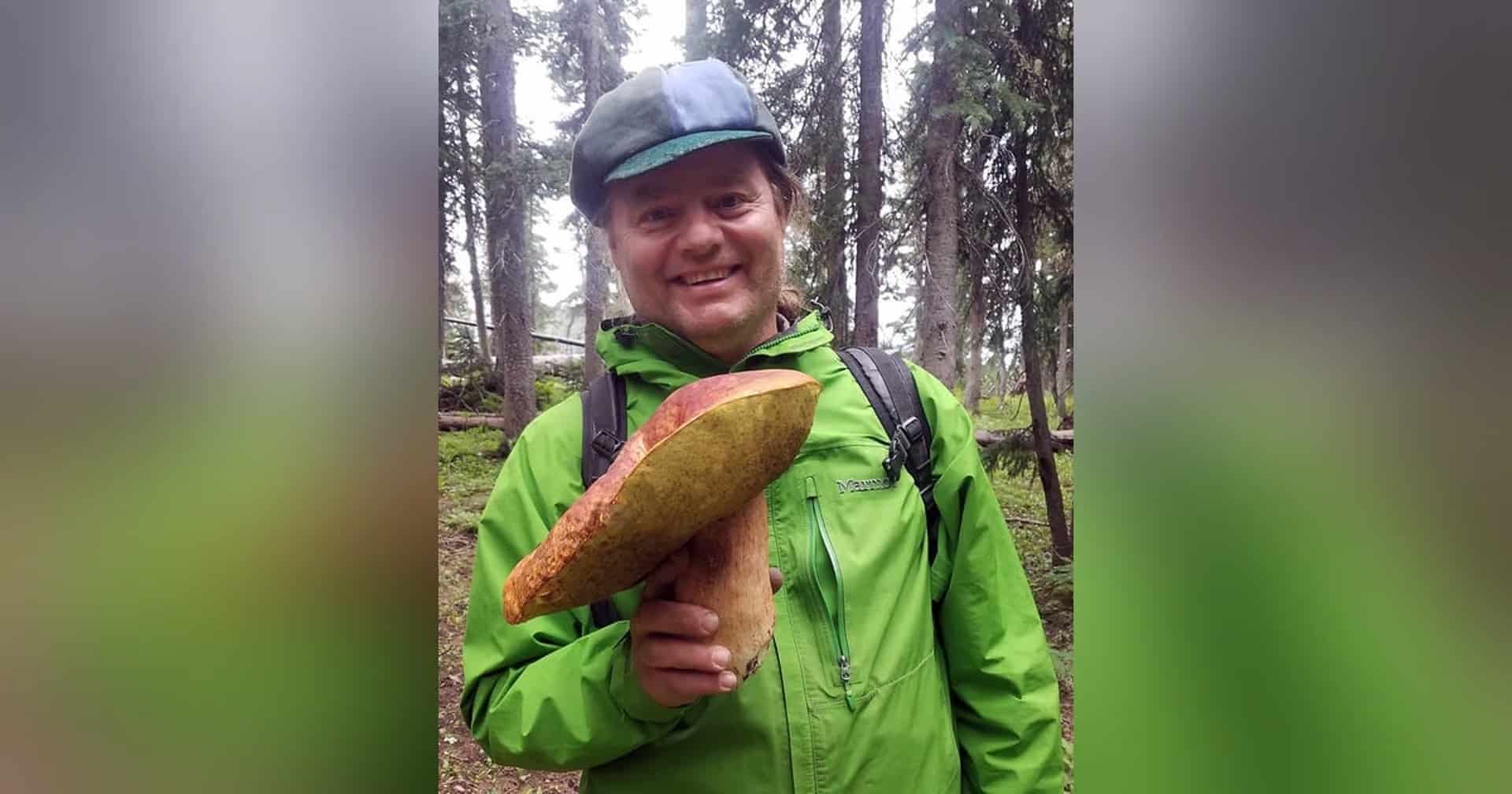
Okay. So the last thing on your bio page, two questions. There’s a photo of you, and you’re holding a large mushroom in your hand.
Daniel Winkler [00:08:32]:
Mhmm.
Scott Cowan [00:08:33]:
What is that mushroom?
Daniel Winkler [00:08:34]:
So that is, again, the Kingval lead.
Scott Cowan [00:08:36]:
Okay.
Daniel Winkler [00:08:36]:
And, that’s in the cascades. And that’s hiking, what was that that was late August, early September. So these whenever we get early rains, or summer rains, August, early September. That’s just perfect for these mushrooms. They like it. They like it a little warmer than than many of the other fall mushrooms.
Scott Cowan [00:08:58]:
Alright. This is the important question. In that photograph, you’re wearing a tie dyed shirt. And I cannot I cannot make out what is on the shirt.
Daniel Winkler [00:09:10]:
I actually removed that. I don’t know. I was a fool, but it it’s a drugstore orchestra.
Scott Cowan [00:09:15]:
Okay. Alright.
Daniel Winkler [00:09:16]:
So, yeah, I do enjoy that’s a benefit in playing, reenacting, grateful dead shows, so a tribute band. By now, I heard we have about 800 Grateful Dead tribute bands.
Scott Cowan [00:09:28]:
Are you kidding me?
Daniel Winkler [00:09:29]:
Yeah. The music is alive. You know? It’s it’s wherever you go in the US, you have in every city, you have dance where the music never stops and just keeps going and turns the orchestra were one of the early ones. And, last September, I was lucky enough to go home to Munich visit family and also joined Durks, the orchestra redoing the Europe 72 tour. So which was nice guarantee for our shows.
Scott Cowan [00:09:59]:
So — Yes. Yes. That would be okay. So we both know that we both enjoy the Grateful Dead because of our previous our previous non recorded conversation, but But Daniel and I have this, a shared affinity for the, jam band, music and, the Grateful Dead.
Daniel Winkler [00:10:16]:
And so — And the mushrooms do figure there too. Right?
Scott Cowan [00:10:19]:
They do. So now the other I I guess I lied. There’s one other thing I need some clarity on. So you’re you described the the steinpoles pills as your favorite edible mushroom. Now why add the word edible?
Daniel Winkler [00:10:35]:
Oh, because well, we have so many mushrooms out here. And, you know, let’s say we have maybe a record of 400, 5000 mushrooms in the Pacific Northwest. So that’s what you can see with your eyes. If you go microscopic, we don’t know what we have, but many, many more. And but, you know, this is like what has been accumulated over century or so. So when we do our mushroom shows and our psychological societies in fall and, you know, the members go out and pick mushrooms and, you know, in Seattle, some might drive to the coast, some drive to the mountains to bring mushrooms. In Seattle, we are happy when we get, what’s our number? Usually, is it a 160 or 250, something like that? In Eugene, they get a 100 mushrooms more per year because they have all these oaks and ashes. So they have more diversity K. So, you know, it it’s it’s much more realistic to talk about 100 of mushrooms, when you go out in the in the woods. And But out of the hundreds, you know, I’ve eaten I’ve eaten, over 200 mushrooms here, maybe 300, and so there’s way more edible mushrooms than there’s really poisonous or toxic mushrooms. And there’s so many way you just don’t bother because they’re too small or, you know, just who knows and, in other countries, we do have protected mushrooms species in the US. We don’t have any legislation to that. Washington State has 1 protect at mushroom, which is a giant polypore that gets 4 or 5 feet across, and it’s only in all growth forests. And Prico Porris. And, you know, since we have taken out, what is it? 95 percent of the old growth forest, of course, that hits a mushroom like that.
Scott Cowan [00:12:37]:
Right.
Daniel Winkler [00:12:39]:
So none edible mushrooms. There’s a lot of beauty and very interesting, ecological functions, also medicinal functions. A whole bunch of our medicinal mushrooms are extremely bitter And so, you know, that disqualifies them from, from the cooking part. Those some people, you know, add that to make teas and coffees like Rishi, the Danodrama, the lack of conk and then drink these extremely bitter teas. And, you know, we can get used to all of it. It’s like, Well, nobody started drinking coffee beer or or wine and say this tastes great at the first take.
Scott Cowan [00:13:20]:
Right? I liked coffee from the very beginning. You did? I did. Yes. But truthfully, I didn’t like beer from the very beginning.
Daniel Winkler [00:13:28]:
Yeah. No. Coffee, I I like the smell. But I’m now drinking since 2 years for writing the book. I started to drink it in the afternoon. So I had a productive session in the afternoon, And, it’s a powerful drug. My god. I I, you know, I I I was impressed and it really helps helps me, focus and being productive in the afternoon. But, you know, I don’t wanna have I don’t wanna end up, like, 10 cups a day or 5 cups a day
Scott Cowan [00:14:00]:
or so. That’s that’s you you you’d be fine at 10 cups a day. It’s you
Daniel Winkler [00:14:03]:
can do. I’ll do my green tea. I do my 10 cups an
Scott Cowan [00:14:05]:
a cup of green tea. Okay. Yeah. See, tea hits me differently than coffee does. That’s interesting. Okay. So I’ve now bounced over to your presentations page one of the things I think that you do that’s kind of interesting is you’re also your own photographer.
Daniel Winkler [00:14:22]:
Oh, yeah. It’s it’s there’s I love photographing mushrooms. I mean, there’s the bonus. They don’t run away. Yes. You have to find them. Okay. The wind is most of the time, no problem. Like, you know, when I try to take orchid pick, and then the wind moves these things. It’s just such a challenge. It’s really harsh on the equipment. Because you’re out there when it’s wet and hands get dirty and cameras get dirty too. So, but it’s it’s just amazing what you can see and and, you know, and then with macro photography. So when you really can see details, And now when I got into photo stacking where, you know, I take maybe 10 or of a little thing, I take 50 or 80 different photos and then with a software, Hilicon software, then that makes one picture out of it. And every tiny detail is in focus Like, your eye can’t even focus on a thing like that. And and that’s that’s just such beauty. And then I drag it through Photoshop, work on contrasts, and and colors and light. And and then, you know, it’s just amazing, you know, what’s out there and how you can see it. And, and, you know, when so many people, we go through life and don’t even notice mushrooms. And if they maybe see one, they step on it because it’s a danger to their survival. But once people start stopping and looking, it had so much enjoyment to their life. It’s amazing.
Scott Cowan [00:16:02]:
Yeah. No. Absolutely. So you Going back to what something said. The 1 the 1 mushroom in Washington State that’s protected. You you said that it it grows to 4 feet across?
Daniel Winkler [00:16:12]:
Yeah. 4 or 5 feet across, it’s a polypore. So it’s a conk. Very tough. It’s very hairy on top. And it grows on ancient giant, I don’t know if it’s Douglas first. Some conifer. I’ve only seen it Wenatchee, and we keep where we find them. We don’t share the locations. Besides a few people who work on these things so that nobody goes there and, you know, Gus trophy hunting. And So down below, it’s even hard to recognize because it’s so big Cowan it gets so old that lots of debris will fall on top of it.
Scott Cowan [00:16:54]:
So so how long? So — How
Daniel Winkler [00:16:57]:
long does it take to grow to that side? Yeah. Oh, I I would guess decades. You know?
Scott Cowan [00:17:02]:
Oh, okay.
Daniel Winkler [00:17:04]:
Yeah. So because it’s it’s it’s a conk. It’s a woody mushroom. So it adds on each year. Okay. And that’s on the layer, and it gets a little wider. And, so, like, a Garikon is another famous conc, and that can definitely get fifty, eighty years old, and it adds each year a little bit. And, so you know, but we have on the other side, we have regular mushrooms, cap and guild mushrooms that are just up there for a couple hours, you know, and they just grow their food. They release their sports, and then they disintegrate. So
Scott Cowan [00:17:41]:
— See, that’s my my my very my very layman’s knowledge about mushrooms is that. That’s what I was expecting. And so I was trying to figure out how this thing would grow 4 feet big
Daniel Winkler [00:17:52]:
White. It’s more white.
Scott Cowan [00:17:53]:
White. But how it would do that in a very brief period of time? I had no idea that, there are mushrooms that that lasts for years low decades. So that so that’s kinda my point.
Daniel Winkler [00:18:06]:
You’ve seen the kongs on trees, the shell fungi, you know, like, the red belted conk. You see these things growing out of a dying tree that looks very woody and rounded, like, some people call them hoof shaped, And so these things, they they are perennial. Some of them are perennial and, you know, but not I mean, often the tree dies, but once the mushroom is in there, the they eat the tree. And then the tree will disintegrate and, you know, it all collapses and They have done their job. And so, to you gotta have a special as a parasite. You have to have a special strategy that you keep your host alive for for decades. Right?
Scott Cowan [00:18:47]:
Right. Right. Okay.
Daniel Winkler [00:18:49]:
That’s so not all of them manage that.
Scott Cowan [00:18:55]:
Well, since we’re all about Washington State and you you were you were born in Germany, what brought you to to Washington?
Daniel Winkler [00:19:04]:
So my wife, moved me over here. We met before in Colorado, and, originally, I came to the US to follow the grateful dead around. So, discovered them in 1981 when they were touring Europe and, didn’t know what it is, but fell in love with it. And, nobody would talk about them. You know, I mean, anybody who heard grateful deadshot, heavy metal, you know, it’s the years of heavy metal and in in, you know, I was born in 64. So this was in the early eighties, and the media in Europe would not write a the grateful dad. I mean, that was, you know, that was in the early seventies that they would pay attention. And so that brought me over here, and I definitely fell in love with the environment, the openness of the people. I mean, that’s just, you know, in Europe, everybody sits on their piece of land for how long. And even if this movement, but, you know, and then especially the Germans are much more careful in reaching out. You make a friend and you have that for much longer. And then when they come to the US, they get all upset. I thought I made these great friends, and now they they’re not interested in me anymore. So they were just friendly when you met them. You know?
Scott Cowan [00:20:19]:
Okay.
Daniel Winkler [00:20:21]:
And, anyway, so that brought me here to the US, and and I’m so happy here with having all these vast forests and the nature and, you know, still living here in in Seattle, suburbia, having the Eagles fly over my yard. I mean, you know, you don’t get that in Europe anymore. And, yes, there’s a few Eagles here and there still, and they’re coming back luckily. But, Yeah. The mushrooms, much less competition. I mean, a lot of people are really fed up how many people now pick mushrooms. And when I got here and I just went on the highway, took the first exit, went into woods, and found tons of chantrels. That’s not happening that way anymore. That was in the mid nineties. K. And I did my fair share teaching 100100 of people. Often in connection with the Puget Sound psychological society and and our classes, how to find edible mushrooms, and That’s perfectly fine. There’s so much in the woods. Okay. Now you gotta go a little further. You know? It’s not enough to go your two hundred yards. But if you go a mile in, there is no competition. And unless you know, maybe, okay, it’s a it’s a like Oregon and matsutake commercial collection area, then people go deep or morale but still, there’s so much for everyone. It’s it’s just beautiful.
Scott Cowan [00:21:48]:
Important question. Best Grateful Dead Show in Europe and Best Grateful Dead Show in North America.
Daniel Winkler [00:22:00]:
Hey, Scott. When when we gonna have to talk about my book?
Scott Cowan [00:22:04]:
Oh, we will. We will. But you gotta answer this question because this is you are one of few people I’ve ever had the luxury of chatting with has seen the dead in Europe. So that — Yeah. — is to me.
Daniel Winkler [00:22:15]:
Well, in the US, I I really liked the environment. I think it was Park West, Utah. Yeah. September. 84 just outside in the mountains, you know. I didn’t go to Telluride. I didn’t catch when they played Telluride. I was a fool. I saw the end of that too. That would have been the place, definitely. I really like, high school gym in Augusta Maine That was just so small.
Scott Cowan [00:22:43]:
That was cool. — to see that show?
Daniel Winkler [00:22:45]:
Yeah. Yeah. An awesome morning view. I mean, it just got all the best songs and,
Scott Cowan [00:22:50]:
Okay.
Daniel Winkler [00:22:51]:
And then in Europe, maybe maybe Berlin 90 because I was living in Berlin and I have bought, for all my friends and and all the other dead hats we know knew and know 25 tickets in the first two rows. You know, just going up to the counter there with cash and getting the first two rows Okay. So that was that was pretty cool. And,
Scott Cowan [00:23:18]:
— Alright. Yeah. Okay.
Daniel Winkler [00:23:20]:
It’s Ventura, California on the beach was was was awesome too. Nice.
Scott Cowan [00:23:26]:
So your latest book. Fruits of the forest. It’s a field guide to Pacific Northwest Edible mushrooms. This is how many books have you written now?
Daniel Winkler [00:23:36]:
That’s my first proper book. I did a whole bunch of mushroom fold outs before and wrote dozens of, articles, scientific articles and and popular stuff. So, Yeah. So I had to do that. You know, it’s it’s always when you just end up, writing, you know, the smaller, more concise stuff that I was scared. It’s big. You know, it takes so much time. It’s it’s it’s a lot of Cowan I did it all alone, which which is just, you know, you know, there’s describing mushrooms. I mean, the the the nice part writing about them, you know, infusing it with all my background knowledge, with all the ethnomycology about mushroom appreciation and other cultures and how you best work with it and, you know, fun anecdotes. I mean, this was also awesome to do, but that’s done quickly. You know, that flows. But then when it comes to the scientific descriptions, you know, where you just gotta be precise, and you gotta wanna find a balance between not making it accessible without, you know, without leaving out important details and then finding the right terminology. I mean, so much in in mycology and botany is terminology. And all these words, which most forages around the world don’t have to book you don’t need to be able to put a word to the little details you’re looking at but that’s science and especially because the science started at a point where printing was basically unaffordable. And by now, you know, we can have images on all our devices and we can take them with us in the forest So we can do so much more with, recognition by eyesight, and that’s what we’ve trained for 1000000 years to recognize things. Just imagine if he would start scientifically describing faces to recognize people. I mean, just impossible to write down the differences between the faces of your friends.
Scott Cowan [00:25:54]:
Right.
Daniel Winkler [00:25:54]:
So that you by reading the description, you can say, oh, this gotta be this friend. This gotta be that friend.
Scott Cowan [00:26:00]:
Right. Right. No. That’s — —
Daniel Winkler [00:26:01]:
with a with a one view, you know, exactly who it is because that’s what we trained for evolutionary. And so also mushroom hunting, any kind of foraging, we trained for 1000000 years to recognize organisms that support us and to recognize organisms, we better stay away from. And we just got a little bit out of touch with that. And this is not so hard to get back to it. And one key information is that, you know, do I deal with something where the is dangerous look alikes?
Scott Cowan [00:26:34]:
Mhmm. And
Daniel Winkler [00:26:35]:
like with the blackberry, hey, we nobody tells us watch out because there’s a deadly red nightshadeberry that might it’s it might be growing right in middle of the the blackberries. You know, well, one is purple. The other one is red. So not a big challenge. Well, it could grow with your strawberries or your raspberries. But that’s just the the stigma mushrooms have that everything is is is so dangerous, and it’s your life on the line. And but cherry picking is just something luckily we kept through. We kept up and we all enjoy it, and we don’t worry about our kid picking berries. Right? Right. Actually, one neighbor got really upset when my five year old daughter taught their kids to eat. And, you know, because it wasn’t strawberries. It wasn’t raspberries. And and and so they were totally alarmed that our little daughter taught that other kid that she can eat salarberries, but, at first, we didn’t get it when she just described it to us. We didn’t realize what it was, so she had to take us there and show us. Okay. Yeah. Yeah. We told you, Dave, I had a boy. You’re right. So even a five year old, you know, can can be a perfect forager. And, because, you know, that’s just what the evolution they have been done we got into this whole agricultural thing that, you know, messed up a lot of things and, helped us to multiply way beyond sustainability.
Scott Cowan [00:28:11]:
Right. So I got some questions about the book for the process of it. But the first question is, what was your reaction when you saw it for the first time? And where did have you seen it in the wild, so to speak? Where was the first place you’ve seen it on the shelf?
Daniel Winkler [00:28:30]:
Well, I got a picture from the publishers, and so I saw a picture, and then it took quite a while. It took way longer than I had expected, to actually get my hand on it. So I was back in Germany visiting with my ninety two year old father and I was really hoping to get him a book, you know, not knowing if I see him again and that, unfortunately, could have easily worked out, but it didn’t work out. And then it took then I got back here and then I still had to do, you know, phone calls. Hey. How come? Where’s the book? And then finally, and it was just so nice. You know? I mean, it’s four hundred pages. So it it has content. And, yes, it’s not really a pocket guide. And My thing, I mean, as we talked about, I love doing pictures and, I made I I made sure that these that these pictures are big enough actually, the whole printing got hold up because the pictures it it it the so called final layout were too small. And I said, no. We gotta go back. You gotta use more of the space, a field guide, you know, it’s it’s all about, visibility of these of these mushrooms. And, so, yeah, and then it’s just so nice. And I have in the pile, and the colors are beautiful, the cover I I love green as a color. I like to put on green clothes too. And and so it’s,
Scott Cowan [00:30:04]:
it’s it’s a beautiful book. And I know I told you this when Wenatchee talking before, but is I keep flipping through it. It just it really I’m a guy who likes to stay inside, and this is making me wanna go go up the up the the road a little bit and go wander around. These The photography is beautiful. The descriptions are clear and, for somebody who doesn’t know anything, I feel like, especially as, like, I’m I’m looking at the Chantrails at the moment. And, it’s just kudos to you and to the publisher for this.
Daniel Winkler [00:30:41]:
Thank you.
Scott Cowan [00:30:42]:
So have you seen the book at a bookstore yet?
Daniel Winkler [00:30:46]:
I I did. I think the first time where did I see it? I don’t know. So it was coming out a little late and and my focus honestly is is you know, getting my book to wherever the mushroom people are. So I made sure, you know, I go to these mushroom, weekends or the the, you know, involved in all these mushroom clubs psychological societies, we put up our annual shows and we show mushrooms and there’s mushroom cooking and there’s mushroom Hara Fanelia and mushroom books for sale. And, so, that’s really where, you know, where where it showed up, but it was only at this point me because I had that direct connection to the publishers. And in the stores, I think it borders. I Wenatchee or four times to borders and say, hey, guys. Do you have that book? You really should have that book and they had, like, 4 or 5 mushroom books. Here in curtain. I was impressed the diversity, and then I bucked them for 3 months till it finally showed up. And, so, it’s it doesn’t really, you know, didn’t work the way how you would expect it. And I was just oh, there it’s in the bookstores. And and also for me, you know, economically, it’s so different if I sell it through my web page or directly or if it’s sold online, you know, where at this point, I just get 10, 12% of the wholesale. So I’m down to a dollar 20, a dollar 50 a book, So my my struggle here is right now that I get it out that I mail it out. And, but, you know, it’s it’s It will be in all the bookstores, and I get such great feedback. And I went also to a couple of bookstores. I go to small bookstores when I’m out there, mushroom hunting, somewhere backcountry and they show it to them and then they get excited and they they order it and so on. So, but, you know, it’s it’s just got out in in in November, it hit the market. So it’s it’s it’s very short. And, so next fall really is when it’s Gonna be everywhere.
Scott Cowan [00:33:16]:
So I don’t know if this will make you feel better, but your your struggles. I I’ve talked to a fair number of authors and what you just described is is pretty typical from what I’ve heard from other authors. The funniest thing I’ve heard, to me, this is funny. The funniest thing I heard so far is there’s a a guy in the Seattle area who writes, he’s he’s got some books out on the prohibition era in Seattle. Oh, cool. And I asked him. I said, so where was the first place you saw your book in, you know, in in real life? And he goes, oh, Bartel Drugs. And I’m like, what? He goes, yeah. I walked into my local Bartel Drugs and it was on the shelf. At I would have never in a 1000000 years guess Bartel Drugs who be the the source of —
Daniel Winkler [00:33:58]:
Well, that’s that’s a little off topic, but that’s one of my beefs here live living in the US. We have only so few drug stores, and they hardly have any drug. You need a specialized Band Aid. And oh, no. We don’t have that, but get your soda pop. Get your paper. Get anything, but really what drugstore should be about because the merchant is not good enough that they offer you some specialized band aids. You know? Right. Right. Yeah. Yeah. But it’s cool if they have good books. Yeah.
Scott Cowan [00:34:27]:
Yeah. So one of the things you’re doing kind of a a a promo tour for the book. Right? You’re you’re you’re out you’re doing a road show.
Daniel Winkler [00:34:33]:
I, yeah, I mean, I, try to whatever I get offered at this point, I take, which basically I did before too. I mean, yes, I will not be paid, but I’ve been doing for 10, 15 years here going to the libraries, doing presentations. I was also in Wenatchee. Some years ago in Tenaskett and, Kerliu. So I I did some of the remote places in Eastern Washington, really enjoyed that. It was also spring king season. So on the way back, I got me a couple of spring kings too. Okay. But yeah. And and I mean, the libraries are just awesome in the US. You know? This is basically people. This is how socialism Cowan beautiful socialism can be. There’s a library. It’s not about making money. It’s about serving us all. It’s pulling our resources and really educating and and entertaining and providing access like the computers and so on to the people. I mean, this is as good as we can do is people working together. And, of course, as a author, I could say, well, I want people to buy my book and not get it at the library, but No. Libraries are awesome, and and this is really what we have to remember ourselves. What we are capable as a society that we can work together and really make everybody happy. And so I do a lot of library tours. I always give talks to the psychological societies. And, so now with the book, it’s the same and a little bit more and and adding some bookstores like in in Kirkland, Booktree, which is a tiny store, which, you know, we really gotta keep these little stores
Scott Cowan [00:36:18]:
— Mhmm. —
Daniel Winkler [00:36:18]:
alive. You know, I mean, we’re killing ourselves in our, need for comfort and in our frugality, you know, we need diversity, economic, and ecological, and cultural diversity. And bringing, you know, giving all our money to Bezos is just killing ourselves. You know, it’s So I try to stay away as much as I can from these monopoleists and and I don’t offer any of my my other field guides or my merchandise on on any of, Amazon I mean, yes, it’s super convenient. They have great ideas, but, you know, our our legal framework is not ready to handle that. Is not willing to handle that. And so we need to make our choices, and I’m in a lucky position that I can say, okay. I can pay a buck more and go over there. And I don’t need everything, the next day. And, so okay. So I do a book tour, and I really love it. Having done the years with Zoom where you don’t see the people, maybe you see a couple of tiny pictures, but you gotta gotta remind myself. There’s people out there. You know? Right. I’ll just download information.
Scott Cowan [00:37:34]:
You’re suffering Carlo.
Daniel Winkler [00:37:36]:
Carlo? Yeah. Very different. I mean, that was definitely an awesome night. Even if I didn’t find a town first, I drove twice through it, and I didn’t realize that was it. And my cell phone wouldn’t work. So, I wanna I mean, oh, it’s just such a beautiful corner, you know, and and that’s one of the thing mushroom hunting to get in these corners into Washington. You know, into into places, there’s so much beauty out there. It’s such a huge place, you know, and and having grown up in Munich, Germany, you know, I mean, you drive an hour and you’re in the next town with half a million people and out spoke, you know, which been around for 2000 years or two and a half 1000 years. And then everything is so close and so many people, and he has so much space and so much nature. It’s just amazing.
Scott Cowan [00:38:26]:
So I’ve never been to Europe yet. So my like I told you before, my daughter lives in in, Austria. And, you know, when I hear her and I hear people, you know, I you know, you like you said, 30 minutes away, it’s another big city, and I’m so used to when when other when the entirety of Germany would fit in the state of Oregon.
Daniel Winkler [00:38:46]:
Right. And then 80,000,000 people, 84,000,000
Scott Cowan [00:38:48]:
a year. That’s crazy to me.
Daniel Winkler [00:38:50]:
That is crazy.
Scott Cowan [00:38:51]:
Yeah. And, so, yeah, it’s just it’s it’s kind of mind boggling to me when I to try to wrap my brain around it. So The book so you’re selling the book directly off your website, which we’re gonna put a link in into, in the show notes so people can look at that. But you also have your your field guides are also on your website too for sale. Correct? So people could pick those. Okay. Great. But the other thing that you’re doing, which isn’t related to Washington State, but it’s it’s so cool. I think we need to we need to make an exception. You’re going on some adventure tours this year to baton and Columbia.
Daniel Winkler [00:39:29]:
Yeah.
Scott Cowan [00:39:32]:
When I think of mushrooms, I don’t think of Columbia.
Daniel Winkler [00:39:36]:
And the Colombian won’t think of it either.
Scott Cowan [00:39:39]:
So — Okay.
Daniel Winkler [00:39:40]:
That’s it’s it’s why on the on the radar there, usually?
Scott Cowan [00:39:44]:
Why Columbia?
Daniel Winkler [00:39:48]:
Because I have a my college’s friend and, I when I grew up, I had a guy in my class who was born in Columbia German family, but they had immigrated to Columbia some generations ago. And then his mother said, this is too crazy. I raised my kids back in Munich. And so I always wanted to go to her crazy stories about it. And then I was introduced to a mycologist Tatiana San Juan who got her PhD on cordyceps, which are these really bizarre parasitic tiny fungi that take over insects, and then they grow, a little fungus out of the insect. And yeah. So right now, people have this watch all the last of us, which is a, you know, which made the leap that the cordyceps could infect humans and cordyceps controls the activity of the insect once it’s infected. It makes it go into a certain position. For example, an end and the end will bite into a leaf or into a tiny tweak, and then the fungus will dissolve the muscle that move the mandible, the jaw of the insect. So the insect cannot let go anymore. So it is fixed to a branch or a twig, and then the fungus will start. It takes over the whole body and the Cowan essential organs and and, tissue first. But then once it is fixed to to its final rest, it will digest everything of the insect inside, the outside, the exoskeleton survives. So you don’t really see what’s going on, and then these fooding bodies grow out of the neck or the head or in between, body parts, the softer areas, and they can be very colorful and, and but it controls the movements of the insect. So this is very strange. And, of course, you know, I mean, I’ve been doing this since 1990 7. I think I ran into my first cordyceps in Tibet, where it’s the main source of rural income. And I did years years of research on the socioeconomic, the the ecology, the ethnomycology of of cordyceps. So I was extremely lucky running into that. And, that’s how I turned into an ethnologist researching mushrooms and culture. And the Chinese are crazy about this as a medicine, and, you know, you pay the weight. By weight, it’s more expensive than gold. And so it is crazy. And so this cordyceps thing is there’s not another region on this globe where people make so much of their money through a fungus. And, you know, it is for our purse from our perspective, it’s anything but attractive. You know, it is a lot of that grows a brown fungus out of the head, which is as thick as a pencil than fresh, and maybe 3 inches long, and the insect itself is maybe 2 to 3 inches. So It’s relatively small. It’s incredibly hard to spot because it’s brown, and it just starts growing in spring when life comes back, on the mountain meadows around tree line and above tree line. So people live in the cold mountains, in camps, for 4 to 6 weeks and pick that and make in 6 weeks more money than they make the whole year doing whatever. Okay. Okay. Doesn’t sound like your lifestyle skills.
Scott Cowan [00:43:46]:
It’s not something I’m gonna sign up for.
Daniel Winkler [00:43:49]:
Yeah. So And I was the first, you know, the first non Tibet non Chinese who really ran into that and wrote about it. Right. And and had the possibility doing the research, you know, asking, asking collectors how much they get paid, talking to the in between dealers and then the big dealers and, you know, working on quantities and mapping it out and stuff like that. Which, you know, working in Tibetan areas was already when we had a window where it was possible in the late nineties and the early 2000 was already hard enough, but I got really lucky and and and knew the right people. To do that research. And, you know, when I first wanted to publish that in a prestigious ecological scientific journal, Ambio in in Sweden, they turned my article Cowan, said, well, this is fascinating, but how could that guy get that data? You know, that’s gotta be fake. It’s like, come on. Anyways, you know, I didn’t I didn’t do it as a PhD. So that was another thing. And but it was just so this is how I really got scientifically deep into into fungi and and where I had something with some instance, and that’s when I started out, you know, presenting on this on on the caterpillar fungus or yachts, a Goombucha, Tibetan, call it, and, you know, also researched all the other edible mushrooms and the mushroom markets in Tibet and brought home these beautiful colorful pictures and, you know, was right there witnessing how how, with the economic opening of China, how how outsiders would come into the Tibetan areas and tell the people, hey, guys. You have morels. You know that? And morals were not big on on on the Tibetan radar when it came to edibility. And, so, you know, like, it would be Chinese Muslims who are often the itinerant dealers. They would go there and say, hey. We pay you. Let’s say, 50 bucks a pound if you bring us these. And so that make gets the people really excited. And then but that’s only until people figure out what it is and then say, okay. Now we gotta get real if we pay you $10 a pound.
Scott Cowan [00:46:07]:
And
Daniel Winkler [00:46:07]:
then people got really upset and more else happen to be hollow. And then there’ll people start putting rocks inside to drive up the weight, and then the wheels are really upset. And So this is the beginning, you know, how you teach people, hey. Look for this mushroom. You might not be into it, but there is a price to it. And now, Morel hunting in spring for the international market is a thing and a Tibetan collector gets the same amount per pound as a collector out here gets on our in our burns. That’s where people collect commercially more else. Whenever there was a forest fire, the next spring, assuming there was enough snow melt or enough rain, the morals will pop like crazy, and that’s where commercial picking pays off. And, And, you know, it’s a global market. You get the same amount, fairly the same amount for a for American picker or a Tibetan Winkler, luckily in Tibet, you can probably buy 10 times the amount of, tea for the same price coffee might not work. You pay the same as you pay. Yes. Nobody drinks it there.
Scott Cowan [00:47:23]:
But that’s, yeah, that’s fascinating. So I wanna I think what I wanna like work our way towards wrapping this up with. If somebody in our area in Washington State is now getting intrigued and interested in learning more about mushrooms. What do you recommend as a a good first step?
Daniel Winkler [00:47:49]:
Yeah. So It’s the best is there’s a handful of mushrooms that are much easier and they’re fairly safe to collect. And so the Chantrel, we live in Chantrel Heaven. There’s no other region on this globe that has this much Chantrel biomass as we have out here and especially in our lowland Douglas Firhamloc forests. Forget about red seeders, forget about maples. They don’t have good edible mushrooms on their roots. Hamlock Douglas Forest full of Chantraels if the conditions are right. So when there has been enough rain, when the rains came back in fall, 2, 3 weeks later, and all you gotta know is you look for these yellow orange things and you can do great in any plantation forest. You can do great in Oakrose Forest or in older grow older forests where it gets often much harder if there’s lots of sword ferns, that, you know, that you don’t see much. So these barren plantations, it’s so easy to see them. And, you know, then it’s just a high handful of things. You gotta compare it to a picture. You gotta feel how hefty it is. How it has a rubbery consistence, how firm it is, how it has a fruity apricot like odor, and then you look at the gill like folds, or rips, you know, that run down the outside of the cap and down the stem. And, you know, it’s it’s really no rocket science. And, you can learn it, you know, go in a store, see what day when they sell Chantrails, and then so helpful to join your local psychological society or mushroom club, you know, which here we have in Bellingham, Bremerton, Wenatchee, Everett, OLIS, Vancouver, Eugene, Salem, Arcada down the coast. And then, Spokane unfortunately imploded years ago, and nobody has started it. We do also people working in in the north kits up Olympic pen insular also trying to get a club going and how Vancouver Victoria and so on. So you know, where there’s a lot of people, you usually find a mushroom club. And then in other areas where there’s commercial picking, like around Mount Adams or so, you know, you you can see it. You go there and and and see, oh, there’s people buying mushrooms. Oh, whenever you see a sign, look, what they’re buying. Okay. So when I travel, like, with my mushrooming, we always go to local markets and check out what’s on the market. What do people sell? In a country like Columbia, well, we know from one market in the country would have somewhat mushroom sold. Otherwise, nowhere. It’s just there’s not a history. Spanish colonialists did not bring any interest in mushrooms. And but you go to a place like Baton which is, in the Himalayas informed by Tibetan culture or Nepal, China on the markets, Eastern Europe, Europe, and you see what is traded and you know what’s the best edible mushrooms. And So whenever, people, if you like traveling, you like mushrooms, go to the veggie markets, check out what’s on the markets, and ask the people where’s that stuff coming from. Okay.
Scott Cowan [00:51:33]:
I know one thing I left out in your book that we talked about the first call. Cowan 3. Resipes.
Daniel Winkler [00:51:40]:
Resipes. Yeah. So, I mean, as much fun as it is finding mushrooms, because each time, you know, you get this hit of I know. Is it adrenaline or whatever? You know, it’s just bliss excitement. And often, I get the the privilege taken out people for the first time mushroom hunting. And it is just so refreshing and so beautiful when you see the joy when people find a mushroom. And and so that is definitely a a peak experience, but then you gotta do something with the mushroom. Right? And so you gotta do your due diligence. You’ve gotta figure out what you have. You never ever should eat something. You are not a 100% sure. Even if you don’t poison yourself, the fear you can instill in yourself is really awful. Been there, done that. Don’t, you know, you gotta be sure what you’re doing, and it’s very easy these days with all the good books we have. My book made it even more easier now for the Pacific Northwest, and then you can go online and look at 40 pictures of that mushroom and one gotta be your man. Gotta be a real real match before we had one book and who knows. You know?
Scott Cowan [00:52:52]:
It’s
Daniel Winkler [00:52:52]:
just like having a picture of Scott twelve years old, and then I gotta recognize him now. How do you gotta do that? Right? Yeah. Unless there’s a big wart somewhere. Right? And so, anyways, and then you gotta Cowan. And that’s really such a beautiful connection to mushrooms. And a lot of our mushroom books, good ID books, The authors are not into eating their mushrooms. And I guess that gives them more time to work on their taxonomy, but, you know, most of the people who buy mushrooms books, they wanna eat their mushrooms. And then there’s so little information in these field guides. So I really came from the perspective. We don’t need another Pacific Northwest field guide that describes, you know, another Amanita or another Ursula. But where where is what can you do with these mushrooms? And, you know, while with a Chantrel or King believed, you can’t do much wrong. They have a great taste and great consistency, and you can prepare them in many, many ways. But there’s a whole range of mushrooms where when you like the slippery jacks. It’s a bullied relative that has a really good taste, quality, earthy, you know, Balletti is like nutty. It’s not as sweet as the king believed, but it really has a rich aroma. And most people just say, well, if you dry it and powder it, you get a good you can use it because when you just slice them and you fry them, they turn into a total mush.
Scott Cowan [00:54:27]:
Okay.
Daniel Winkler [00:54:28]:
That only happens if you put oil in your frying pan, the oil seals, the flash of the mushroom, and then the moisture can’t is not released. It’s locked in and everything turns mushy. Now if you dry fry them, which you should do with any moist mushroom. And we have a lot of moist mushrooms when we pick in October. Right?
Scott Cowan [00:54:49]:
Right.
Daniel Winkler [00:54:49]:
You just dry fry them. Meaning, You cut them to size as you like them. You put them in a frying pan without any oil or butter, and they release their water 90% of the mushroom is water. They don’t release all of it, but maybe half of it. And if it’s a lot, you put that aside for making a sauce there’s a lot of taste in there. Mhmm. And if it’s a little bit, you just let it evaporate. And once the mushroom starts sticking in your frying pan, then you add butter or oil. And then you have the consistency of the mushroom has improved substantially. So there’s no machinist anymore. And, you know, I think mushroom tastes really benefit a lot from carabaly station. And what’s the other thing? The Meinhardt process when proteins get, roasted or fried, it really brings out the taste of mushrooms and So even even with button mushrooms, if you just slice them and put them in a frying pan, one layer only and you brown one side and you flip them over. If you never done that, you will say, wow. I had no idea how tasty these things can be. And how that much effector can be really, reduced substantially. And, So and then I have, it’s 50 pages out of the 400 pages. It’s, I counted it yesterday or day before. It’s 22 full recipes. Where it’s really explained, in detail what to do. And then always at the end, there’s also some alternatives. You can substitute this for that. You can use these or that mushroom or do it this in that way. I also, talk about how you can do all these things, gluten free, because my wife has to be gluten free. And but, you know, not sacrificing here, in the recipe, And then I have another 20, inspirations where I don’t give you every step. You know, mix this with that, but I just tell you, okay. You know, this is the idea. This is basically find this recipe, and then this is the mushroom, twist, how you how you integrate your mushrooms well into it. And, yeah, because it’s it’s really an already before in the individual description of the 180 species of mushrooms I’m dealing with. Which many of them won’t be named edible in other books. I I give hints how to prepare them the best way because that’s really crucial.
Scott Cowan [00:57:26]:
Well, how do I wanna say this? I’m I’m looking at your con the table of contents on your book Cowan I don’t know that I’m gonna true wanna try anything from these puffballs and stink horns category. I just don’t know that that’s gonna that’s gonna jump up for me. But I do love, like, Chantrails, love those, portobellos. Those are fine. Button mushrooms. I don’t I’m not a big fan of that factory farming that they do because it just stinks for miles and miles and miles.
Daniel Winkler [00:58:00]:
And there’s also they’re using if it’s conventional, they’re using a whole bunch of, insecticides because, you know, mushrooms when you do it on that scale, any little bit of contamination is a big challenge. And so, you’re doing much better getting your health benefits from mushrooms, and there’s a lot of the I mean, there’s incredible research that really tells us we would do so much better eating many mushrooms. And, you know, they they they have so 90% water, and then you have 10% non water. And out of these 10% edible mushrooms, 30 to 40% protein. And you have the complete spectrum. You have all the amino acids you need. You have minerals. You have vitamin d, just like we produce vitamin d when the sun hits us, mushrooms do the same. If you try your mushrooms in the sun, they are loaded with vitamin d because the Augusta that turns into vitamin d is in every cell wall of the mushroom. And the more you the more surface you create, posing to the UV light, the more vitamin d you get. And then they are the food that is richest in fiber. Which is so important. One of our main problems is we don’t get enough fibers anymore. And the fibers move toxins out of our system. They clean our intestinal system. And, you know, they’re soluble and unsolvable fibers and mushrooms alerted. Like, no. They do better than vegetables. And in addition, they have, polysaccharides. These are big sugars that are really helpful for our health. And one part of it is the body sees, oh, there’s a fungus, and it it reacts with the immune reaction. Mhmm. So it it helps our immune system. It activates our immune system in a positive way. And we even have medicinal mushrooms like Rayshi, GaNODERMA, that will help our immune system to adjust. If it’s overactive, it will reduce the activity. And if it’s not performing strong enough, it will increase it. We have research out of Singapore that elderly people when they eat two portions of mushrooms a week that the likelihood of mild cognitive impairment goes down by 50%.
Scott Cowan [01:00:26]:
Wow.
Daniel Winkler [01:00:26]:
I mean, you know, and it’s it’s it’s east Asia has so many medicinal mushrooms studies and Europe has a bunch, but in the US, it so little because our pharmaceutical interest is not interested in a natural substance. They want 1 molecule, but nature you know, our immune system doesn’t work with 1 molecule. It’s always a cocktail. And so good food doesn’t just have one active ingredient. It has a white bandwidth of helpful, powerful, compounds in there, and that’s what mushrooms offer to us. And of course, you gotta stay with the animal ones. Right?
Scott Cowan [01:01:08]:
Right. Right. Yeah. Absolutely. So I know we could continue this conversation. Well, you could continue the conversation because you’re you’re a a fountain of knowledge. So we’re gonna wrap it up with 22 questions. Alright. We are, you know, for full disclosure, we already asked you this, both of these before, but we’re gonna play along.
Daniel Winkler [01:01:27]:
Luckily, I don’t remember because I don’t
Scott Cowan [01:01:29]:
Perfect. So so what’s really important here, the takeaway. Cake or pie and why?
Daniel Winkler [01:01:40]:
Well, the last time I said cake, but I didn’t think of there’s, you know, like Shepherd’s pie, you could make mushroom pie. Right?
Scott Cowan [01:01:50]:
Okay.
Daniel Winkler [01:01:51]:
But No. I like cake much better, though. I must say the US has an awesome high culture, which I wouldn’t say about cake. Old world cake is just much lighter on sugar and much more invested in good ingredients And if I go here too, oh, it doesn’t matter. Safeway, QFC, Costco, his cakes all suck. They are just I love chocolate. I love sugar, but in the right dose, and these are all just full of color and so little chocolate taste, for example. And so I really had to train myself at these events, you know, my kids, went here through the schooling system that I do not fall for these cakes again and again because it’s just there is no satisfaction. Cowan, yes, I love dark chocolate, and I enjoy daily, but these co these cakes, it’s a waste of of chocolate because there’s way too much sugar in there. And so, yes, I do love cake and I love good cake. And I’m hoping that will be a revolution just like within a brewing scene, you know, where the US settled for water down year because the US government told them in the 2nd world where, hey, guys. You’re using too much grain.
Scott Cowan [01:03:12]:
Right.
Daniel Winkler [01:03:12]:
You watered down your beer. They gladly did it, and nobody the word said, hey. Can they go back to real beer? So and that happened with the microbrew revolution. And, you know, the same happened here to Brent and and cake that commercial interests just, hey. We can make it cheaper. It still looks good, and people won’t tell. And, so we need a cake revolution there too, just as we had the beer revolution. And the bread revolution is slowly happening that people realize wonder bread is not bread. Wanda bread is is is, you know, it’s, for shareholders, not for bodies, not for people.
Scott Cowan [01:03:49]:
Okay. I don’t I agree with you 100%. Alright. Last question. What didn’t I ask you that I should have?
Daniel Winkler [01:04:02]:
Well, I Cowan, unfortunately, since we already talked before. We covered a lot of things that, we didn’t talk about today. And I think the one important point I I alluded already too is is that British culture, American culture is so informed by Fangophobia, the field for mushrooms. And Yes. We gotta be careful what we eat. We gotta know what we eat, and the same thing applies if we go foraging or if we’re in the supermarket. It. It really pays off to check out what you eat. And it’s not alright that we eat all these thousands of chemicals that have never been tested on humans where we are the guinea pigs. Right?
Scott Cowan [01:04:44]:
Right.
Daniel Winkler [01:04:45]:
So if you can reduce that, no point to be paranoid, but if if he if the ingredients list is too long, well, stay away.
Scott Cowan [01:04:53]:
Or or if you can’t pronounce the the the the words. You know,
Daniel Winkler [01:04:58]:
I’m not telling people you can’t eat mushrooms if you can’t pronounce the names.
Scott Cowan [01:05:02]:
No. But I’m talking about, like, the chemicals that are
Daniel Winkler [01:05:04]:
like — I know. I — words that are
Scott Cowan [01:05:05]:
like 37, you know, Yeah.
Daniel Winkler [01:05:08]:
It’s it’s just yeah. And and and all that putting on our shoulders, you know, it’s just not fair. So have respect for the mushrooms. Don’t pick everything, you know, be easy on them. Be grateful we have them. We are so lucky we have access, California. It is so difficult. You’re not allowed to pick in most places
Scott Cowan [01:05:35]:
in California. You gotta
Daniel Winkler [01:05:35]:
know private ownership, private landowners to hunt there. Luckily, we don’t have that here in Washington, Oregon, and, and, you know, do your due diligence and, you’ll have a a hobby. You discover something that adds so much quality to life. Finding your own food, figuring out out how to prepare it, and, you know, just know your limits. Don’t don’t do things where there’s clear warnings. Don’t over indulge, especially when you start out. You know, when there’s a warning that people get a reaction, well, make sure it’s not you who gets a Cowan. Eat a little bit. And then, you know, the next day, eat more and you’re fine and for most people. And and, yes, a few people like Morel’s, great mushrooms, but base. I don’t know. We don’t have a percentage, but a handful of people get sick eating them. And, most people don’t have a problem and so,
Scott Cowan [01:06:45]:
you know, just do your
Daniel Winkler [01:06:45]:
due diligence and and you know, you add so much quality to life. And when you’re out in nature, suddenly there’s a whole new dimension you’re discovering. And it is a little dangerous in regard of the speed, you know, when you’re out there hiking and my wife really wants to go get to a peak or destination enters me. You get stuck again and again. So we have sometimes rules Much of picking only on the way back. Right?
Scott Cowan [01:07:18]:
Gotcha. Gotcha. Alright. Well, Daniel, thank you so much for taking Twice the time that we would normally take.
Daniel Winkler [01:07:26]:
Well, thank you, Scott.
Scott Cowan [01:07:27]:
I enjoyed it. I can encourage everyone to make sure to check out the book, the fruits of the forest. It’s it’s beautiful. It’s informative. It’s gonna like I said, I’m gonna get off my couch and go take a look a look here, around a little bit. There’s some stuff in here that I could ask you questions for hours on, but I’ll spare you. But I well, this, I do have one last question. So what’s the what’s the future gonna hold for you? What do what do you wanna do in the future?
Daniel Winkler [01:07:58]:
Good question. I mean, the book was on the radar for a long time. I had other publishers who wanted me to write a book, but the framework was just, you know, work on hire. I mean, disgusting where I have no rights to what I write. So I didn’t do it and, Falcon Publishers. And their their field guides are are disappointing. So I’m very glad I hold out and said, no, I’m not gonna do that. And very happy. Haven’t done it now with the mounted years. Who had their first mushroom book. I mean, they’ve been around for how long. You know? And then the first mushroom field guide, well, it’s just, you know, phagophobia. So I don’t know exactly what I’m gonna do. I love soils. We have the climate crisis. That’s a big deal. My mushroom tourism is not really in line with our carbon footprints. It’s such a challenge. The the the whole travel industry here. And that’s why I offer always, like, 2 weeks and encourage people even take more time because, you know, to these distances, it’s just you you gotta make most out of it. Really, make sure it’s it’s worth it. And, I I don’t know exactly. I’m not gonna write a book like that again, and I’m not gonna just, say now I gonna write that same thing for the miss Midwest or the East Coast.
Scott Cowan [01:09:28]:
Mhmm.
Daniel Winkler [01:09:28]:
Because regional guides are always much better than than, non regional guides I might I might do something for the tropics, Latin America because there’s nothing out there on edible mushrooms. And I did a fair amount of work there in Bolivia and Suriname and and and think that would be a contribution. Our Amazon field guide, which is still a fold out, but nothing else really available for the Amazon. We just, publishing now a Spanish version. And, but I might so I don’t know exactly. You know, maybe I gotta go into soil protection, re, you know, I feel a little guilty with the whole climate thing. And and, you know, for the next generations and, we gotta get that carbon back in the soil, and mushrooms have a really small carbon footprint. But, of course, that doesn’t apply when you drive your 3 a half hours in the mountain. To get a basket of more else. But in general, it’s an awesome contribution to eat more mushrooms, less, especially red meat, much better for your health. And, the carbon footprint is not comparable. Mushrooms just take so little they’re really humble and turn, you know, agricultural residue and and and organic garbage. Let’s call it into into incredible nutritious food. So sorry. Don’t have an answer for the huge. I keep going what I keep doing what I do. I love, the mushrooms. I love traveling. I love landscaping. And, you know, got a great family and, love spending time with them.
Scott Cowan [01:11:16]:
There you go. Awesome. Yeah. Well, again, Daniel, thank you so much for being on. Really appreciate your time.
Daniel Winkler [01:11:22]:
Thank you.
Scott Cowan [01:11:23]:
It’s a lot of fun for me. And I I wish you much success with the sale of the book.
Daniel Winkler [01:11:29]:
Thank you. And people can get it for my mushroaming.com web page. So, and I usually may without the same or the next day, and I’ll happily sign it for you. And, there’s a couple other small perks you get with that too. So I really appreciate that. And, Scott, I hope you get out in the woods and look out a little bit for the mushrooms.
Scott Cowan [01:11:53]:
I will. I’ll report back too.
Daniel Winkler [01:11:56]:
Right. And otherwise, if you ever come over here, let’s go together and see, some music.
Scott Cowan [01:12:02]:
I’ve I will take you absolutely up on that. That would be a lot of fun.
Daniel Winkler [01:12:06]:
Right on. Okay. Okay. Bye bye.
Before you go
That is the whole idea behind the Explore Washington State Card. Free to carry, with a little something waiting at participating places when you visit. Your zip code is a vote for which towns we sign up next, and our weekly Washington travel newsletter starts landing right away.
Get your free card- About the Author
- Latest Posts

The Exploring Washington State Podcast is your go-to source for discovering the diverse wonders of the Evergreen State. Whether you’re seeking inspiration for your next adventure, looking to savor local cuisine, or eager to learn about the businesses and artists that call Washington home, this podcast has something for everyone. Join us as we showcase the splendor of Washington State, reminding you that “there is always more to explore!”


