From Columbia River to Vineyard: The Tri-Cities Ironman Experience Through One Athlete’s Eyes meet Claude Brun
The Columbia River may look calm from the shore, but beneath its surface flows a current that can shave precious minutes off an Ironman swim time. For Claude Brun, a French-American triathlete preparing for his second Tri-Cities IRONMAN, this downstream advantage is just one of many reasons why this race has become an annual pilgrimage.
Originally from France’s Champagne region and now living in Seattle, Claude discovered triathlons nine years ago after completing marathons in Seattle and Paris. What started as a curiosity about combining swimming, biking, and running has evolved into a passion that’s taken him across the globe—from local sprint distances to the World Championships in New Zealand.
The Tri-Cities Draw
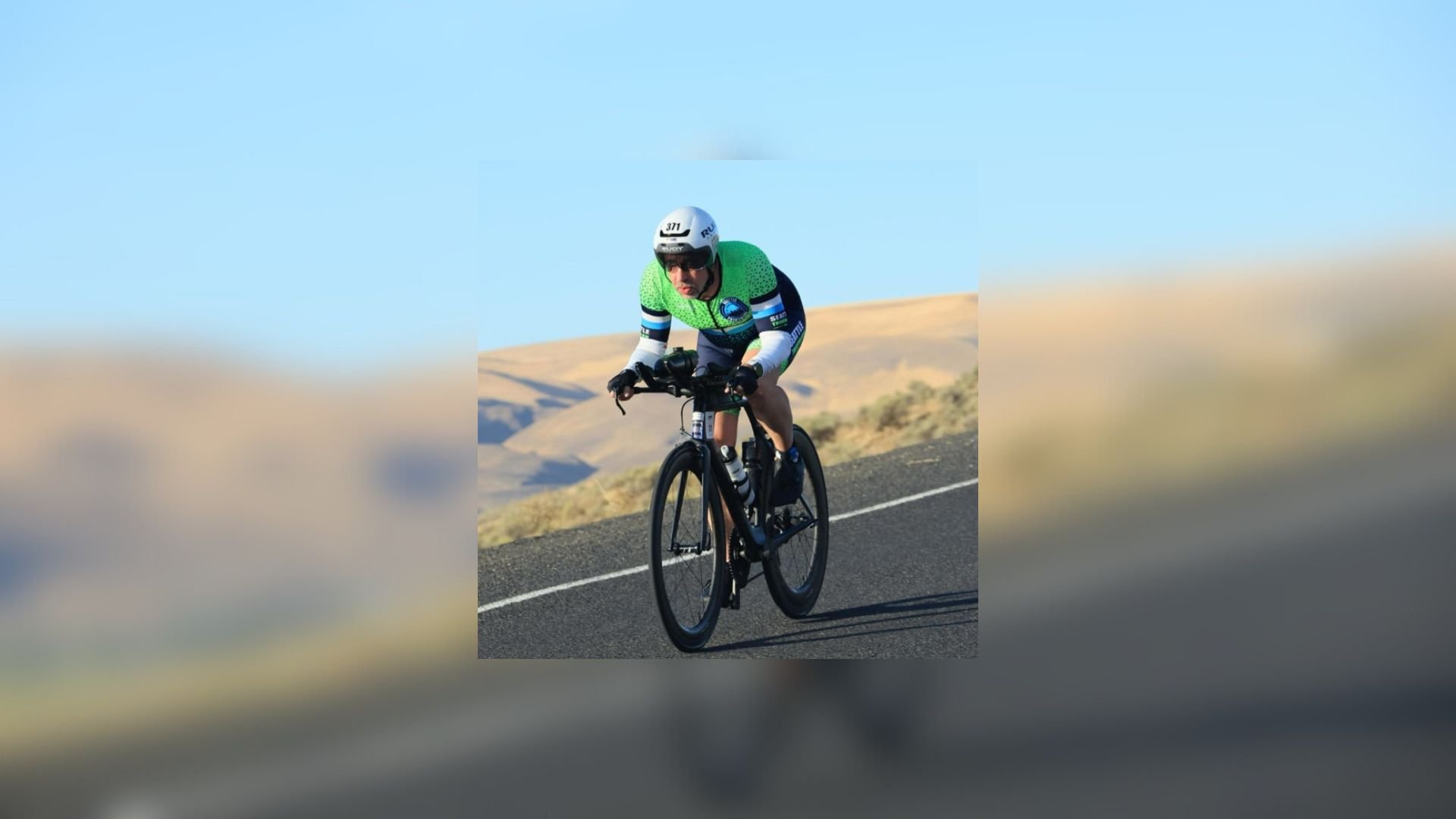
This year marks Claude’s second time tackling the Tri-Cities course, and he’s bringing more than just personal ambitions to the starting line. As past president of the Seattle Triathlon Group, a 300-member organization he helped rebrand and grow, Claude is part of a contingent of teammates making the journey to Eastern Washington. The club’s bright green and blue kit will be hard to miss among the 2,500 athletes expected to compete.
“We cheer each other as we cross paths on the bike, on the run,” Claude explains. “It’s always nice.” This sense of community extends beyond race day, with many athletes viewing the event as both athletic challenge and social gathering.
Racing the Current
The Tri-Cities course offers unique advantages that draw athletes from across the Pacific Northwest. The Columbia River’s downstream flow can turn what might be a 40-minute lake swim into a 28-minute river cruise, giving athletes a psychological boost before tackling the bike and run segments. But Claude, who admits swimming isn’t his strongest discipline, appreciates more than just the time savings.
“I’m more of a slow swimmer, but I’m a very strong biker,” he shares. This plays perfectly into the Tri-Cities course design, where the cycling segment winds through Washington wine country—terrain that allows stronger cyclists to make up ground while enjoying some of the state’s most scenic agricultural landscapes.
The Science of Endurance
Claude’s preparation reveals the meticulous planning behind endurance athletics. His training schedule averages 8-10 hours per week, including brick workouts (bike-to-run transitions) that simulate race conditions. Nutrition becomes critical during the 5,000-calorie burn of an Ironman, with liquid carbohydrates and sodium replacement carefully timed throughout the bike segment.
This year, Claude has completed 10 triathlons, including a grueling five-week stretch where he raced every weekend. His ability to recover quickly—something he calls his “superpower”—allows for this aggressive competition schedule while maintaining the quality training needed for his ultimate goal: breaking the five-hour barrier.
Wine Country Rewards
Perhaps uniquely among endurance events, the Tri-Cities IRONMAN concludes in one of Washington’s premier wine regions. Last year, Claude celebrated his 5-hour-15-minute finish with a visit to a local winery, where he met a fellow competitor from Spain who was also heading to the World Championships. It’s this combination of athletic achievement and regional celebration that sets the Tri-Cities race apart.
“That’s someone I met, a triathlete that I met at a winery after a race,” Claude recalls. The friendship forged over post-race wine tasting has continued through subsequent competitions, highlighting how the Tri-Cities event creates connections that extend far beyond the finish line.
Chasing Personal Bests
With race day approaching, Claude’s training has intensified to race simulations lasting over three hours, followed immediately by 40-50 minute runs. His goal is ambitious but achievable: 4 hours and 59 minutes, which would place him in the top 25-30% of his competitive age group.
Whether he achieves that sub-five-hour dream or simply improves on last year’s performance, Claude’s journey illustrates why the Tri-Cities Ironman has become a destination race. It’s not just the downstream swim or the wine country setting—it’s the complete experience of challenging yourself in one of Washington’s most welcoming regions.
For visitors and athletes alike, the Tri-Cities offers a unique blend of natural advantages, scenic beauty, and post-race celebration opportunities that transform a grueling athletic challenge into a memorable Washington adventure.
Listen to the full conversation with Claude Brun in this episode of the Exploring Washington State Podcast.
CLAUD BRUN Episode Transcript
Welcome to the Exploring Washington State podcast. My name is Scott Cowan and I’m the host of the show. Each episode I have a conversation with an interesting guest who is living in or from Washington state. These are casual conversations with real and interesting people. I think you’re going to like the show. So let’s jump right in with today’s guest.
After much trouble, it seems to start off all my episodes with a statement with that after much trouble, I am sitting here tonight, virtually sitting here with Claude Brun. And Claude is a participant in the upcoming IRONMAN down here in Tri Cities.
Scott Cowan:
So this is the third conversation I’ve had with people involved in this Tri Cities IRONMAN for this year. So, Claude, welcome.
Claude Brun:
Thank you for having me. Scott.
Scott Cowan:
Well, as I think I joked with you before, you drew the short straw and you weren’t in the meeting and they said you get to talk to Scott. So I know a little bit about you. Basically, you are living here in the states for over 20 years. Originally from France, you got into this sport of marathons and Ironman and triathlons. About nine years ago, I watched this little brief interview you did on tv and I’m going to jump off from that. So about nine years ago, you got into this sport. How many marathons have you completed?
Claude Brun:
Marathon or triathlons?
Scott Cowan:
Let’s do marathons first.
Claude Brun:
Before my triathlon time, I was running. And so I ended up doing two triathlons, one here in Seattle.
Scott Cowan:
Okay.
Claude Brun:
Which was kind of checked off my list. Never again. And then somehow I ended up doing one in Paris. So back to my home country, which was, which was fun. And so we was a big, big, very large marathon. So those are the two standalone marathon I’ve done.
Scott Cowan:
Okay. And now if that wasn’t enough, you decided to add the triathlon piece to it. So what, what was your. I had another guest on that’s participating and, you know, I called her crazy. And I’ll probably call you crazy too. And it is a compliment, not an insult. What is your motivation to push yourself to this? To me, this seems very extreme. So what’s your motivation to do this?
Claude Brun:
So first, first off, I’d say triathlon doesn’t have to be extreme. I know a lot of people associate triathlon with the longest of the triathlon or the classic triathlon, which is an Iron man, which is crazy and very, very long. You have very short triathlon. And I say on the, on the show last week, on the, on the broadcast that anyone can do a triathlon. I will correct there. Anyone in Reasonably good shape, can do a triathlon. No physical, no major physical issue. Although, yeah, that can be argue as well.
Claude Brun:
But so you have very short triathlon. So it’s not necessarily completely crazy. Those short ones are fairly approachable, I’d say. But for me, when I was kind of done checking that marathon box of my bucket list of things to do, I was looking for the next thing and I’m like, well, I could try a triathlon. I’ve always loved biking, especially as a kid. And I knew I would be pretty good if I was putting, putting a bit more time on the, on the bike. I was running. I was not a great runner, but I was running, so that was good.
Claude Brun:
And then there was the component of the swimming. I knew how to swim, but I never really. I was never really a good swimmer, especially freestyle, which is what you tend to do in triathlons. And so to me, there was that. There’s one piece that I know. Well, there’s one piece I know I’m gonna really enjoy. That’s the bike. And, and there’s one new piece.
Claude Brun:
So there’s this learning. I have to reach that point where I have to learn, I have to improve, and then I can do it. So I started by taking lessons at the pool for a few months and it was really hard. I remember the few ones I would do 25 yards and I would be so exhausted. I was crazy. And then eventually one day clicked and I was able to do like 100 yards and I was still alive. And then slowly made my way at least to a point where, okay, it looks like I can swim freestyle reasonably well. And so now let’s try the triathlon.
Claude Brun:
And my goal was one day I want to do an Olympic distance. So Olympic distance is kind of wise, is the distance, traditional distance of the Olympic game, which is one and a half kilometer swim, 40 kilometers, which is 24 miles, bike ride and 10k run. I thought that was the reasonable distance. Quite a, quite a goal. But that was kind of my, my goal. So I started by a shorter one, which is half of that, a sprint triathlon. And it’s terrible. And I’m like.
Claude Brun:
From there I was like, okay, you know, I like the challenge. I like it. Clearly I need to do better. Let’s work at it and let’s do more.
Scott Cowan:
Okay, now I gotta ask you this just because the way my brain works. So you grew up in France.
Claude Brun:
Yeah.
Scott Cowan:
And you liked biking. So that makes me think of. The one thing I think about with France and biking is the Tour de France. Have you ever, have you ever watched that in person?
Claude Brun:
Yes. Growing up, I love watching the tour. So usually on tv every summer I would watch every stage and then whenever they would be either in my, going through my hometown or, or any location I might, I might be on vacation, I would see, I would go watch them. So I’ve seen a handful of time either starting the stage or finishing the stage or going through. So, okay, not very many, but a few times.
Scott Cowan:
That’s. You’re the only person I’ve ever met in my entire life that’s actually been present. I mean, we’ve watched it on tv, you know, I mean, what little they show here in the States type thing compared. But you’re the only person that I’ve ever met that’s. And I remember it growing up as a kid, just being so impressed with those, those athletes too. So I, I’ve kind of got this endurance athlete fanboy. How’s that? We’ll call it a fanboy. All right, so now you started this.
Scott Cowan:
You didn’t do well, you liked it, you wanted to keep going. But now fill me in on a blank. The King 5 interview. How many triathlons have you done this year?
Claude Brun:
This year I have done 10 or so, I think.
Scott Cowan:
So that’s more than one a month.
Claude Brun:
Yeah, I had a stretch of in June, I think May, June, I had a stretch of. Or no, that July. There’s a stretch of five weeks where I would race every week, different distances. So back to back to back to back. So.
Scott Cowan:
Okay.
Claude Brun:
Not all are crazy. They’re not, they’re not Iron Man. They are the High Fired man or, or shorter distance.
Scott Cowan:
Sure. But, but still, that’s, that’s. And I know people, I know there are people that, you know, have done more than that too. But I guess the, my takeaway that I, I think I want to know, and I think the audience wants to hear too, is during that stretch, what’s the re. How do you recover from that exertion? What do you, what do you have to do to, you know, take care of your body so that you can go out and do it again a week later type thing? What, what, what’s training and recovery look like?
Claude Brun:
Usually after a race, kind of the day after I, I take the day off and it’s like kind of relaxation bath massage, if I get a chance, just kind of easy, easy walk to get my muscle going. But, but, but trying to relax. And then usually the following day I try to do to, to be back usually on the bike for a Very easy, easy ride just to get the legs moving. Nothing hard, nothing too long and kind of ease back into it. And after kind of two, three days, back to, back to my regular kind of training, training schedule really. I tend to recover, I think pretty quickly, which sometimes makes me wonder if I push hard enough during the race. But I, I tend to recover fairly quickly. That’s maybe one of my superpower, I don’t know.
Claude Brun:
But so it’s, it’s not really different. If I was not racing the following week, I would probably do a hard training anyway and so the intensity wouldn’t be that different. It’s just sometimes the logistics and the overall either travel or preparing stuff different from a race versus training.
Scott Cowan:
Now you’re in the Seattle area, which has an abundance of places for you to train. What I’m, I guess I’m a fair weather person. So what, what’s your training regimen? So we’re recording this. It’s the end of August. The Ironman we’re talking about today is the Tri Cities ones September 21st. After that, you know, I joke, but you know, Seattle becomes rainy for the next 10 months in a row. I’m, I’m kidding. But what, what do you, how do you train during fall and winter? What’s that look like for you? Do you go indoors? What’s, what’s going on.
Claude Brun:
This year? I’m looking forward to have actually a break in the, in the fall in particular. The last few years I would be racing all the way through December in different locations. This year, Tri City is my final race of the season and for forseeable future. And so I don’t have to, to worry about pure triathlon training. So I will continue training, but I will, I’ll move, I will move more indoor at the gym, doing more, more core workouts, trans training, fairly light initially and then gradually increasing. I will, I will run. I mean it’s easy to run even if it’s, if it’s kind of raining or, or not the nicest weather. I tend to be a little bit of a fair weather person too, to be honest.
Claude Brun:
So if it’s really terrible, if I don’t have something I have to do, I probably, you know, if I want to run, do it on the treadmill. But, but yeah, I’ll slightly move indoor. That said, my. During my regular season, I definitely try to run outside. It’s easier, it’s nicer, it’s more enjoyable. But my biking tend to be 95% on the trainer, so it might be a super nice Day outside like it is today. If I wasn’t talking to you tonight, maybe I will ride and I will ride right where I am right now in this room on my, on my trainer.
Scott Cowan:
On your trainer. Okay. And so let’s just say you’re not talking to me and you’re going to get on the, on the trainer right now. This, you know, at the time that we’re recording this. How, how many miles are you going to put in on a, on a weeknight like this?
Claude Brun:
My, during the week, my workout tend to be give, give or take for about, about an hour. So depending the, the virtual ride take, it’s going to be around 20, 20 miles, give or take or so. Okay, so an hour of work.
Scott Cowan:
All right. And now we’re about, we’ll call it three weeks away from the, from the, the Ironman and Tri Cities. What’s your preparation going to look like for the next three weeks? What, what, what do you do to get yourself, you know, both physically and mentally prepared to go and compete in these things?
Claude Brun:
Well, I have a, I have a training schedule that I, I follow, I work that with my coach. And so it’s kind of based on when is my next race and gradually kind of the intensity, the load is increasing up to usually two weeks or so before the race where intensity remains, but the load and the duration goes down significantly so that my body start to rest. So my schedule between now and Tri Cities for the next 10 days, I have, I mean I work out pretty much every, every day, one day of rest usually. And then on the weekends I have a very, very long workout which is kind of a race simulation. So I will probably do that tomorrow evening or Saturday morning. I have not decided. It’s going to be. This week is going to be roughly a two and a half hour ride.
Claude Brun:
So on the trainer and then as soon as I’m done, I will go run for 40, 50 minutes.
Scott Cowan:
Okay.
Claude Brun:
And I think next week again during the weekend it’s going to be even longer on the, on the bike. I haven’t fully looked at, but I think it’s going to be over three hours on the bike in a longer run as well. So it’s really kind of almost like the race without the swim. That’s fairly typical as I train for, for race to do this run bike, we call that brick or bike run, sorry, bike run training with fairly long duration to simulate the race where I work on the bike, on the run and also on the nutrition of the same nutrition protocol that I will have during the Race.
Scott Cowan:
What? Okay, so when I talked to Jennifer Comfort, she kind of was elaborate, not elaborating, but going over kind of the nutrition and how you refuel while you’re on the move. What does your. I mean, how many calories are you gonna try to consume during a typical. An Ironman race?
Claude Brun:
Yeah, I think it’s about roughly. I mean, the. The calories I’m gonna spend during the event, I think it’s around 5,000.
Scott Cowan:
Okay.
Claude Brun:
So. So it’s a lot of calories, and it’s more than my body can. Can have stored. And so especially on the bike, that’s where you have to replenish yourself, and that’s something I. The last. The last few years at doing better. So a lot of nutrition on the bike, some on the run, definitely not on the swim while you’re swimming, so you can’t really do much. But on the bike, it’s where you want to.
Claude Brun:
The goal is to make sure that when I finish the bike, I should be kind of at neutral in terms of deficiency of any nutrition and weight before starting the run, or very slight deficit, but not much. So liquid carbohydrates, sodium in particular, make sure I have whatever I’m using during the bike and before it needs to be replenished to start the run so I can have a good run.
Scott Cowan:
So how. So what sort of specific. How are you getting your sodium replenished? What do you. What do you use for that?
Claude Brun:
I have different kind of product and usually powder that I put in my bottle. So all my nutrition these days is liquid. So powder with. With sodium and. And carbohydrates and. And water on top of that.
Scott Cowan:
Okay, that’s just. Still. I just. I. I listen to you guys and it’s just. I just. I’m. I’m baffled by it, you know, I really am.
Scott Cowan:
I really am baffled. Not baffled, but just. It’s just the science behind all of this. The. The. The where you’re. Because you’re competing. The way I look at it, you’re competing with yourself.
Scott Cowan:
You’re trying to. To. I’m gonna. I’m guessing here, and you tell me if I’m wrong, but you’re going into this specific race with kind of a plan. You want. You’ve got a target time. You want to get to accomplish these. These splits in.
Scott Cowan:
You got. You want to. You want to jump on the river and get out of the river in a certain amount of time. You want to get on the bike and get off the bike in a certain amount of Time you want to run and be done. And then you have to transition. I mean, you’re jumping out of a wetsuit into, you know, you’re not jumping out of the wetsuit, you’re pulling the wetsuit off and you’re, you’re getting on. You know, you’re doing all these things that you probably have to think about optimizing. Now, the last time I heard there was like 2500 people doing this race in the Tri Cities.
Scott Cowan:
Approximately. Ballpark.
Claude Brun:
Yeah, I think that’s right.
Scott Cowan:
And so it’s not like you’re doing it getting out of the river, going to your bike. You’re doing that with a bunch of people around you and you can’t control anybody else but yourself. And so somebody could get in your way, you could get in somebody else’s way, all these things. And that’s. I’m looking forward to being there. I’m going to, I’m going to be at this race to watch it. I am looking forward to seeing what I’m going to call chaos. Because.
Scott Cowan:
Yeah, we’re gonna, and I’m gonna stop and I’m just gonna ask you this. So you competed in this race last year, right? Okay. So you, I want you to go back and I want you to walk me through this. When you, let’s say you were getting ready to go in the first leg to the swim, how many people go in the water at one time? About.
Claude Brun:
So I can’t remember the exact race, but usually this send three to five people every three to five seconds. So you have beep. You have three or four or five people, depending the race, jumping in the water and then a few seconds later, beep. And the next wave goes. And so to put 2,500 people in the water, I think it’s going to take about an hour. Wow. So from the very first people going in the water and you self seed yourself in those races now, which means they want the fast people to go first.
Scott Cowan:
Okay.
Claude Brun:
And then the slower people to go, to go later based on your predicted time for the swim. That way everyone has a better experience. You don’t have people faster swimming over people which are slower and then being in the way. So that way it’s a much more enjoyable swim for everyone. So that’s the way it works. So it’s fairly spread out. Out.
Scott Cowan:
Okay.
Claude Brun:
And that’s kind of make the, the chaos fairly controlled. And then you’re spread out on the swim to start. You’re even more spread out on the bike. Although some courses can, can Become pretty crowded, but that’s the way it’s organized.
Scott Cowan:
So where, so you said you kind of self select where you’re gonna go in from, you know, let’s say 6am to 7am, you know. So where, where do you anticipate going in at halfway through first? Are you going to be the first guy in the, in, in the river? You can be the last guy in the river.
Claude Brun:
Yeah, kind of, kind of halfway through. I am not a very fast swimmer, so I tend to be kind of in the middle. So usually they have, they have volunteer with sign saying and, and we sign with predicted time and those times are based on a swimming if it was in a non assisted swim, meaning not a downriver swim. Tri City is a downriver swim. So if you were to swim 40 minutes to do the swim leg in a usual race in a lake, let’s say it will take you probably 30 minutes in tri cities, depending how strong the current is. So the time predicted is if you were to swim in a regular race, not downriver, you know, 40 minutes. You have someone with that might say 40 to 43 minutes. You stand here and the whole cohort moves together and then you get, you line up as I described.
Scott Cowan:
Okay. About last year, how long did it take you to do the swim component?
Claude Brun:
It took me 28 minutes.
Scott Cowan:
28 minutes?
Claude Brun:
Yeah, something like that.
Scott Cowan:
And how much time do you think the river gave you? I mean if you did that in a lake, what do you think that at that pace that you did?
Claude Brun:
Yeah, it was like a 30 gain. It would have, yeah, that’s a significant.
Scott Cowan:
So you’ve seen the Columbia, you swam in the Columbia? The Columbia, when you look at it, looks like it’s pretty just calm. It doesn’t look, it doesn’t look to me like there’s current.
Claude Brun:
Yeah.
Scott Cowan:
And so you’re telling me that your, your, your pace is maybe 30% in, enhanced by the down. Okay, wow.
Claude Brun:
All right. Yeah, it moves and you know, it might be faster this year. It might be slower. It depends how much water, you know, all those other elements. So last year was particularly fast, I think. So we’ll see how this year is.
Scott Cowan:
Okay. All right, so you get out. This is the part that I’m really unclear on. You got, this is the way I’m envisioning it. You got 2,500 bicycles, you got 2,500 helmets, you’ve got 2,500 pairs of bike cycling shoes. Even if they’re well organized, that seems like chaos to find your bike. You know, it’s like, how do you find. Find your bike when you get out of the river?
Claude Brun:
So you have an enclosed area where all the bikes are, and they are organized by row and by racks and with numbers. And so depending on your bib number, you’re going to put your bike before the race, the day before the race, in a particular place and put it back when we’re done with the bike. So you have a number on the rack that indicates where your bike should be. And so it’s fairly easy to find. And usually before the race, the day before, or even the morning off, you kind of visualize, okay, I’m gonna get off the swim from here. I’m gonna walk this way in the third row or where the tree is or where the sign is. This is where I’m gonna make my right turn to get to my bike, which is halfway through the rocks. That’s how I try to visualize so that I don’t have to think.
Claude Brun:
I kind of know where it is and, and I get to it easily. I don’t have to read the sign on the rack. So it’s number 100 to 300 or so on.
Scott Cowan:
Okay, and do you change out of the wetsuit there at the bike? Is that where that happens?
Claude Brun:
Yes.
Scott Cowan:
Okay, and so what do you have to do with the wetsuit? Do you have to put it on the rack type thing or what? Or do you just leave it on the ground?
Claude Brun:
Just usually leave it on the ground.
Scott Cowan:
Okay, so you, you, you pull that thing off, you, you put on your cycling shoes, you put on your helmet. Because Jennifer was telling me they’re very particular, you have to have the helmet on and strapped. I mean, it’s, you can’t just. You got to be on purpose.
Claude Brun:
Okay, I’m unstrapped. Before you can touch the bike?
Scott Cowan:
Yes, before you can touch the bike. Okay. All right.
Claude Brun:
Yeah.
Scott Cowan:
So now you’re going to get on your, you’re going to do all that. You’re going to get on your bike. Last year in the Tri Cities, how, how crowded was the. The bike circuit for you?
Claude Brun:
So it’s always interesting for me when I, when I do those, those races, because I’m, I’m. I’m more of a, you know, me to slow swimmer, but I’m very strong biker. So on the bike, I tend to pass a lot of people who were either faster than me on the swim or pass me on the swim. So, yeah, it’s usually not too crowded, but sometimes I have to pass a fair amount of people, which is in some Way kind of fun because it’s always more fun to pass people than being passed by people. So it kind of motivates me to go faster. I don’t particularly remember in Tri City being too crowded. I know at the beginning last year, it’s changing this year. There was a lot of, when you were just kind of leaving town, a lot of 90 degrees turn.
Claude Brun:
So you were more slowing down because of the turn, not so much because of the people. So I don’t remember that being as a very crowded race.
Scott Cowan:
Okay, you’re gonna go, and you’re gonna go out in wine country, which we’re gonna talk about wine at some point in this conversation. But you’re gonna go, you’re gonna drive. You’re gonna drive. You’re gonna be riding your bike out in the Tri Cities. It’s gonna be late September. It’s probably gonna be what, 8 o’ clock in the morning? Ballpark.
Claude Brun:
Ish. Yeah, probably. Yeah, ish.
Scott Cowan:
So it’s not going to be super hot. It’s going to be warming up. It’s not gonna be super, you know, it’s not gonna be 100 degrees. I mean, let’s, let’s hope not. You’re gonna go for this ride. You’re gonna. Because that’s your strong suit. That’s, you’re gonna, you’re gonna make up some time there maybe for, you know, that’s, that’s where you gain ground.
Scott Cowan:
You’re gonna race back to where the bike rack is. So you have to put the bike back in the same bike rack. You have to, you have to take off the helmet. You have to change. I didn’t even think about your running shoes, you guys. Your running shoes have been left behind there as well. Okay? So you got to take off the cycling shoes, put on your running shoes, and off you go. And then you complete the run and you finish this thing.
Scott Cowan:
So last year, do you remember your time from last year?
Claude Brun:
It was five hours and 15 minutes.
Scott Cowan:
Five hours and 15 minutes. Okay. I’m tired just hearing that. That’s, that’s crazy. Okay, so I’m gonna put you on the spot. What’s your time going to be this year?
Claude Brun:
It’s. It’s gonna be four hours and 59 minutes.
Scott Cowan:
You’re gonna break five.
Claude Brun:
That’s the plan.
Scott Cowan:
That’s the plan.
Claude Brun:
It’s gonna be hard, but that’s the plan. And that’s, that’s what’s gonna happen.
Scott Cowan:
Have, have you broken five in another Iron Man?
Claude Brun:
No. I came close.
Scott Cowan:
Okay.
Claude Brun:
Came close, but I Have not. And so this is my second attempt this year to make it happen.
Scott Cowan:
So this would be your personal record then? If you, if you, if you cross the line, 4 minutes or 4 minutes, 4 hours, 59 minutes, and you don’t care how many seconds, so to speak, Hundreds of seconds, you know, you’re like, boom, you. That will be your. That’s a personal record for you, and that’s what you’re shooting for.
Claude Brun:
Yeah, I’ll be happy if I, if I beat my time from last year, no matter what. So under 5:15, that would be a good accomplishment because I feel like I was stronger than last year. So that’s number one goal. But ideally, under five hours, it’s what I’m going after.
Scott Cowan:
Okay.
Claude Brun:
And that’s what I’ve, I’ve worked towards.
Scott Cowan:
So now. Okay, in your age range, if you, if you go sub 5 in your age range, where does that kind of put you in the spectrum of male participants in your age range?
Claude Brun:
It’s hard to say because you never quite know who is going to show up that day at that race. My age group, like many age group, but is very competitive. I mean, you have people really doing crazy time, especially on the run, incredible times. So it’s very competitive. My guess is that if I’m under five hours, I will be in the, in the top 30%, maybe 25% of my age group.
Scott Cowan:
Okay.
Claude Brun:
So. So that’s, that would be quite, quite good.
Scott Cowan:
That’s, that’s great. Okay. All right. What happens when you’re done? What do you, what do you, what did you do last year? I guess we’ll just. Everything’s gonna be compared to. What’d you do last year? What, what did you do last year when you finished the Ironman in Tri Cities?
Claude Brun:
So my, kind of, my, my routine, it’s me being a little bit of maybe a personality, I don’t know. But when I’m done with my race and maybe if I have some, some, some friends and teammates running or doing the same race, I try to see them finish. If they are reasonably close in time, I might see some who have crossed the finish line already. But I usually don’t stay very long at the finish area. I go back to my hotel, I go gather my bike and my gear, go back to my hotel, clean myself, clean my gear, get that done, get my wetsuit washed and hanging and drying and same for the rest. So I’m not even taking a minute to really relax after the race, usually. And once that’s done and I’m Clean and I’m a bit refreshed obviously, as I do that, I try to hydrate a lot of replenished, especially after the run, especially if it’s been hot. And then it depends kind of where I am.
Claude Brun:
Usually I go back to the finish line to see some more competitors finish for the rewards ceremony and the award ceremony and the world slot allocation, which I did last year. And then depending kind of the time I have and if I happen to be, you know, we said we might talk about wine in a wine country. I see if I can have, find some wine. So in Tri Cities last year there was a winery which I, I know and I wanted to go try out and I knew it would not be too late. They were still, they would still be open. So I went there after kind of the reward ceremony and had a few, a little wine tasting to relax and, and, and finish the day in a, in a nice way.
Scott Cowan:
So I’ve got. Okay, I got some follow ups on that topic. So you had wine tasting. Okay. So was it, was it reds or was it whites?
Claude Brun:
It was mostly reds, but I believe I had, I had a one or two whites as well.
Scott Cowan:
I don’t know why, but I think red pairs better with Iron Man. I don’t know why. That’s just kind of my. I don’t know. I don’t know. That’s just kind of, I’m being kind of funny or trying to be kind of funny, but at the same time I, I do think, yeah, I think I would probably go for red. So what, what winery did you go to? Okay.
Claude Brun:
And I didn’t, I mean, I knew the name, but I didn’t know the winery. They are beautiful properties. It was, it was very nice sunset. So it was, it’s very nice. I met a, a lady there. I could see she had a wristband, so I knew she had done the race too. Who turned out to be originally from Spain, so both European. She lives in Arizona.
Claude Brun:
So she was traveling through the race and we’ve kept in touch. So we had a couple of glasses together and we were both going to the world championship that year in New Zealand. So we got to see each other in New Zealand a few months after and I’ve seen her at a few races here and there. She’s a very strong competitor. So that’s someone I met, a triathlete that I met at a winery after a race. And so that happens.
Scott Cowan:
So this year have you picked out a winery to go and check out?
Claude Brun:
I have not.
Scott Cowan:
I have not.
Claude Brun:
So we’ll see how I feel. I might hang out in tri cities after the race. I might decide I just want to be back home as quickly as possible. Depend also how I feel and how my, my performance is. So I. I don’t know yet.
Scott Cowan:
You don’t know yet.
Claude Brun:
We’ll improvise. We’ll improvise.
Scott Cowan:
Okay, so you said teammates and you’re, you’re part of an organization in Seattle, Triathletes. So let’s talk about that for a few seconds. How did, how did you get. I think if I read your bio, which is really small on my laptop screen, which I can’t cheat off of right now. Did you start this the Seattle. Were you part of the starting it, or am I misspeaking?
Claude Brun:
Yes and no. So when I started with triathlon, I kind of started on my own for the first couple of races and then I joined an existing club at the time in Seattle, which was a Seattle Green Lake Triathlon Group, which was a great way to meet people and get a few tips from people who actually know what they are doing. Unlike, unlike me and kind of being part of a community and that was helpful. And I did a few, few runs with, with the group or a few bike rides initially and just getting some more tips and, and things to do to be a better triathlete. And then after some years doing that, I wanted to give back a little bit. So a few years ago, three years ago, I joined the board of that, of that group, that triathlon group, to, to help and see if I can, I can contribute in some way to support the club. And one thing that I thought would help the, the club to have a broader appeal, broader reach would be to change the name from the Seattle Green Lake Triathlon Group, which was born out of a running club that was around the Green Lake area in Seattle and to have a more kind of more appealing name to a wider audience in the greater Seattle area. And so I suggested we change the name to the Seattle Triathlon Group.
Claude Brun:
Ended up kind of leading the effort to make that happen. We have to go through a number of hoops. We ended up actually creating a new, a brand new entity which is a nonprofit and kind of relaunched that and as part of the relaunch, because I was kind of the one, one of the few, one driving the effort, I ended up being the president for a couple years until last April, where my mandate as a president ended and I kind of gave the baton to someone else. I’m still on the board and the club has been doing well in terms of people getting involved and members and reach and recognition with triathlon organization. So it’s been great to see the growth there.
Scott Cowan:
Approximately how many members are in the group?
Claude Brun:
We are shy. I think very close to 300 paid members. We have a very modest membership fee, which is great value. You get a lot of benefits from being part of that. And then we have a Facebook page which has a reach of over 3,000 people. So people who have some interest or active in triathlon, but not part of the. The membership per se.
Scott Cowan:
Okay, so you got about 300 members. Do you have any idea of those active members, how many of them might be going down to Tri Cities?
Claude Brun:
I do. So we have, we will have. Well, as of yesterday, actually, you have 29 people who are signed up for the race with. When you sign up for an Iron man race, you can, you can assign a. Your, you can tell the. As you register which club you’re part of.
Scott Cowan:
Okay.
Claude Brun:
And so 29 people have said their, their club. Their group is the Seattle Triathlon Group. Now, there might be other who are part of the. Part of our group who might be members or, or non members, but part of the broader kind of family, but they might be racing for another organization, maybe the, the club of their coach, maybe some kind of brand they’re part of, and they pay membership to be part of that. So I don’t know the numbers of people who are affiliated more broadly with us, but it’s probably going to be around 50, 50 people.
Scott Cowan:
We’ll.
Claude Brun:
We’ll see. We’ll try to take a group picture like we did last year. Um, so. But it’s still a fair amount and maybe even more than that.
Scott Cowan:
That’s. That’s really. I mean, that’s very impressive to me. Okay. What’s the farthest distance you’ve ever gone to compete in a triathlon?
Claude Brun:
Well, that would be at that world championship I, I mentioned earlier. That was December last year. That was in Topo, New Zealand. So basically on the other side of the planet.
Scott Cowan:
Do you have a location you haven’t gone to to compete that you want to go?
Claude Brun:
I think I’d love to do one in France, actually. So that would be fun to. I’ve never done a triathlon in France, even if I’m from there. I was just biking when I was there and it’s been a while anyway, so that would be fun to do one in France, I think. Otherwise, I’m not necessarily particularly looking at, oh, I want to go do a triathlon in every countries or every Continent or whatnot. I don’t, I haven’t set that as a goal, but do I do one in France? One day would be fun.
Scott Cowan:
Okay, all right, so New Zealand, you know, when I was talking to Jennifer, I mean, just, just getting to New Zealand is, you know, logistically, I mean, you get on an airplane, but the point is you’ve got to put your bike a very, a very valuable piece of equipment on an airplane. And if you’ve ever watched luggage handlers, you know, I mean, oh boy, I wouldn’t let that thing out of my sight. But you’re, you’re taking a very, very valuable and well, well tuned instrument across, halfway across the world. How much time does it take you to get your bike ready? When you, let’s use New Zealand, for example. How long. When you got to, when you got to New Zealand, you got the bike out. You’re making sure it was, everything was the way you wanted it to be. How long does it take you to get that thing dialed in for the race?
Claude Brun:
It doesn’t take me too long. If everything, if there’s nothing wrong, no incident, no, you know, no damage, no bang or anything, it takes, it takes me a half hour to get it out of the, out of the bag and kind of ready and then, and then maybe some fine tuning. I always obviously test drive it before, before the race, maybe a few times. So maybe I have some, some fine tuning to do. So but if everything is pretty smooth, it’s, it’s an hour or less. Yeah.
Scott Cowan:
And your bike, about what does that thing weigh?
Claude Brun:
I think it’s about 20 pounds. The bike, the bike itself.
Scott Cowan:
Wow.
Claude Brun:
And with the kind of, the bike and the bag I use and the structure, it’s usually under £50. So I get to, it’s just an oversized luggage right. When I, when I travel.
Scott Cowan:
Right. But. So your bike weighs about 20 pounds? That’s. I’m trying to think.
Claude Brun:
I think, yeah.
Scott Cowan:
I mean, last time I.
Claude Brun:
Every day, but the last time, I mean.
Scott Cowan:
So what type of frame is it?
Claude Brun:
Carbon.
Scott Cowan:
Carbon, okay.
Claude Brun:
Yeah.
Scott Cowan:
And is it your, the bike, is it built for? What’s it. Okay, Is it built for comfort? I mean, is it, you know, it’s not built for comfort. But what’s the, what do you prioritize on a bike for a triathlon or for America? You know, what’s, what do you need? Does that make any sense to you? Like, it’s not a mountain bike, right? It’s not, it’s not, it’s not a big fat tire bike, is it? Is it stripped down like a race bike.
Claude Brun:
It’s a, it’s a triathlon bike. So it has a particular shape, especially the handlebar where you’re as aerodynamic as possible. Unlike a regular road bike, even kind of race road bike. We talk about the Tour de France where you have to, you’re in the peloton, you have to navigate, you have lots of turns and you have to navigate with other people. In a triathlon, it’s a time trial format, so you have few, very few people around you. Most of the time you have limited amount of turns and so you don’t need the same agility, but you need speed, you need aerodynamics. And so it’s all about, it’s all about that. So the, the position is much more aggressive, the handling is a bit more difficult, but you can go faster and cut through the, the air much better.
Scott Cowan:
And when you’re taking that thing out and you’re, when you’re, what sort of pace do you keep?
Claude Brun:
It depends the course. I mean obviously it’s, the more elevation climbing. The base is going to be different, but on a, on a fairly flat course, I think I’ll average probably around 20, 23 miles an hour.
Scott Cowan:
Okay. Okay.
Claude Brun:
Something like that.
Scott Cowan:
Okay. Now the last, this I promise is the last deer question. But we haven’t talked about running, we haven’t talked about shoes, how fast. Okay, so this, so when I was speaking with Jennifer, she, she admitted, and this is, you know, somebody could go listen to this. So I’m not saying anything I did listen to. Okay, so she’s got what, 50 or 60 pairs of shoes in her garage? I mean.
Claude Brun:
Yeah, yeah.
Scott Cowan:
I gotta put you on the spot. How many, how many pairs of worn out shoes do you keep around?
Claude Brun:
I don’t have many, very many worn out shoes. I try to get rid of them sometimes like, like in, in some race you have to walk through the swim start. So you use those old shoes and then you, you get rid of them there. So, and then I try to kind of rotate those. So I must have, I don’t know, not nearly as nearly 60 pair of, of running shoes maybe. All in all I have, I have 10.
Scott Cowan:
We.
Claude Brun:
Some are almost new or new and some are almost ready to be end of life and kind of everything in between. I also have different ones depending the type of running I do. I have more. My, my, my nicer one. My, my race shoes, my training shoes, my. More like trail shoes. Yeah, maybe it’s more than 10 actually trail shoes. Now if I was to say overall, how Many pair of shoes do I have? That is a very different question.
Scott Cowan:
Right, right.
Claude Brun:
But we’re talking running shoes.
Scott Cowan:
So what brand do you. Are you. What brand do you. Works for you?
Claude Brun:
I kind of tend to use two. Two brands Brooks very often. So local Seattle brand for, for training, but racing. The last few years I’ve been racing with. With hoka.
Scott Cowan:
With hoka. Okay. Now are you okay? I have a pair of hokas and they’re, they’ve got that gigantic thick sole and I feel like I’m wobbling on them. You’re not running in those, are you? Or.
Claude Brun:
Mine are not super, super high like this. They look more like. I can feel your regular running shoes. I mean they have some, some nice cushion, but not, not crazy.
Scott Cowan:
Not. Yeah, because mine. I was actually honestly disappointed in them. They were, they were so, so I had no idea how. I don’t know. I just don’t feel. Didn’t feel stable on them. I.
Scott Cowan:
They. My. Yeah, my ankles aren’t strong. Okay, so you run in Brooks or you train in Brooks and you run in Hocus. Okay. All right. So when you’re about how many hours a week are you committing to training? On an average week?
Claude Brun:
Around, around 8, 9, 10. So like it’s about an hour a day during the week and then a few hours on, on weekends.
Scott Cowan:
Okay.
Claude Brun:
Yeah.
Scott Cowan:
So when you’re not working, when you’re not training and we know you like wine, but what else do you, what else do you like to do for fun and entertainment?
Claude Brun:
I have to say the last few years has been fairly limited because of my, my racing and training schedule. And there’s always, you know, stuff to do around the house or things like that. And that takes usually the rest of my, of my time, but I try to do some, some, some, some fun stuff. Hiking, you know, living in Seattle every now and then. I used to do some sailing. Not as much again the last few years, but we would go selling like definitely fair weather sailor.
Scott Cowan:
Okay.
Claude Brun:
For sure. Some, some traveling. I like to do that too. Again, my, my, my. My travel schedule has been mostly focused around racing, but when I can, I like to. To go to new places. I’ll go to France in a few, in a few months to see family and friends. So.
Claude Brun:
And then kind of cooking, eating wine. Friends. Yeah.
Scott Cowan:
That’s okay. In the Seattle area. What, where’s what for wine. What do you, what are you finding in the Seattle area these days? Do you. What’s there any good. I’ll call it a wine bar, for lack of a better word. But where, where’s one going these days in the Seattle area? Where’s a good tasting room?
Claude Brun:
So tasting room. Good friend of mine who is also. I bike every now and then with him. I’ve done Seattle to Portland bike ride a couple times with him. He’s a winemaker, he has a few testing room. It’s called Structure Sellers in Sodo. South of the stadium in Seattle. Yep.
Claude Brun:
And so that’s the place where I go on a regular basis. Love his wine.
Scott Cowan:
All right.
Claude Brun:
And then there are tons of, of nice wine taste test wine tasting room in, in Woodinville in particular. So I try to go and I like always to like discover, discover new ones. Go to one I like. So it depends. One bar per se. Not that often, no, like a 1:1 bar. But yeah, that’s lots of options.
Scott Cowan:
What so Structure is the, the name. What do you, what is he. What is he producing that you like? What’s what. What is your palate like? What, what do you tend to gravitate towards?
Claude Brun:
I gravitate around Bordeaux. Bordeaux style wine. That’s. If I had to kind of drink wine, one type of wine for the rest of my life, that would be a Bordeaux probably right bank and so the, the cab cap front even some, some, some, some Petite Verdure or some others or things like. But usually a Bordeaux blend would be what I would like I like the most. I’m from the Champagne region though, so I definitely like my, my champagne as well.
Scott Cowan:
Now what little I know about that is we can’t, we can only call it champagne if it’s from that region. So anything that’s made here in the US Even though somebody might like myself might say it’s champagne, it’s not. So sparkling wine. Are there any good Washington sparkling wines that you’ve encountered?
Claude Brun:
I don’t think I’m there very many sparkling in Washington. You have some in Oregon a little bit.
Scott Cowan:
Okay.
Claude Brun:
But in Washington I haven’t seen very many. I don’t know. I’m picky with my bubbles and so I haven’t really found one that I particularly like in Washington or anywhere else, which doesn’t mean I wouldn’t drink it, but no, no, I much prefer. Yeah.
Scott Cowan:
So you say you’re picky about your bubbles. Elaborate on that for me. What are you looking for? What makes a delicious champagne in your opinion?
Claude Brun:
It’s something well balanced, definitely not sweet, more on the dry side. And the soil in the Champagne region is a lot of clay and makes it really the perfect solid condition to, to get to get the right champagne there. So kind of hard to describe. And it’s. And I was. I was saying I’m picking about my bubbles. I mean, the champagne is not necessarily about the bubbles. I mean, that’s effervescence.
Claude Brun:
But big bubbles doesn’t. Doesn’t mean good champagne by. By any means, just to be. To be clear. But there are a few, A few brands that I like, and whenever I can find those in the state, I try to. To get some. But yeah, it’s this balance, elegance, I think, dryness aspect that I enjoy, which is very different from what I would dry, where I would drink other type of wine. I do love, like, wine from, like, red wine from many regions.
Claude Brun:
I used to live in Sonoma County, California, when I moved to the states. Love wine from there. Or Napa. Love the love of the Washington wine. Big cabs or caffeine, some other Syrah as well.
Scott Cowan:
So Washington has, over the years, I mean, it’s been multiple decades now that Washington’s really up their wine game, if you will. And it’s. There’s. I mean, it seems like you can’t. I, you know. Okay, so you live in the Seattle area. You know, on every street corner, there’s three Starbucks. So it seems like over here in eastern Washington, it’s, you know, on every corner there’s a wine tasting room.
Scott Cowan:
I mean, there’s just an abundance of them everywhere. And as you get down to Tri Cities, I was shocked. What was the number? I think it’s 200 wineries within 50 miles of tri Cities. It’s some outrageous number to me. It’s like, you know, amazing. And there’s like 1400 wineries in the state. I mean, it’s just kind of crazy, all right. That I’m not a wine guy, I’m a coffee guy.
Scott Cowan:
So I got to put you on the spot. You live in the Seattle area. There’s no good coffee in Seattle. You got to tell me where I can go get a good cup of coffee in Seattle.
Claude Brun:
I can, I can make you a nice espresso at my place where I would start.
Scott Cowan:
Okay, that’s that solid. Solid.
Claude Brun:
So. Yeah, but what about, I mean, like, other. Other places? I mean, I don’t have, like, I would say I don’t have a. A go to place. I. I have one when I. When I go racing in Oregon. In Salem, Oregon, there is a place that I always go to, and they make the best cappuccino that I’ve ever.
Scott Cowan:
Had in Salem, Oregon.
Claude Brun:
In Salem, Oregon. Yeah. Yeah.
Scott Cowan:
All Right.
Claude Brun:
But in. So I don’t have a go to place here. I do go to, you know, some of those Starbucks to get some drink that’s convenient. One place that I like when I’m, when I’m around there in one of the shopping center in, in Bellevue is Dote Cafe. They make very, very nice macchiato, espresso, different things.
Scott Cowan:
What’s your go to? Like what, what? You said cappuccino. You said macchiato, you said espresso. So what, what do you kind of, what’s your go to coffee drink?
Claude Brun:
It depends what time it is. Usually in the morning I would do something like a latte or a flat white and then after lunch, espresso or espresso macchiato, that kind of, you know, I can do cappuccino every now and then as well, but I think, you know, if I to pick one, I like the macchiato with kind of the double shot of espresso and a little bit of foam. I think that’s, that’s very enjoyable.
Scott Cowan:
Okay.
Claude Brun:
No sugar, no. No flavors, no nothing.
Scott Cowan:
As it, as it should be. No pumpkin spice ever.
Claude Brun:
Yeah.
Scott Cowan:
All right, so next question I always ask everybody is. So it’s around lunchtime. Where’s. Where’s an interesting place to grab lunch in the Seattle area?
Claude Brun:
So in one, one place I like is probably the restaurants I’ve been the most since I’ve lived here. It’s just, it’s in Kirkland, South Kirkland on the water. It’s called Grand Bistro American. Grand Bistro American, which is an interesting name because it’s a French restaurant.
Scott Cowan:
But.
Claude Brun:
It’S kind of your typical. Kind of or reminds of a typical Parisian bistro. And it’s on the water. So you can have, you can have great French fries, different French dish, mussels, oysters as well. So it’s actually a nice place for lunch or for happy hours or for a sunset dinner. So I would, I recommend that place.
Scott Cowan:
Okay. All right. As we wrap this up, I’m still amazed by that there’s gonna be 2500 people like yourself that are going to go to Tri Cities. And. Because the other thing is, this is the one thing is I gotta ask you this. I. Okay, it’s race day. What time are you getting?
Claude Brun:
I. I need to kind of check the schedule exactly of the race. But let’s say if the. My swim start might be around, let’s say around seven, which means the, the swim. Or maybe 6:30. Let’s say the swim will start around six and again, I haven’t checked the details. I always try to be there early to make sure that my, my bike’s okay, everything’s set up. So, so I’ll probably get up around four, have breakfast, get to the race venue, set up my stuff, and then slowly get ready to walk to the swim start.
Claude Brun:
So give me plenty of times. Yeah.
Scott Cowan:
So for some people that in the audience, they just groan when they hear you’re saying you’re getting up at 4am to do this. And then there’s others of us like myself, that, that, like, that’s great time. Let’s go, let’s get going. Okay, so you’re gonna start about 4am you’re gonna get done, probably the whole day is gonna be wrapped up in about 12 hours, let’s say by 4pm you’re, you’re, you’re, you’re, you’ve completed everything. You’ve cleaned up, you’ve cleaned yourself, you cleaned the bike, you’ve gone back, you’re, you’re ready, you’re relaxing. So you’re spending 12 hours of your day that day. Does that be about their fair estimate?
Claude Brun:
Yeah.
Scott Cowan:
Okay. And is it likely that you would drive back to Seattle that night or is it likely you’re gonna stay in Tri Cities?
Claude Brun:
It’s, it’s a 50, 50. Last year, last year I did drive back kind of after, after or around dinner time. I didn’t feel too exhausted or tired so I thought I could do the drive. So I decided to drive back. Now that’s a long day. Yeah, that becomes like a 20, easily a 20, 20 hour day where you didn’t really rest. So.
Scott Cowan:
Yeah, that’s a long day. Okay, well, if, maybe our paths will cross in Tri Cities. If, if not, I wish you that you. I want to, I want you to get back in touch with me and let me know that you broke your time. Okay. I want, I want you to follow up with me, please, and tell me, Scott, I broke the five hour mark. I do want to know that. All right, I’m going to be there.
Scott Cowan:
The visit Tri Cities group has asked me to come down. I’m going to come down there, I’m going to watch the race in various stages of it. I’m going to talk to other people down there that are participating in other things. It’s a whole weekend thing for me. It’s going to be a lot of fun. If our paths cross, I’ll, if I see you, I hear, I hear your voice or something, I’ll reach and say, hi, I Won’t bug you if it’s before your race type thing. You know, you got to do your thing. But I wish you personal success and you know that you, you break that.
Scott Cowan:
Before I ask you my final question, I will ask you this question. Is there anything we didn’t talk about that we should have?
Claude Brun:
Not, not really. I mean you mentioned the, the long day. The, you know, I mentioned the 4am I would say often the kind of sometimes joke with myself. The toughest part of the race is, is getting up and there’s really a race where I would be like, okay, you know, it’s 4:00am why am I doing this? How about I just stay in bed and do not go racing and then I realize, oh, I pay for that thing and I have those goals I’ve set. So I should get up. But it’s, it’s, it’s, I’m not a morning person so it’s, it’s kind of hard to, to, to get up. Luckily, with experience I’ve been able to. I, I, I, I try to go to bed super early the day before and I tend to sleep fairly well and get a reasonable night’s sleep.
Claude Brun:
Probably more than the average most of the time. But still getting up at, at that early is not, is not, it’s one of the toughest things part of the day. Okay. But yeah, you know, I’d love to see you on race our Seattle triathlon group kit like we call it, which is a one piece. Yeah. Are very visible, a lot of bright green and blue. So you will, you can’t miss us. And hopefully I will be, I will be wearing my kids, so I’ll be one of those people wearing these.
Scott Cowan:
So, and there’s gonna be a large number of you there. That’s, that’s, yeah, yeah. That’s awesome.
Claude Brun:
So that’ll be fun. And we cheer each other as we cross past on the bike on the right. It’s always nice.
Scott Cowan:
Okay, so, so the last question. I’m going to ask you something before I ask you the last question. You said you listened to my conversation with Jennifer. Did you hear this last question? The one did you cheat and listen to the very end and hear the question?
Claude Brun:
I, I heard the question. I already forgot what it was. But I.
Scott Cowan:
That’S not a big endorsement. Okay, so here’s the question. Here’s the question. Cake or pie? And why?
Claude Brun:
That’s a super easy one for me. It’s cake. I’m just not a pie person and it’s cake and I can tell you which cake in the family for any. Since I was a kid and even to this day when I go back for holiday and birthday my mom would make this mocha cake. So it’s. You like coffee? So it’s a coffee buttercream base. Delicious. And there’s, there’s nothing, nothing better in my opinion than that mocha cake.
Claude Brun:
So that’s what, what I grew up with. And even if my mom makes great pie, apple pie, cherry pie, always been more of a cake kind of sweeter, sweeter person. So that’s, that’s the one.
Scott Cowan:
Okay. Well Claude, thank you. I don’t know. I’m kidding but I don’t know why you guys do this but at the same time I’m, I’m, I’m so fascinated by all of it because it’s just, it seems, I mean you kind of downplay it like it, oh, anybody can do it. I, I don’t want to say you’re wrong. I don’t mean, you know, confrontationally like you’re wrong. I, I think you’re over, you’re giving people way more credit. I think you’re underestimating the volume of effort that it would, that it takes to do these things.
Scott Cowan:
And I, and I really do applaud all of you that are trying to in completing. I don’t care if you, I, I hope you complete it. But what I’m saying is anybody that has the tenacity in the endurance to train, that’s amazing to me. I think that’s fabulous and I, I hope everybody is every. All 2500 people get their best times ever. That’s my goal.
Claude Brun:
Except if they are in my age group obviously but.
Scott Cowan:
Oh yeah, yeah, no, no, absolutely. I’m sorry, yes, every, everyone except your age group. How many and just out of curiosity, how many people do you think are in your age group at this race?
Claude Brun:
I’m going to say around 80. Oh probably so a fairly, fairly large number.
Scott Cowan:
So how big is the age group?
Claude Brun:
It’s five years so. But it’s. So by five year slot you have the men ones and the women’s ones. Actually I was saying age group now it doesn’t really matter and the reason for that is by age group you get slots for the world championship which is always kind of the dream for me when I race. Unlikely, but it happened before and you never know. But Ironman changed the system so it’s not necessarily quite by age group anymore. It’s a different system. Everybody gets mixed together.
Claude Brun:
So you’re not necessarily competing just against your age group anymore or you’re competing against the field with different handicap based on your age. So it’s a more fair system. But age group is not that the, the only thing anymore. So just so if, if you, if.
Scott Cowan:
You complete this in a, in a time that allows you to qualify for the World Championships, when are they in the next one? When is the next one and where is it?
Claude Brun:
It’s going to be in France. It’s going to be in Nice, France next year. So it’s probably around September, October time. October time frame, I think.
Scott Cowan:
Well, there you go. You need to qualify just so you can go. And then you accomplish two things. You get to go the World Championships and you get to do it in France.
Claude Brun:
That’s a great idea, Scott.
Scott Cowan:
Yes. I think that’s what you should shoot for there. As your coach, I have just given you your motivation.
Claude Brun:
So awesome.
Scott Cowan:
Thank you, sir, for your time. You have a wonderful rest of your day.
Claude Brun:
Same to you. Thank you for having me.
Before you go
That is the whole idea behind the Explore Washington State Card. Free to carry, with a little something waiting at participating places when you visit. Your zip code is a vote for which towns we sign up next, and our weekly Washington travel newsletter starts landing right away.
Get your free card- About the Author
- Latest Posts
Explore Washington State has been covering the real Washington for more than a decade. State parks, small towns, back roads, rest stops, and the people who make this place worth exploring. What started as a hyperlocal project covering individual communities grew into a full media project with more than 340 podcast episodes, a weekly newsletter with over 6,300 subscribers, and coverage of all 146 Washington State Parks. The content here comes from people who have actually been to these places: locals, regulars, and lifelong Washington residents who care more about getting it right than getting clicks.