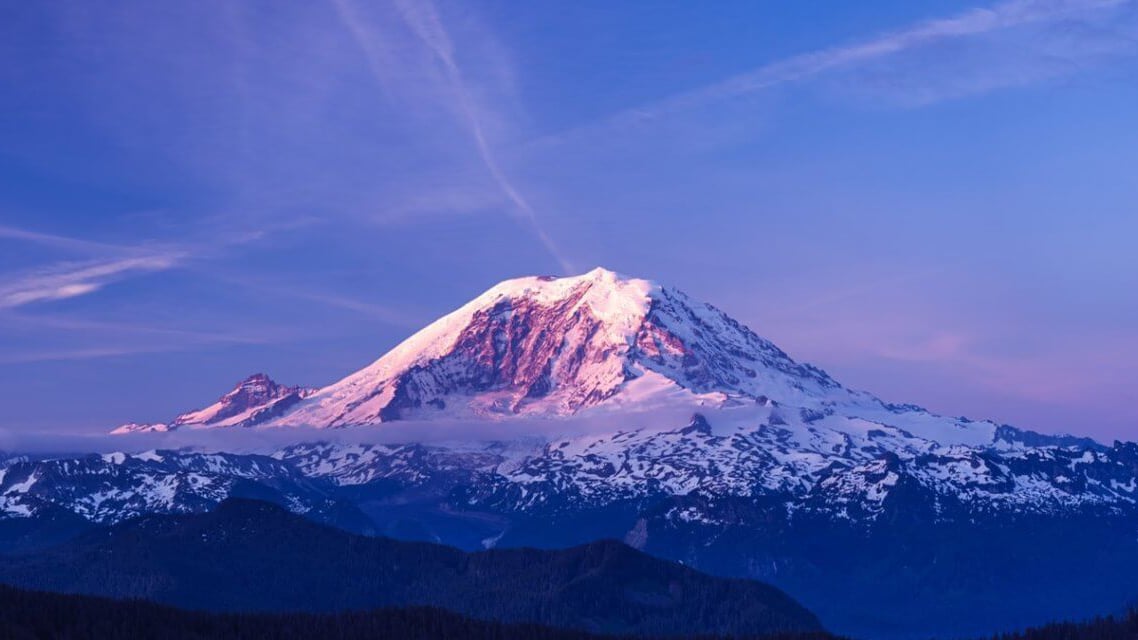
Mount Rainier National Park
Washington's tallest peak, 14,410 feet, with more glaciers than any other mountain in the lower 48 and a wildflower window at Paradise that runs about two weeks in late July and August.
Mount Rainier National Park is built around a single dominant feature. The mountain itself is 14,410 feet tall, an active stratovolcano, and the most heavily glaciated peak in the contiguous United States. Twenty five named glaciers cover its upper flanks. They feed five major rivers and supply the meltwater that keeps Paradise green well after lower elevations have dried out for the summer.
The park was established in 1899, the fifth national park in the country and the first carved out of a national forest. Its 236,381 acres wrap around the mountain in a rough rectangle, and most of those acres are wilderness. Roads reach four developed corners: Paradise on the southwest, Sunrise on the northeast, Ohanapecosh on the southeast, and Longmire on the way up to Paradise. The center is wilderness.
Roughly two million people visit each year. That is forty times the visitation of North Cascades, the next park north, and it concentrates almost entirely between June and September. Outside that window, Sunrise Road is closed under snow, the wildflowers are gone, and Paradise becomes a destination for snowshoers and backcountry skiers rather than day hikers.
In 2026 the park is not requiring timed entry reservations, a reversal from the previous two seasons. That makes spontaneous trips possible again. It also means the busy day pressure on parking has returned in full, and the only real fix is to arrive early or visit on a weekday.
Mount Rainier holds more glaciers than any peak in the lower 48. Twenty five of them, feeding five major rivers that drain off the mountain in every direction.
Hiking in Mount Rainier National Park
Burroughs Mountain: The Closest You Can Get to the Mountain Face on a Day Hike
Naches Peak Loop: 3 Miles of Meadows and Mountain Views Without the Climb
Mt. Fremont Lookout: Mountain Goats, a 1934 Fire Lookout, and Olympic Views on a Clear Day
Comet Falls and Van Trump Park: A Waterfall and a Wildflower Meadow in One Trip
Bench and Snow Lakes: The Quietest Lake Hike on Stevens Canyon Road
Wonderland Trail: The 93 Mile Loop Around the Mountain
Camping in Mount Rainier National Park
Cougar Rock Campground
White River Campground
Ohanapecosh Campground (CLOSED for 2026)
Visiting Mount Rainier and one other national park this year? The pass already pays for itself.
Mount Rainier charges $30 per vehicle for 7 days of access in 2026. The America the Beautiful interagency annual pass costs $80 and covers Mount Rainier plus every other fee charging federal site in the country, including Olympic and North Cascades. If your year includes Rainier and even one other national park, the math is already in your favor. The pass also covers Northwest Forest Pass trailheads on the national forest land surrounding Rainier, which means parking at the Crystal Mountain access points and other adjacent trailheads is included.
Where to Base Yourself for Mount Rainier National Park
Ashford
6 miles west of the Nisqually entrance. Ashford is the closest town to the park and the de facto base camp for Paradise visits. Six miles east of the Nisqually entrance on State Route 706, with a stretch of cabins, vacation rentals, restaurants, and small inns lining the highway. Whittaker’s Bunkhouse, Copper Creek Inn, and the Wildberry Restaurant are the longstanding anchors. Gas, groceries, and last cell service before the park gate. Open year round, which matters because the Nisqually entrance is the only one open in winter.
Packwood
23 miles east of the Stevens Canyon entrance, 36 miles south of the White River entrance. Packwood is the southeast gateway, on US 12 between the Stevens Canyon entrance and the White River entrance, which makes it the only town that gives flexible access to both Paradise (via Stevens Canyon Road) and Sunrise (via SR 123 to SR 410). It has more restaurants and larger lodging options than Ashford, including the Crest Trail Lodge and a handful of vacation rentals. The Packwood Cafe and Mountain Goat Coffee are the morning stops before heading into the park.
Greenwater and Crystal Mountain
14 miles north of the White River entrance. Greenwater is the smallest of the three main gateway towns, sitting on State Route 410 about 14 miles north of the White River entrance. Limited dining and lodging compared to Ashford or Packwood. The real draw of this side is Crystal Mountain Resort, which is a 6 mile detour off SR 410 and offers full hotel style lodging, restaurants, and the Mt. Rainier Gondola in summer. For visitors targeting Sunrise or Burroughs Mountain who want a real bed, Crystal Mountain is the most comfortable option.
Getting to Mount Rainier National Park
Mount Rainier has four road entrances, each serving a different part of the park. There is no public transit option. A car is required.
Nisqually Entrance (southwest): The main entrance, open year round, and the only road into Paradise. From Seattle, take I-5 south to exit 127, then State Route 7 south to Elbe, then State Route 706 east through Ashford to the entrance. Roughly 95 miles, 2 to 2.5 hours. From Nisqually, it is another 18 miles up to Paradise.
Stevens Canyon Entrance (southeast): Open seasonally, typically late May through early November. Connects to Paradise via Stevens Canyon Road and to Ohanapecosh on the east side. From Packwood, follow US 12 west to State Route 123 north.
White River Entrance (northeast): Open seasonally, typically late May through October. The only road approach to Sunrise, the highest point in the park reachable by car at 6,400 feet. From Seattle, take State Route 410 east through Enumclaw and Greenwater. About 110 miles, 2.5 hours.
Carbon River and Mowich Lake (northwest): No longer accessible by road. The State Route 165 Fairfax Bridge was condemned in April 2025 and permanently closed. WSDOT estimates a replacement is at least five years away. Backcountry hiking access only.

Planning Your Visit
The usable window for most of Mount Rainier is mid June through early October. Paradise Road is open year round but conditions are winter driving from November through April. Sunrise Road typically opens between late June and the Fourth of July depending on snow and stays open through mid September.
For wildflowers at Paradise, the prime window is the last week of July through the first week of August. For fall color and fewer crowds, mid to late September delivers golden meadows at Sunrise without the peak summer parking crush.
Timed entry reservations are not required in 2026, but parking is the real constraint. Paradise lots fill by 9am on summer weekends. Sunrise lots fill by 10am. Arrive early or visit Tuesday through Thursday if you have flexibility. Cell service ends shortly past Ashford on the southwest side and Greenwater on the northeast side. Download offline maps before entering the park. Bear canisters are required for all backcountry overnight trips.
Seasonal Events and Highlights
Find a Cabin Near Mount Rainier National Park
Skip the campground lottery. Browse privately owned cabins close to the park on Washington Staycations.
More from EWS on Mount Rainier National Park
Frequently Asked Questions
How much does it cost to enter Mount Rainier National Park?
The entrance fee is $30 per vehicle for 7 days in 2026. Motorcycles are $25, and individuals on foot or bicycle pay $15. The America the Beautiful interagency annual pass at $80 also covers Mount Rainier and is the better deal if you plan to visit any other federal recreation site this year. The park is fully cashless. All entrance kiosks accept Visa, Mastercard, American Express, and Discover.
Do you need a timed entry reservation to visit Mount Rainier in 2026?
No. Mount Rainier is not requiring timed entry reservations in 2026, a change from the 2024 and 2025 seasons. Entry to Paradise, Sunrise, and the rest of the park is first come, first served. The trade off is that summer parking fills early. Arrive at Paradise before 9am and Sunrise before 10am on weekends, or visit on a weekday.
When does Sunrise Road open at Mount Rainier?
Sunrise Road typically opens between late June and the Fourth of July, depending on snowpack and avalanche mitigation. It generally stays open through mid September. NPS posts current road status at nps.gov/mora and announces the opening date when crews complete clearing. Sunrise is at 6,400 feet, the highest point in the park reachable by car, so the road needs more snow removal than any other approach.
Can you still drive to Mowich Lake or the Carbon River entrance?
No. The State Route 165 Fairfax Bridge that carried road traffic to both Mowich Lake and the Carbon River Ranger Station was permanently closed in April 2025 after inspections found a buckling support column. WSDOT estimates a replacement bridge is at least five years away. Mowich Lake, Tolmie Peak, Spray Park, and the Carbon Glacier are now accessible only by hiking 19 miles or more from the nearest open trailhead. For most visitors, this means backpacking or skipping the northwest corner entirely.
What are the best hikes in Mount Rainier National Park?
The Skyline Trail Loop at Paradise is the most photographed, a 6.3 mile loop with continuous mountain views and peak wildflowers in late July. Burroughs Mountain at Sunrise delivers the most dramatic glacier views you can reach on foot, at 9.4 miles round trip. For an easy option, the Naches Peak Loop at Chinook Pass is 3.3 miles with steady views and minimal effort. The Wonderland Trail, 93 miles around the entire mountain, is the long distance backpacking objective most hikers eventually point at.
When is the best time to visit Mount Rainier National Park?
Mid July through mid September gives the widest trail access, the most reliable weather, and the wildflower peak at Paradise. Late July through early August is the prime wildflower window. Late September brings fall color at Sunrise without the summer crowds. Outside this window, Sunrise Road is closed and most high elevation trails are under snow. Paradise is accessible year round but functions as a snowshoeing and ski destination from November through April.
Where should I stay if I want to be inside the park?
Two in park lodges are operational in 2026. Paradise Inn at Paradise is open May 18 through September 30, with 121 rooms in a historic 1916 lodge and adjacent annex. Rates run roughly $313 to $559 per night. National Park Inn at Longmire is the only year round in park option, with 25 rooms at lower elevation. Both book out months in advance for July and August. Reserve through Mount Rainier Guest Services. For more flexibility, base in Ashford for Paradise access or in Packwood for both Paradise and Sunrise.