
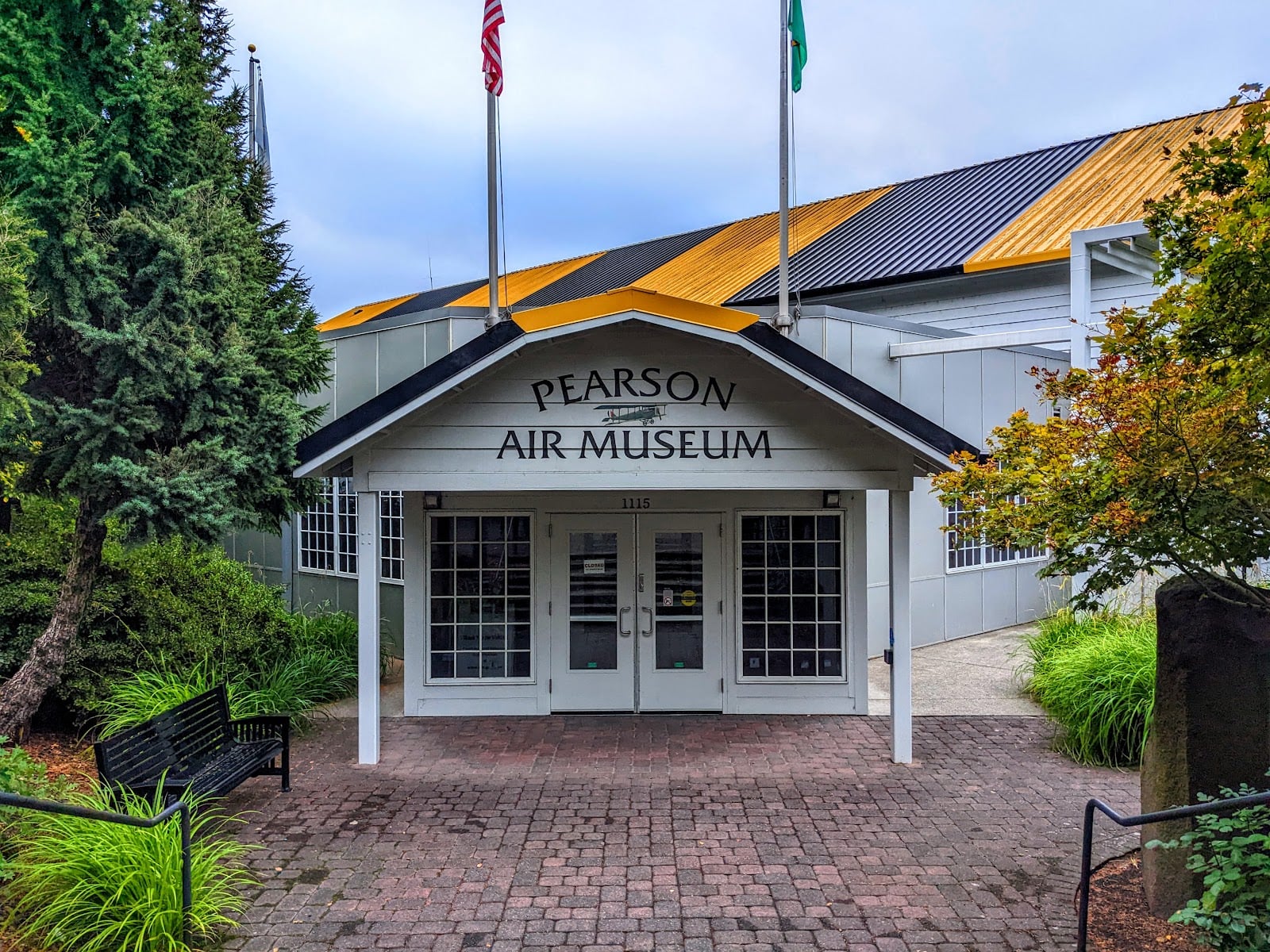
Pearson Air Museum
Photo: Josh via Google Maps
Pearson Air Museum sits at Pearson Field in Vancouver and is part of Fort Vancouver National Historic Site, run by the National Park Service. It tells the story of Pearson Field, which the park service calls one of the country’s oldest continuously operating airfields, and the main gallery fills a hangar on a single floor.
Aviation fans come for the early aircraft, but you do not need to be one to enjoy it. The exhibits cover the field’s earliest dirigible and airplane flights, a giant World War I lumber mill, the field’s Army years and the day a Soviet crew landed here after flying over the North Pole. It is a compact, easygoing museum, and because it belongs to the same national historic site as the fort, it fits neatly into a day exploring Vancouver’s history.
What You’ll See
- World War I era aircraft. A restored DH-4 Liberty Plane and a JN-4 Curtiss Jenny trainer anchor the collection.
- The Curtiss Pusher replica. Park volunteers spent two years building a full scale replica of the 1912 Curtiss Pusher flown by Silas Christofferson, working from original 1912 plans. Christofferson famously took off from the roof of Portland’s 13 story Multnomah Hotel in June 1912.
- Leah Hing’s biplane. The 1931 Fleet Model 7 once owned by Leah Hing, an early Chinese American pilot associated with Pearson Field and the Portland Chinese American Flying Club, joined the permanent exhibits in 2022. Hing earned her pilot’s license in 1934.
- The transpolar flight. On June 20, 1937, a Soviet crew including test pilot Valery Chkalov landed at Pearson after flying nonstop from Moscow over the North Pole in a little more than 63 hours, completing the first nonstop transpolar flight.
- The Spruce Mill. Exhibits explain how the Army built a huge mill on this site during World War I to cut spruce for military aircraft, along with the history of the 321st Observation Squadron.
The Story Behind It
Flight here goes back to 1905, when Lincoln Beachey piloted the dirigible Gelatine to the field, making the first aerial crossing of the Columbia River. The first airplane flight followed in 1911 on the polo grounds of Vancouver Barracks. During World War I the Army’s spruce mill covered 50 acres and produced more than 76 million board feet of aircraft lumber. The field was later named for Lieutenant Alexander Pearson, a decorated Army pilot who died in a 1924 accident.
The museum itself began in 1988. The City of Vancouver ran it for years under an agreement with the National Park Service, and since January 1, 2013, the park service has staffed it directly as part of Fort Vancouver National Historic Site.
Tips for Your Visit
- Free parking is available in the lot next to the museum.
- The museum has accessible entrances, the main hangar gallery is all on one floor, and ADA accessible restroom stalls are available.
- Check the NPS page for the museum’s current schedule before you go, especially if you plan to combine it with other parts of Fort Vancouver National Historic Site.
- Watch the City of Vancouver and NPS calendars for aviation events at Pearson Field, when the museum hosts extra programs.
Plan Your Visit
Address: 1115 E 5th St, Vancouver, WA 98661
Phone: 360.816.6232
Website: nps.gov/fova
Hours and admission: Check the museum website for current days, hours, and admission before you visit.
Directions: View on Google Maps