
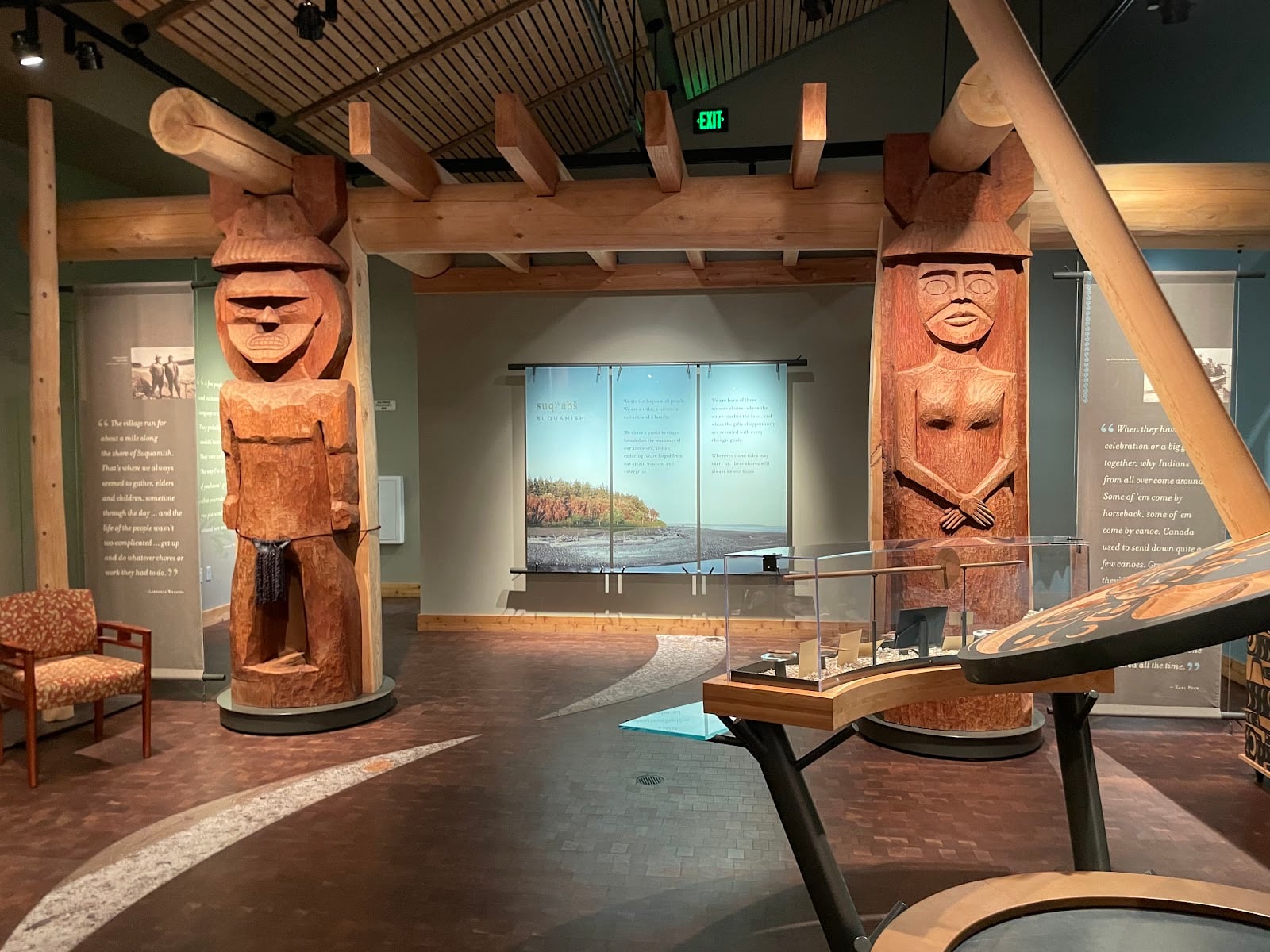
Suquamish Museum
Photo: Rubie Baker via Google Maps
The Suquamish Museum is the Suquamish Tribe’s own museum, set among cedar, hemlock and Douglas fir on the Port Madison Indian Reservation in the town of Suquamish. Its mission is to collect, preserve and teach the living culture and history of the Suquamish people, the tribe of Chief Seattle, whose homelands once spanned the Kitsap Peninsula, Puget Sound and what is now the city that bears his name.
It is about a 15 minute drive from both the Bainbridge Island and Kingston ferry terminals, which makes it an easy add to a Kitsap day. The museum also anchors a walkable cluster of important places, including Chief Seattle’s gravesite and the House of Awakened Culture, so plan to spend time outside as well as in the galleries.
What You’ll See
- The building itself. Designed by the Seattle firm Mithun and opened in 2012, the 9,000 square foot museum was inspired by a nurse log and evokes the longhouse character of the historic Old Man House village. A tideline path set with locally gathered shells winds through the exhibit space.
- The core exhibit. When the building opened, its permanent exhibit was laid out chronologically, with bone needles and slate blades from Old Man House excavations, drums, eating utensils, woven cedar baskets, and a canoe carried by six standing figures that honors the Paddle to Seattle and Paddle to Bella Bella journeys.
- Old Man House artifacts. In 2013 nearly 500 artifacts from the Old Man House site, including harpoon points and jewelry, were transferred to the museum from the Burke Museum.
- The Leota Anthony Museum Store. Jewelry, art and books tied to Suquamish heritage, with purchases supporting the museum’s work.
The Story Behind It
The Suquamish Museum opened in 1983, when it was only the second tribal museum in Washington, and it marked its 40th anniversary in June 2023. The idea began with Lawrence Webster, the eldest son of Julia Jacob and her Makah husband. Punished along with other students for speaking Lushootseed at the Tulalip Indian Boarding School, he held onto the language anyway and played a crucial role in keeping it alive, a legacy that still shapes its revival today.
In 2012 the museum moved into its current LEED Gold building, triple the size of the original. It sits at the heart of the tribe’s cultural district, near Old Man House Park, site of the great longhouse that the U.S. government ordered burned in 1870 and land the tribe regained in 2004.
Tips for Your Visit
- Pick up the museum’s self guided walking tour map, which leads to Chief Seattle’s Gravesite, the Veterans Memorial, the House of Awakened Culture and the Charles Lawrence Memorial Pole and Boat Ramp.
- The upper parking lot has six stalls, including accessible parking. The larger lower lot involves stairs to reach the museum, and RVs and buses park at the corner of South Street and Division Avenue.
- Entrances, restrooms and seating areas are wheelchair accessible, with push button doors at the main entrance and the exhibit area.
- Photos without flash are welcome in the exhibit area. Outside food and drink are not allowed inside.
- Groups of six or more can request a guided tour, which runs 45 minutes to an hour; submit requests at least three weeks ahead.
The museum is currently on a temporary schedule, so check the website before you go.
Plan Your Visit
Address: 6861 NE South Street, Suquamish, WA 98392
Phone: 360.394.7105
Website: suquamishmuseum.org
Hours and admission: Check the museum website for current days, hours, and admission before you visit.
Directions: View on Google Maps