
Columbia Gorge Museum
Photo: Heather Land via Google Maps
The Columbia Gorge Museum, known for most of its life as the Columbia Gorge Interpretive Center Museum, stands on the north bank of the Columbia River in Stevenson, a stone’s throw from the Bridge of the Gods. The stone and glass building, designed to reflect the landscape around it, is set among native plantings and tall cedar sculptures.
Inside, the museum covers the gorge from its cataclysmic geologic formation through the Indigenous peoples of the gorge, the Lewis and Clark expedition, the fur trade and the timber and fishing industries that built Skamania County. It also holds a truly unexpected collection: thousands of rosaries gathered by a single devoted collector.
What You’ll See
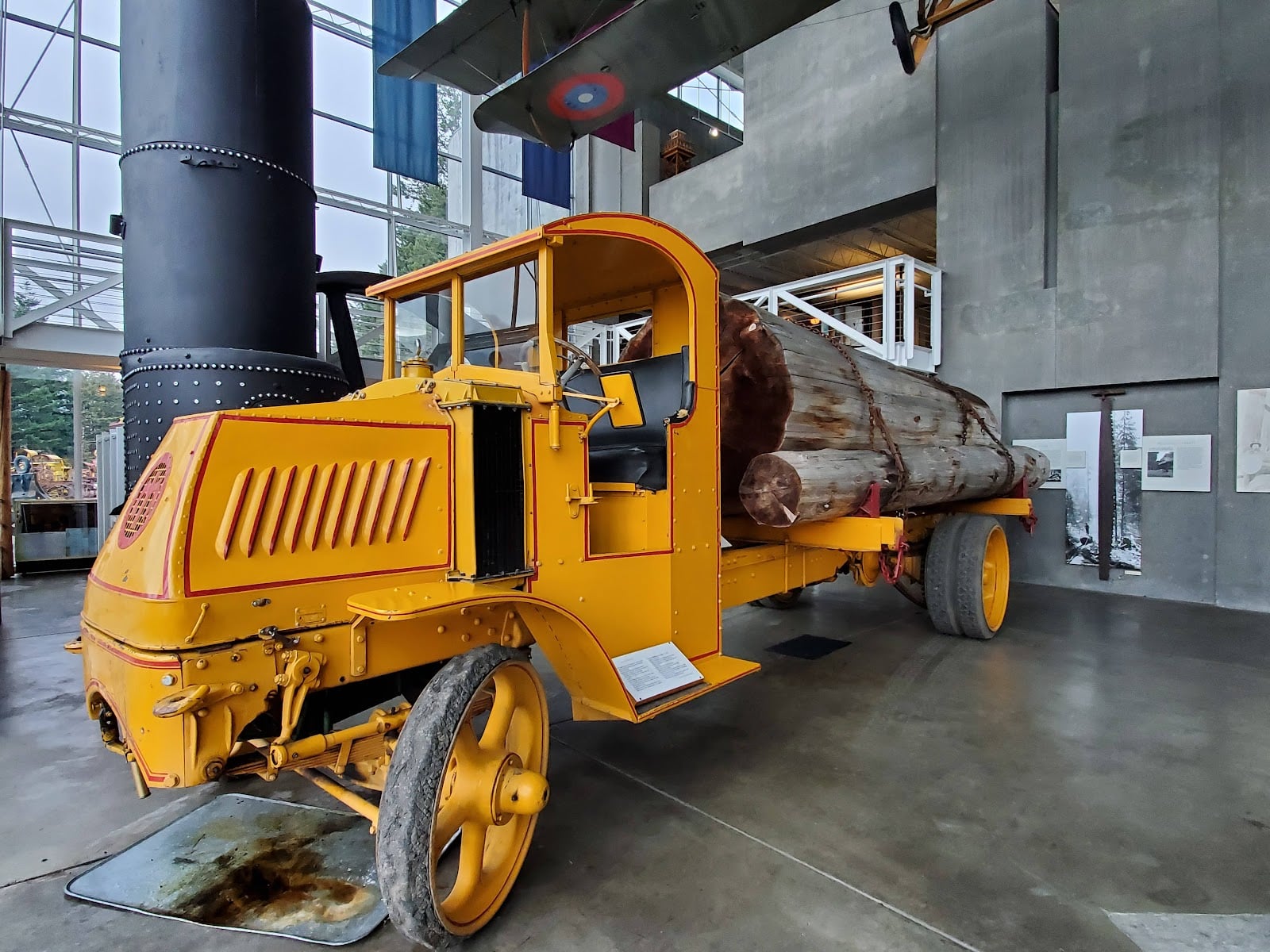
- The Grand Gallery: Big industrial artifacts that tell the story of work in the gorge, anchored by a 37 foot working replica of a 19th century McCord fish wheel, a 1921 Mack logging truck, an 1893 Corliss steam engine and a 1917 Curtiss Jenny biplane.
- Harvesting resources: Exhibits on the region’s timber and commercial fishing industries, with an indoor waterfall that underlines how central the river is to both.
- Indigenous history, Lewis and Clark and early settlement: Artifacts and dioramas trace the First Peoples of the gorge, the expedition’s passage down the river and 19th century fur trading and settlement.
- The Spiritual Quest Gallery: On the top floor, the Don Brown Rosary Collection, which the museum bills as the world’s largest of its kind, with more than 4,000 rosaries made of glass, wood, bone, ivory, fruit pits and even bullets. Among them is a rosary John F. Kennedy carried during World War II.
- Never Forget Garden: A memorial garden of engraved bricks honoring veterans and service members.
The museum also hosts rotating art and history exhibitions, so there is often something new alongside the permanent collection.
The Story Behind It
The museum grew out of the passion of Donald A. Brown of North Bonneville, who in 1926 helped his father found the Skamania County Historical Society. Brown began collecting rosaries in 1917 and kept at it for more than six decades, cataloging every piece. In 1973 Ripley’s Believe It or Not designated his collection the world’s largest of its kind, and that same year he donated it to Skamania County on the condition that it be displayed to the public. That gift led to a small county museum in the basement of the courthouse annex, with a separate room for the rosaries.
The small museum eventually evolved into the Columbia Gorge Interpretive Center Museum, which opened in its current building in 1995 and is owned by the Skamania County Historical Society. In 2023 it took the shorter name it uses today, the Columbia Gorge Museum.
Tips for Your Visit
- Head upstairs to the Spiritual Quest Gallery for the rosary collection. The museum notes it is displayed as an art form, not maintained as a place of worship, and visitors of many faiths enjoy it.
- Groups of 10 or more are asked to schedule a reservation in advance.
- Hours change with the seasons, so check the museum website before you make the drive.
- Pair your visit with the Bridge of the Gods and the Stevenson waterfront, both close by.
Plan Your Visit
Address: 990 SW Rock Creek Drive, Stevenson, WA 98648
Phone: 509.427.8211
Website: columbiagorgemuseum.org
Hours and admission: Check the museum website for current days, hours, and admission before you visit.
Directions: View on Google Maps