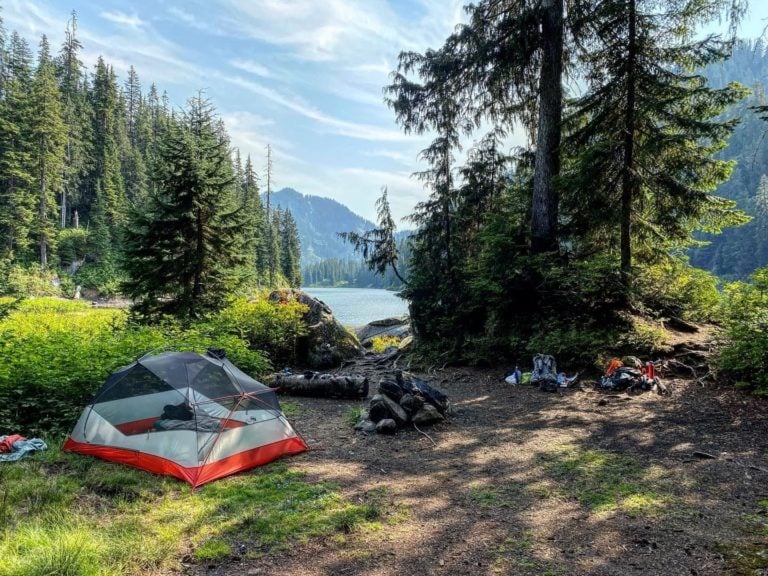
Fairfax Bridge near Mount Rainier National Park
A 103-year-old bridge? 250ft tall? On the way to Mount Rainier National Park? Sounded like something we should check out.
UPDATE: April 25 2025
End of an Era: The Historic SR 165 Carbon River Bridge Closes Permanently
After more than a century of service, the historic SR 165 Carbon River/Fairfax Bridge near Carbonado has officially closed for good. Originally opened in 1921, this narrow, single-lane bridge was a gateway for travelers heading toward Mount Rainier’s Mowich Lake entrance and Carbon River Ranger Station.
Following a recent inspection, serious deterioration was discovered in the bridge’s steel supports, prompting officials to make the tough call to close it permanently to vehicles, bikes, and pedestrians. Photos show the aging support columns starting to buckle — a clear sign the bridge could no longer safely carry the weight of travelers.
While this closure cuts off direct public access from SR 165 to some beloved outdoor areas, emergency detours are in place for first responders and local property owners. Unfortunately, there’s no public detour at this time.
What’s next? The Washington State Department of Transportation (WSDOT) is studying options, including replacing the bridge or realigning SR 165 altogether. Public open houses (both in-person and online) are planned after Memorial Day to gather input. No funding is currently secured for a replacement, but conversations are underway at the state level.
This closure marks a bittersweet goodbye to a bridge that stood strong for generations of explorers. We’ll be watching closely as plans for the future unfold — stay tuned!
Explore Washington State will continue to monitor the WSDOT for updates. At this time NO ETA is known for when a decision will be made of the future of the Fairfax Bridge.
Where is the Fairfax Bridge?
The Fairfax Bridge sits just south of Carbonado, WA (about 50 miles south of Seattle) in Pierce County. It’s on Highway 165 as you follow the Carbon river heading towards the Carbon River Ranger Station or Mowich Lake. Its 494ft length spans a steep, densely-wooded canyon and cars have to take turns going either direction due to it’s narrow construction.
Although driving across it gets you some glimpses of the Carbon River below, the real treat is when you pull off on the west side and walk along the bridge, or on one of the trails on either side. It is steep on both sides of the bridge. And as tempting as it looks, don’t try hiking down to the river. It’s pretty darn steep, and we found that there was a 40-foot drop off once you got to the bottom. So pictures didn’t really turn out there and we ended up covered in moss, mud and thorns with not much to show for it. Maybe there is a path we didn’t notice? If so, let us know 🙂
A Unique Design
The bridge itself is what engineers call a “three-hinged steel arch”. This is opposed to, well, whatever other bridges are, and apparently used to be a popular design in European countries. It is one of the three remaining in Washington state, making it a rare beauty.
A great explanation on the use of arches on bridges, can be provided by J.A.L. Waddell, a civil engineer and “prolific bridge designer,” of that time. An excerpt from his book, Bridge Engineering: “Arches are employed very generally in Europe on account of their superior appearance as compared with simple-truss bridges, and because of the powerful influence of the old masonry arch upon the minds of European bridge designers, regardless of the consideration of economy.
American engineers, on the other hand, have been indifferent to the question of aesthetics, and have preferred simple spans to arches mainly for reasons of simplicity and economy, but sometimes on account of their greater rigidity. Another reason why the arch has not been used much in American practice is that the conditions, which make it economical, are not met with as frequently in this country as in Europe. For deep gorges with rocky sides, or for shallow streams with rock bottom and natural abutments, arches are eminently proper and economical.”
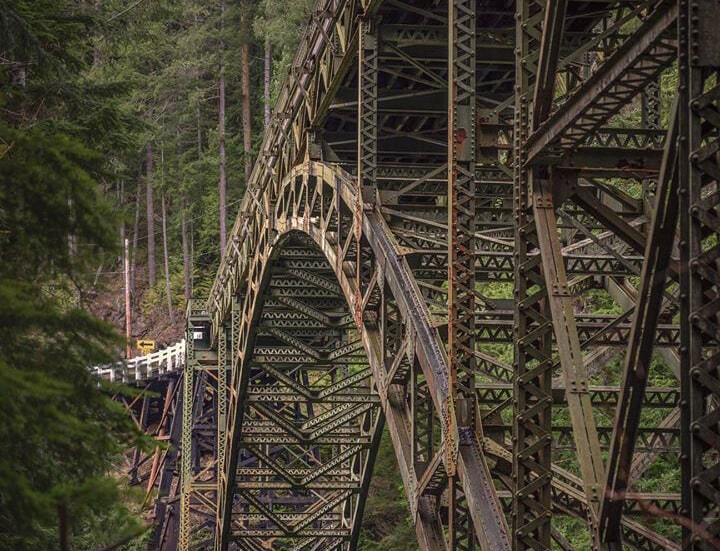
At the time of its construction in 1921, it was the highest bridge in the state. Now that honor goes to the Vance Creek Bridge, built in 1929 and standing almost 350 feet above the ground below. But Fairfax holds the honor of being listed on the National Register of Historic Places back in 1982.
Why It Was Built
The original purpose of the bridge was to help fuel the coal mining boom in the area in the 1920’s. Fairfax and Melmont, two nearby towns, saw an increase in population and demand for coal. Over 250,000 tons of coal were being produced per month by coking ovens, which was putting a strain on the horses or railways going out of their way to get coal to where it needed to be. So for about $80,000 (which is about $1,016,593.81 with inflation, today) the solution was designed, and erected.
(Note: One source said it cost around 500K to build, but the $80,000 figure seems more reliable.) Originally named the “James R. O’Farrell Bridge,” after the County Commissioner, its name was later changed.
Sadly, by 1941, the coal boom had ceased and Melmont was a ghost town. The want and need for coal all but disappeared once oil and gasoline were seen as being more efficient. The Fairfax Hotel, and town school burned to the ground. The Carbon River washed the railroad bridge away, leaving few signs that those small mining communities existed.
But that’s the fun of visiting here. The spookiness of the past, if you’re able to even find it. If you wander for long enough, you might be able to find the Fairfax swimming pool, or at least its foundation, or small pillars of once were speakeasies, homes and more that once belonged and were frequented by coal miners, loggers and residents.
Enjoy the view, soak in the history and try to find signs of the past, we promise, you won’t forget it.
- About the Author
- Latest Posts

Explore Washington State has been covering the real Washington for more than a decade. State parks, small towns, back roads, rest stops, and the people who make this place worth exploring. What started as a hyperlocal project covering individual communities grew into a full media project with more than 340 podcast episodes, a weekly newsletter with 3,800 subscribers, and coverage of all 146 Washington State Parks. The content here comes from people who have actually been to these places: locals, regulars, and lifelong Washington residents who care more about getting it right than getting clicks.