
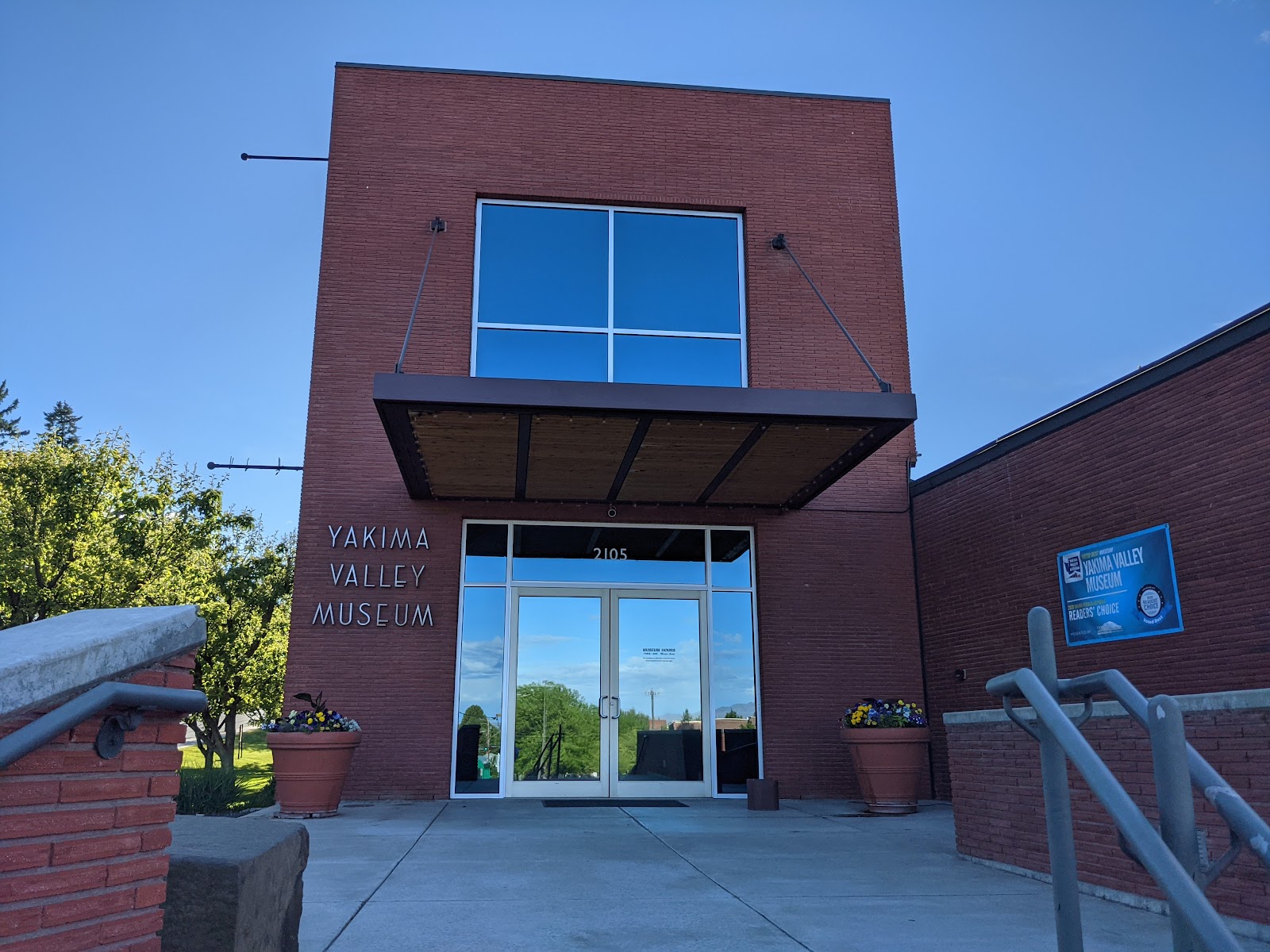
Yakima Valley Museum
Photo: Gary O Paulson via Google Maps
The Yakima Valley Museum on Tieton Drive is the place to understand how the valley became what it is, from the Yakama people and ancient basalt forests to stagecoaches, orchards and vintage neon. The museum describes itself as one of the largest cultural history museums in the state, with 65,000 square feet and more than 48,000 objects, and it is fully accredited by the American Alliance of Museums.
It sits beside Yakima’s Franklin Park, pitches itself as a mix of local history, vintage exhibits and family friendly fun, and has a working soda fountain inside, which makes it an easy stop whether you are a history buff or traveling with kids.
What You’ll See
- Carriages and cars: the museum has 38 animal powered vehicles, including an 1875 hearse, a Concord stagecoach from around 1850, Brewster carriages from about 1890 and a 1910 sheepherder’s wagon complete with stove, table and bed. Visit Yakima calls it the largest collection of wooden wagons west of the Mississippi.
- Yakama Native American artifacts: more than 400 artifacts on display, including baskets, beadwork, parfleches and horse gear made by Yakama, Klickitat and Nez Perce people.
- William O. Douglas: a recreation of the Supreme Court justice’s office in Washington, D.C., furnished with its actual contents, which came to the museum after Douglas died in 1980. Douglas grew up in Yakima.
- Fossils and neon: the Helen N. Jewett Basalt Gallery holds four Miocene tree trunks and ten slabs of petrified wood from trees that grew here 15 million years ago, and it ends with Dick Elliott’s neon artwork Circle Squared, which inspired the museum’s logo.
- A live beehive: a glass paneled hive connected to the outdoors by a clear tube, a reminder of how much the valley’s fruit depends on pollinators.
- Japanese pioneers: a long running exhibit tells the story of the Japanese families who settled in the valley around the turn of the twentieth century.
The Story Behind It
The museum traces its roots to 1917, when a first museum opened in a log cabin clubhouse at the State Fairgrounds, only to be lost to fire several years later. In 1951 the local chapter of the Daughters of the Pioneers of Washington opened a museum room in the basement of Yakima City Hall, and in 1957 a 12,000 square foot brick museum went up beside Franklin Park with help from the Alexander Miller Trust and the community.
The collection grew from there. In 1975 a group of Yakima businessmen donated the William L. Gannon collection of horse drawn vehicles and Native American material, the core of two of today’s signature galleries. Community campaigns expanded the building to 56,000 square feet in 1989 and to its present 65,000 square feet in 2002, and the soda fountain opened in 1996. The museum also owns the Horace M. Gilbert House, an 1898 orchard house three blocks away.
Tips for Your Visit
- Plan lunch at the museum soda fountain, which serves sandwiches and made from scratch soups. Visit Yakima describes it as an operating 1930s Art Deco soda fountain.
- The bees leave for winter and return in spring, so visit in the warmer months if you want to watch the hive.
- Researchers can book time in the Sundquist Research Library and Archives, which the museum calls the principal regional repository devoted to local history.
- Special exhibitions rotate alongside the permanent galleries, so check the exhibits page before you go.
Plan Your Visit
Address: 2105 Tieton Dr, Yakima, WA 98902
Phone: 509.248.0747
Website: yvmuseum.org
Hours and admission: Check the museum website for current days, hours, and admission before you visit.
Directions: View on Google Maps