
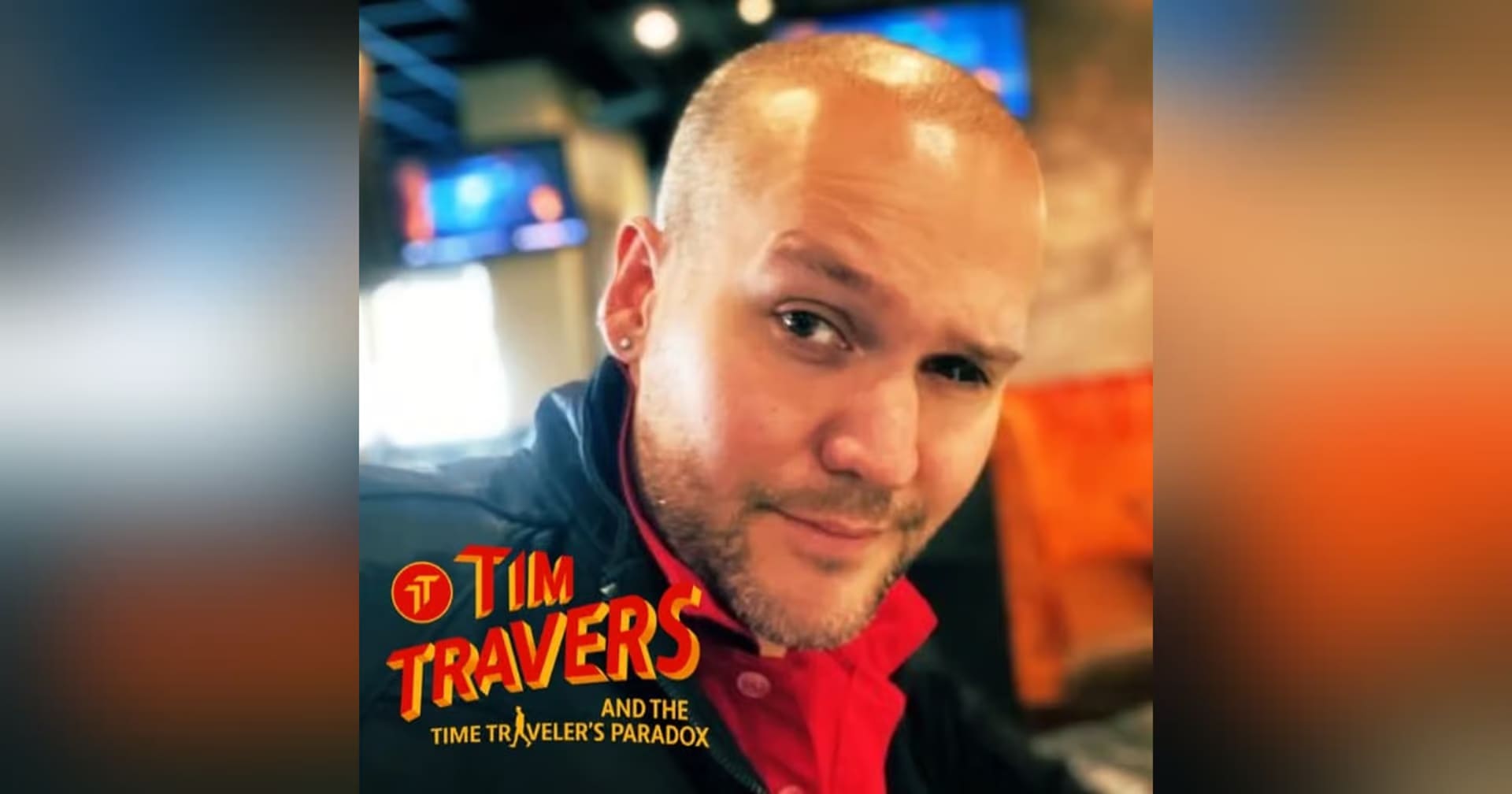
Let’s Chat with Stimson Sneed: Behind the Scenes of “Tim Travers and The Time Traveler’s Paradox”
Meet Stimson Sneed, the writer and director of the film “Tim Travers and the Time Traveler’s Paradox,” Join us as we take a captivating behind-the-scenes look at the ambitious journey of bringing this cinematic creation to life. From the intensive scriptwriting process to the challenges of filming in Washington State, Stimson Sneed shared compelling insights into the making of his innovative movie.
From Short Film to Feature-Length Production
Originally conceived as a short film, “Tim Travers and the Time Traveler’s Paradox” underwent a transformative evolution into a full-length feature within a remarkable 90-day window. Stimson’s vivid account sheds light on the unforeseen challenges encountered during filming, including the impromptu need for additional scenes to adapt to weather conditions and creative considerations.
Collaboration and Casting: Bringing the Characters to Life
Stimson provided an intriguing glimpse into the casting process, detailing the significance of established relationships and his personal connections in securing the talents of renowned actors such as Danny Trejo, Keith David, and Felicia Day. With each actor’s unique contribution to the film, Stimson articulated the careful negotiations and fittings that shaped their roles within the narrative, underscoring the collaborative effort that characterizes the art of filmmaking.
The Journey to the Seattle International Film Festival
Stimson Sneed’s anticipation for the Seattle International Film Festival was palpable as he highlighted the emotional significance of showcasing his film in a region entrenched with personal significance. The festival’s role as a platform for amplifying the film’s visibility and setting the stage for potential future projects underscored the professional impact of this momentous event.
Captivating Audiences: The Essence of “Tim Travers”
“Tim Travers and the Time Traveler’s Paradox“ promises to engage audiences with its unconventional approach to time travel and a narrative that celebrates self-discovery. Stimson Sneed’s revelations about the thematic depth of the film and the significance of its screening at esteemed film festivals unveil the underlying essence of this cinematic creation.
Stimson Sneed Episode Transcript
Hello, friends, and welcome to the exploring Washington State podcast. My name is Scott Cowan, and I’m the host of the show. Each episode, I have a conversation with an interesting guest who is living in or from Washington State. These are casual conversations with real and interesting people. I think you’re gonna like the show. So let’s jump right in with today’s guest. Full disclosure, this is my 2nd time sitting down with Stimson Snead. We had some technical difficulties and Simpson was kind enough to sit down again.
Scott Cowan [00:00:34]:
Stimpson is the writer and director of Tim Travers and the Time Traveler’s Paradox, a film that’s gonna be shown here at the Seattle International Film Festival a little bit later in May. I believe on 10th 11th are the two dates, and you’re gonna be doing q and a at both, after both screenings. So that’s kinda cool.
Stimson Sneed [00:00:50]:
Welcome back. Perfect.
Scott Cowan [00:00:52]:
Welcome back. I’m gonna do a kind of a summation. I know more about you now than we did before. You graduated from Eastern Washington University. You are currently residing in Los Angeles area. Tim Travers and the Time Travelers Paradox is a full featured movie that was done after you did it as a short. There was a whole bunch of filmmaking. Well, I’m gonna let you tell that story.
Scott Cowan [00:01:16]:
How is how come Tim Travers is now a full featured movie? Let’s go.
Stimson Sneed [00:01:21]:
Well, I’m excited to answer these questions that I definitely haven’t heard before. Definitely coming at this 100% blind off the cuff
Scott Cowan [00:01:31]:
Perfect.
Stimson Sneed [00:01:32]:
Practice. Who are you? Tim Travers was originally a short film. We were gonna be doing this feature called Treat Street with North by Northwest, which is the biggest best studio in Washington Scott over in Spokane. But I didn’t wanna be the most inexperienced person on set. And I had this script for a short film called Tim Travers that I kinda thought was too weird to produce. But because I needed to do a short with this studio to prep myself, this was my chance to go for broke and do something completely ridiculous, something really vain. Just for me, this is meant to entertain an audience of 1, and that one is me. But the crazy thing happened when we got to festivals, people loved it.
Stimson Sneed [00:02:13]:
We did phenomenal, number of festivals. We got a huge number of rewards. Great, great press, and everybody was really happy. So a year later, when the budget for the film we had been prepping to do fell through, We were stuck in this horrible position that we had crew, we had budgets, we had timelines. We just didn’t have as much money as we thought we were gonna have, and, unfortunately, not nearly enough money to do the project we planned on. And I realized we’re in this now or never moment. So if I’m gonna make a movie, I’ve gotta do it right now because we’ve got all the materials prepped. So we decided to do the Tim Travers short as a feature.
Stimson Sneed [00:02:53]:
And so we went into it 90 days before rolling camera without even a script ready, and it was just madcap how that came together.
Scott Cowan [00:03:03]:
Yeah. I mean, I can’t imagine, based on our other conversation, and I’ve learned more about filmmaking in our conversation before, I can’t imagine how you managed to pull this off in 90 days. So Well, that’s
Stimson Sneed [00:03:16]:
when I talked about how good North by Northwest is. This is where I just Scott a I know this I swear I’m not trying to suck up to the Washington Scott community because this is a Washington podcast, but it really is the truth here. North by Northwest, now called Northwest Passage, has been the biggest studio in Washington state for 20 years. Multiple TV shows, the, dozens of movies. The show z nation, all of that is them. So when it came time to do this project, the way we did it in that 90 days prep was trusting them. That was a lot of me keeping my hands off the wheel. Like, alright.
Stimson Sneed [00:03:53]:
I’m here to make sure that we start rolling camera on time, that we’re gonna have a script, we’re gonna have a cast, and that I make myself available 247 to anybody in the creative team who needs me. But from an organizational standpoint, it really became a case of me politely deferring to the more experienced people in the room.
Scott Cowan [00:04:12]:
Okay. So 90 days in, you guys roll camera.
Stimson Sneed [00:04:17]:
Yeah.
Scott Cowan [00:04:18]:
And If I remember
Stimson Sneed [00:04:19]:
what a hell of a day that was. Okay.
Scott Cowan [00:04:21]:
Well, let’s talk about that. We haven’t talked about that before. What was the first day on set like?
Stimson Sneed [00:04:25]:
Hell. Okay.
Scott Cowan [00:04:27]:
And moving on to the next topic. No worries. What
Stimson Sneed [00:04:29]:
I spent my, I have spent my adult life waiting to do a fully budgeted feature film. I have been waiting so long for this moment. And day of 1st day of shooting, we had over a foot of snow come down in 1 night. First, I couldn’t get to my own set. I had to call the lead actor because I knew that the car we rented for him while he was in town was a Jeep Wrangler and asked him to pick me up and drive me in. So 1st day of filming after building to this for my whole adult life, the lead actor had to drive me into work because I couldn’t get out of the driveway of the place I was living.
Scott Cowan [00:05:10]:
That’s funny.
Stimson Sneed [00:05:10]:
Oh.
Scott Cowan [00:05:11]:
That that is okay. Alright.
Stimson Sneed [00:05:13]:
It was actually a very good day of filming, but, boy, howdy, did we all get off to a rough start. Easily, half the crew was, like, 10 to 15 minutes late. The snow is so bad.
Scott Cowan [00:05:21]:
Oh my gosh. Okay. So this was filmed in Spokane, which is, you know, in Eastern Washington, we can obviously get a lot of snow there quickly.
Stimson Sneed [00:05:28]:
Just a little bit. Yeah. Just a little bit.
Scott Cowan [00:05:30]:
Just a little bit. Unlike though, I mean, if we’re gonna live, we’re gonna have a little fun here at Seattle’s expense, you know, an inch of snow in Seattle causes the city to curl up in a ball and panic where Eastern Washington, they they handle it a little better.
Stimson Sneed [00:05:43]:
Yeah. I have found a weird pattern with that. I think it seems to be like the nicer the weather, the more people freak out. I used to make fun of Seattle lights for freaking out about snow snow Mhmm. When I grew up in Seattle. Now that I spend half my time in LA, I’m laughing at the Los Angeles who react to rain the way Seattleites react to snow. And also in LA, if it rains for more than 2 consecutive days, they act like the world has ended.
Scott Cowan [00:06:10]:
Yeah. That’s that’s that’s a fair fair at least that’s how the media portrays it to me. I haven’t been down in LA in a number of years, but the media certainly pokes fun at Southern California when it’s, you know
Stimson Sneed [00:06:20]:
It it is an accurate stereotype. Every time every time I’m in LA and people are complaining about the rain, I just think back to Bane in The Dark Knight Rises going, you found the dark. I was born it. That’s how I feel about rain.
Scott Cowan [00:06:35]:
Okay. Well, one of the things I always ask my guests is about coffee. And since we’ve already had this question, you but we’re gonna jump to it early because you sat down and wrote a lot of the script in a coffee shop in Spokane.
Stimson Sneed [00:06:48]:
Yeah. Arctos Coffee in the north side of Spokane because I was already in town. I’d already been living in Spokane for about a year at the time we went into this. So that was just a spot that a friend of mine recommended where I could sit there with my laptop, plant my ass for 8 hours a day, just madcap trying to, to will this script into existence because, because we didn’t have 90 days to write it. We had 30 days to write it because we had to get into preproduction. So sets could be built, props could be, props could be accumulated, schedules could be made for actors coming in from out of town. There’s a huge amount of work that all depends on the script. So my goal at the end of that 30 days wasn’t to have a good script Mhmm.
Stimson Sneed [00:07:32]:
But was to have a version that structurally, in terms of scenes and stuff like that and props, would be a 95% there structurally. Just not good writing wise. And then I could take the next month to massage it out when I was no longer to the time crunch. But there was like just 30 days of me just trying to will this thing into existence. And I was just sitting right there in Arctos coffee, chugging the, those the water the sparkling waters because I can’t drink coffee.
Scott Cowan [00:08:02]:
Yeah. This almost seems like a cruel cruel cruel fate to have to sit in a coffee shop or to sit in a coffee shop and not consume coffee. It’s At
Stimson Sneed [00:08:09]:
least I can still smell it because I do I do love coffee. I don’t my not drinking coffee is not by choice. This is something hoisted upon me for health reasons. This is not a a choice that I willingly accept it.
Scott Cowan [00:08:22]:
Alright. I have a question for you. You said you got the script 95% of the way framed up, let’s say, in in Scott release. So the movie runs how many minutes is run time on the movie?
Stimson Sneed [00:08:33]:
It is a 103 minutes. Although for some baffling reason, we keep getting reported on as being a 110 minutes. I don’t know where that’s coming from. That’s not anyone on my team, but we are a 103 minutes.
Scott Cowan [00:08:43]:
A 103 minutes. So how how many pages was the script for a 103 minutes?
Stimson Sneed [00:08:50]:
Right around 97 pages. So with screenwriting, the there’s actually a lot of reason, filmmaking keeps very, very strict to how you write a screenplay. It’s not like books or comics. I mean, it is very, very formalized. There’s a reason for that because the script is never the final product with the movie. The movie is. So we structure scripts the way they do because if you’re doing it right, one page is 1 minute. So So what we’re taking
Scott Cowan [00:09:16]:
Cowan the page? What
Stimson Sneed [00:09:18]:
Oh, the way it’s work. Okay. So a typical scene is gonna go, interior. Because the first thing it’s gonna tell you is where is it because that’s gonna tell the crew and the set what needs to be acquired. Interior, office building, day or night. It’s not gonna say afternoon or morning because that stuff you tweak with lighting day or night. That’s the part that’s relevant. So first, it tells you where it is, and then it will give you whatever description is necessary and sometime no description necessary at all.
Stimson Sneed [00:09:46]:
In this case, it’s just Stimson is at his computer on a Zoom call with Scott Cowan. Got it. And then it’ll have my name, and then under it, my line.
Scott Cowan [00:09:57]:
Okay.
Stimson Sneed [00:09:58]:
And each of these is spaced out a given amount, to make sure it’s using a certain amount of space because it takes a certain amount of time for things to happen, And that’s what makes it the 1 minute. Now a bad screenwriter is someone who’s trying to keep to the format, but they want it to look short. So they’re trying to cram in more detail on a page so that you don’t actually get that 1 page, 1 minute. Because it’s never gonna be exactly that. With television, it will come down to exactly 1 page, 1 minute, because there are teams of producers and editors to ensure that it comes in exactly at the runtime because that’s how they can make sure there’s commercial breaks and timing. With a movie, you’ve got a little bit more wiggle room. Maybe there was a scene on the page that you thought would flow faster, but the way the actor was playing it was so good. You didn’t wanna speed them up.
Stimson Sneed [00:10:45]:
So we were 97 pages, came in at a 103 minutes. So we were off by about 6 minutes, which is pretty good. And the other big problem you’ll get a lot of time, especially on the indie scene, is they will get so obsessed with their own writing that a 90 page script will be a 70 minute movie. So good screenwriting in addition to just being good storytelling and writing is also a very mechanical process. Like, you’ll have some writers who will literally just have one sentence on an entire page. We see the city because that writer knows they want a whole minute to be devoted to just seeing a place and soaking up the atmosphere. And they won’t bother describing every little detail. They’ll just say, we see the city and the rest of
Scott Cowan [00:11:28]:
the page is blank. Okay. So so you were the screenwriter?
Stimson Sneed [00:11:32]:
Yeah. That’s the other thing with that. A lot of the times the director will look at these screenwriters choices and go, I’ll keep your dialogue, but I’m doing my own thing. In my case, because I am the screenwriter, I can say, I like that writer. I got on really well with my writer on this. Couldn’t stand my director. Utter prick.
Scott Cowan [00:11:50]:
Yeah. So walk me then through as the director. You’re looking at that page, and the scene is, you know, Stimpson’s on a Zoom call with Scott.
Stimson Sneed [00:12:00]:
The the it’s easier in that case because with being the writer, everything I was writing, I knew already knew how I wanted to film it. So there would be some cases where I was actually being a little lazy as a writer. So let’s say, I know there’s a particular way I wanna frame a shot when I’m writing, which I don’t bother to include that because as the director, I already know how I’m gonna decide to do it later on. Whereas if you’re not the director, a lot of the time, the writer, they can’t describe a shot. That’s not their job, but they can describe what is meant to be seen. So let’s say you’re imagining a close-up. You would say, Stimpson sits down, grabs his can of Celsius. But the way that you would focus in on that in the writing is a Stimpson pauses, curls his fingers around the can of Celsius, letting his thumb rest on the sea.
Stimson Sneed [00:12:48]:
Mhmm. Because that’s such a detail specific. The only way to film that would be to go into a close-up. So even though I never used the words close-up, I never gave a shot instruction. I described it in such a way that the only way to convey that is with a close-up. That’s how writers will do that sneakily. Now on Tim Travers, because I was also directing, I kind of skipped a lot of that process. Now the flip side, because I already knew now the flip side is say I was writing and directing something, but I didn’t control the purse strings.
Stimson Sneed [00:13:18]:
Then I would be trying to gussy up and pretty up my script as much as humanly possible because I’m trying to sell it to somebody else. So, typically, most films will often have different versions of the screenplay. It’ll be the same basic story, same dialogue, same structure, but they will oftentimes rewrite it to cater to the audience. What you show to investors is different than what you’re bringing on set.
Scott Cowan [00:13:44]:
Interesting.
Stimson Sneed [00:13:45]:
Okay. Because you’re wanting to sell the investors on the story, and the investors don’t have a movie to watch. The movie doesn’t exist yet. The script is all they got. So you might make that a little bit more sellable just for them.
Scott Cowan [00:13:57]:
Got it. Okay.
Stimson Sneed [00:13:57]:
And then have something a little more streamlined on set. We even have another version. A lot of productions still do this. Some don’t. Well, they have what’s called a shooting script, which is a 2 sided version of the same script where on one side, you have the original script as written. On the other side, you have full shot lists and breakdown and stuff like that. There’s a lot of different ways to do it. The only really consistent factor is screenwriting format is very, very specific.
Scott Cowan [00:14:20]:
Got it. Alright. Couple of thoughts because getting talent to appear in your film without a Scott, how do you how did you convince, you know, an actor that this was a vehicle for them?
Stimson Sneed [00:14:37]:
Well, that’s interesting. In this case, we didn’t. We didn’t actually offer roles until the script was ready. Just because we’re too small as a team. We can’t but a lot of the times you’ll attach actors based on the reputation of the director, based on the reputation of the source material, if it’s, drawn from, like, a really good book or something like that. We were a small team Scott based on anything. And if we had gone out to some of the big actors we wanted to talk to without the script, we probably would’ve gotten a no on default just because we’re an unknown property.
Scott Cowan [00:15:08]:
Right.
Stimson Sneed [00:15:09]:
The actors need to see the script to know that I’m competent and that they’re not gonna embarrass himself, or I’m not gonna try to put racist words or something like that in their mouth. They need to, they need that for their own peace of mind. The other issue, and the real way to do this is you get a very well respected casting director because the casting director is involved from the very beginning. They know the script inside it out. If the script is still in process, they know the characters inside it out because they sat down with the writers at length. And because a casting director is a trusted party, they kind of act as your access. So like if I had an unknown casting director, it wouldn’t do me any good in something like this. We had a casting director named Ronnie Scott.
Stimson Sneed [00:15:52]:
Ronnie is a living legend in the industry. Little films like pulp Cowan, reservoir dogs. That’s Ronnie Yeskel’s work.
Scott Cowan [00:15:59]:
Never heard of them.
Stimson Sneed [00:16:00]:
Exactly. Yeah. A little 80 films. Yeah. But because of that reputation, actors and and their agents know that if Ronnie is offering them a project, it’s going to be a legit project with a trustworthy team. So my name doesn’t add credibility. Hers does.
Scott Cowan [00:16:16]:
So how did you get her on board?
Stimson Sneed [00:16:19]:
I didn’t. Okay. I interned for her 10 years ago. So we’re old friends. I was one of her unpaid people say internships go nowhere. Mine got me, Ronnie, which got me my celebrities. So I was an unpaid intern for her back in my mid twenties, way back in the day. So we’re just old friends.
Scott Cowan [00:16:42]:
So so Ronnie then well, one thing you, we said before, and this I’m just going to say this is, you know, wasting time here, but, but the point is whenever we have to rerecord an episode, I wanna reference so much what we talked about, but it’s almost like it’s, you know, it’s a inside story between you and I. But we’re having fun.
Stimson Sneed [00:17:01]:
I’m feeling more rehearsed this time. I feel like I’m on the ball. Yeah.
Scott Cowan [00:17:05]:
But but Joe McHale was already on Treat Street. Treat Street. So he he was willing to be on this project because his time had already been blocked for Treat Street. Correct?
Stimson Sneed [00:17:19]:
Treat Street would have filmed a month sooner, so it wasn’t exact, but he was already attached to Treat Street. So he already knew my writing style. He already, we had not met at that time, but we knew each other by reputation. He knew my writing for Treat Street. And more importantly with Joel, he really wanted to to support, Washington filmmakers, particularly on the independent scene. Joel is a Seattle guy himself, born and raised in the area, and he still comes up to Washington a lot. We had several people on set who were just old friends of his. Dan Merchant, the showrunner for the, show going home, which was being filmed on the adjoining stage, is old friends with
Scott Cowan [00:17:59]:
him. So a lot of that was Joel doing this out of the kindness of his heart.
Stimson Sneed [00:18:04]:
We still didn’t approach him, though, until the script was ready because I just don’t have that kind of relationship. But I hope to I I think I do now, but I did not at that time. So the script needed to be presentable.
Scott Cowan [00:18:16]:
And I thought it was because you had a very small part in an episode of community and that you bonded so connect so quickly on that show.
Stimson Sneed [00:18:24]:
That is a random coincidence that I did not bring up with him until he was already physically on my set.
Scott Cowan [00:18:32]:
Okay.
Stimson Sneed [00:18:32]:
I went out of my way not to bring that up. I was one of the young gay boys in the gay bash episode of season 3. And what to this day, I’m convinced is a shockingly bad casting decision. I was in the worst health of my life. So you walk on set. It’s meant to be this young LGP 2 party. Everybody is good looking and shirtless and handsome. And in the middle of all these beautiful men, you have me looking like the crypt keeper.
Stimson Sneed [00:19:01]:
I was £22 underweight at the time. I had eggs under my eyes so heavy. It looks like I’m wearing goth makeup. My hair was long and greasy and thinning. I am to this day, I am convinced I was there by mistake, that you can see me in the episode. I’m easy to spot. I’m the I’m the die I am the dying man in the Hawaiian t shirt in the background.
Scott Cowan [00:19:27]:
Oh my god. Alright.
Stimson Sneed [00:19:28]:
Yeah. I must’ve been £20 lighter than every other guy there that day. Just it was so amazing. It was gross. Oh god.
Scott Cowan [00:19:35]:
And so and so you didn’t you didn’t pull that string with him?
Stimson Sneed [00:19:39]:
No. No. Not remotely. Not remotely. I was just happy I was just happy to be there. That was actually one of my first jobs I had in LA, with first doing background. No. I was I was eager to share that story with him once we were on my set, and it was too late for him to back out.
Stimson Sneed [00:19:54]:
I didn’t wanna bring this up until he had signed the contract.
Scott Cowan [00:19:58]:
I love it. I love that. Awesome.
Stimson Sneed [00:19:59]:
In fact, I was one of the guys who was throwing stuff at Chevy Chase at the end of the episode, when all the people are throwing stuff at him. So I have thrown a beer can at Chevy Chase and paid to do it.
Scott Cowan [00:20:10]:
You paid to do it. Yeah. So for a complete aside, was it an actual aluminum beer can, or was it a No.
Stimson Sneed [00:20:16]:
No. They give you little plastic they get all these sets. The art of film is to make something look dangerous while keeping it incredibly, incredibly safe. Right. Right. I I’ve never community included, I have never been on a set that wasn’t an extraordinarily safe space. We are we filmmakers are very good at it, keeping stuff safe.
Scott Cowan [00:20:37]:
Some of the some of the Tim Travers movie takes place in a fairly rundown looking area.
Stimson Sneed [00:20:46]:
Yeah. We filmed on this place called Kaiser Aluminum, and this is actually the, perfect example of what I was talking about with safety. So Kaiser Aluminum is about a 200 acre abandoned Illumini factory complex, and it is a death trap. It is a legit, very dangerous place to film if you don’t know what you’re doing. The good news is, and this is one of the reasons I keep mentioning Northwest passage, they had filmed out there for years on the show z nation. They know the the place backward and forward. They had dozens of safety people making sure this is properly managed. We had trucks out there in the morning plowing snow.
Stimson Sneed [00:21:20]:
I think we went through several 1,000 gallons of deicer so that there are clear paths. There are car shuttles, so people aren’t walking around out there. They’re actually being shuttled between the different locations. It is a small scale military operation when you do it, but that’s the reason nobody got hurt. Other than the fact that we were all really cold because it was miserable weather, it was a very safe environment. But that really does come down to letting your team do their job and do it right. And, our first AD, Cheyenne Smith, is an excellent first AD, and she surrounded herself with a really top notch team.
Scott Cowan [00:21:56]:
For the audience, AD is?
Stimson Sneed [00:21:58]:
Assistant director. K. And there’s usually and there’s different assistant directors of different ranks. So she is what’s called the first assistant director. That means, she is the one who actually runs the set. She is telling everyone else where to go, what to do when stuff is happening. On set, even though I’m the one getting to make all the creative decisions, I work for her. I go she tells me to go.
Stimson Sneed [00:22:20]:
I am not the director is not the one running the set. They’re there to run the art. They’re there to run all the creative decisions. They’re there to keep to kinda keep the vision on focus and to be kind of a leader, but it is the 1st AD who runs the show. So Cheyenne is the one running it and we’re out there. Her assistant is what’s called the second AD, and sometimes you can have a lot of seconds depending on a production. You can have as many as 3 or 4. So we and then after that, you have what are called PAs, production assistants, who are the small army of people running around, working for them, and they’re all on headsets.
Stimson Sneed [00:22:56]:
Like, they’re talking to each other in real time with, like, as you know, with, like, secret service headsets.
Scott Cowan [00:23:03]:
Okay.
Stimson Sneed [00:23:03]:
So first ADs are the unsung heroes, product they do not get the the attention they deserve. To be a union first AD, you have to have more than a 1000 hours, I think, logged on union projects before you Cowan even get union status, and they’re the ones who are in charge of the safety. Like, if something goes wrong, it is the it is the, ADs and the weapon masters under them who are responsible. Okay.
Scott Cowan [00:23:29]:
About how many people worked on this film during filming?
Stimson Sneed [00:23:33]:
It depended on our days. I think when we were out at Kaiser because of all the additional safety processes, we were probably around 60 or so people those days. When we were back on set, on our nice controlled stage with the time machine, we would drop down to around 40, maybe 30 people on a given day. Okay. And then, like, if we were on location at the bar, you have to account for background because there’s about 8 or 9. It it it fluctuates. But I would say the core team who was always physically there when we were filming was about 30 people.
Scott Cowan [00:24:02]:
And it was about 17 days of filming. Correct?
Stimson Sneed [00:24:04]:
It was exactly 17 days plus 4 days of pickups and then one additional pickup 6 months after the fact when there was a problem in edit that we didn’t know we had until the film was basically done, and we realized we needed about 30 seconds of something.
Scott Cowan [00:24:19]:
Okay. And how so you were obviously able to do that, but what what what would happen what would you do if that wasn’t the case?
Stimson Sneed [00:24:28]:
Edit around it and hope for the best. The goal is to not have to do that. So reshoots and pickups are normal things. So a reshoot is when you have to go back and refill something. Mhmm. And that means you gotta bring back the whole crew. You gotta bring back the actors. Pickups are little things.
Stimson Sneed [00:24:43]:
So we had our 17 days of principle, and then our pickups are little things that we didn’t need the actors for and, frankly, didn’t even need me for.
Scott Cowan [00:24:51]:
K.
Stimson Sneed [00:24:52]:
So, like, I think I came by set for the pickups to see how they were going, but I wasn’t even running it at that point. So it’s little things like Cowan insert of a hand hitting a switch or a beer can on the ground. It’s all the little stuff that’s honestly just not worth the trouble, especially when you’re under the gun to get as much as we’re trying to get filmed. Now the additional shoot we had to do later that summer was when we realized we needed something. So the big change that happened in this film, it was intended to be what’s called day for night, where you shoot during the day, but then you make it look like nighttime in post. Okay. Like in old westerns, that’s where you get the kind of dark blue skies and the shadows in the desert. Technology has gotten much better now.
Stimson Sneed [00:25:30]:
We can fake day for night much more realistically, but it’s still the same idea. But what happened that nobody was expecting was when we had this fog roll in, that was beautiful during all of the exterior day shots. It probably made the movie look a $1,000,000 more expensive than it was because it looks good. But if we’d done day for night, all of that would have been lost. So we had to do this one scene later that summer because my character who I play, Helter, is at one point sitting in a car, which we did indoors on a sound stage because we figured it would be warmer for me and safer for everybody, and it’s all be day for night anyway. So putting me on a dark stage didn’t matter, except now having the car in a dark environment during the middle of the day wouldn’t make sense. So we shot this additional 10 seconds of my character walking into a garage with the garage door shutting behind him. Mhmm.
Stimson Sneed [00:26:22]:
So it wasn’t even a major creative thing. It was just we just needed that for the edit to make sense. And if we had been unable to film that, then, well, we would just would have to hope the audience didn’t notice. K.
Scott Cowan [00:26:33]:
Are the are you you you’re I’m kidding. But your character would have been on the cutting room floor.
Stimson Sneed [00:26:38]:
We That has happened. Characters or scenes will get cut out for precisely that reason. And, yeah, there probably would have been a discussion, not about cutting my character because he’s too integral to the plot. You literally can’t cut him. But we would have seen, would it work to cut those 2 scenes? Like, would the stuff with my character and Danny Trejo still make sense if we cut out the 2 scenes in the car? And it just didn’t make sense without the 2 scenes. And the other reason we wanted to keep them was for flow. A lot of what you’re looking at in editing isn’t about doesn’t make sense. You get a lot of editors who get very mechanical where if it’s not absolutely essential, they think it needs to be cut.
Stimson Sneed [00:27:15]:
That is not a school of thought that I agree with. A film is an emotional experience, and a lot of it’s about flow. And a lot of what those scenes with my character and Joel’s character are basically all the supporting characters. What we’re doing is we’re acting as act breaks between what’s happening with all the Tims. Otherwise, you would have a constant wall to wall thing with the the Tim Travers character. And so you need it even briefly just to break up that flow.
Scott Cowan [00:27:42]:
Okay. That makes sense. I mean, even with Joel like,
Stimson Sneed [00:27:45]:
even with Joel, we could have cut out half his stuff because it’s not plot essential, but then we would have been losing some of the funniest scenes in the movie because Joel is hilarious. But in terms of advancing the plot, he’s not really there to advance the plot. He’s there to comment on the plot to be kind of an insert character for the audience
Scott Cowan [00:28:03]:
Mhmm.
Stimson Sneed [00:28:03]:
And to just be really funny at which Joel McHale excels.
Scott Cowan [00:28:08]:
His character in this film is is it it’s nice. It’s highly yes.
Stimson Sneed [00:28:14]:
But he did it from a plot point, he’s not actually doing much from a plot standpoint.
Scott Cowan [00:28:18]:
I see that. Danny Trejo, you know, everybody recognizes him. They may not know the name, but everybody recognizes him. How did you guys obtain his services?
Stimson Sneed [00:28:31]:
Oh, obtaining his services was easy. We went through Ronnie Yesco. We sent his agents the Scott. And, typically, the way this process works is the agents will take a look at the script first. If it’s coming from a reputable source. So step 1, Ronnie reaches out. That’s the reputable source. So the agents, before they even look at the script, know this is a legit film coming from a legit source.
Stimson Sneed [00:28:52]:
They’re not going to endanger Danny in any way because there are lunatics who will try to cast celebrities. And the agent’s first and foremost responsibility before money, before quality is safety. Making sure their client, Danny Trejo, is going to be protected and safe. So that’s the first step, and that’s what Ronnie is mostly for. Then the agents may not read the script cover to cover unless it’s from a top tier director, but they will peruse it. They will get a sense of it and determine, okay. This is of a quality that our client, Danny, would do well to be in this film, because they’re not gonna put him in something that they think would hurt his reputation or lower his brand value. Mhmm.
Stimson Sneed [00:29:29]:
Then the step after that is they show it to Danny. And some, actors trust their agents so much that if the agent says, do this script, the actor’s gonna say yes, sight unseen. Others will wanna sit down and read the script really carefully, but that’s that’s a personal decision for the actor, and I have not asked Danny about it as that would be rude.
Scott Cowan [00:29:48]:
Mhmm.
Stimson Sneed [00:29:48]:
So I don’t but so then if Danny likes it, we enter into negotiation. Negotiations Cowan be handled in 2 to 3 days sometimes. Sometimes our opening bid will be more than enough to have the actor go, yeah. I’m on board. And as long as the actor is available, we bring them out. So getting the actor is actually very straightforward. It’s just you go through the right channels. Why we cast Danny is because of how recognized there’s a whole when people who know Danny Trejo think of a Danny Trejo character, they have a very specific image in their mind.
Stimson Sneed [00:30:22]:
That’s why we wanted to cast him or someone like him if he had passed because the whole joke of his character is how we very quickly undercut your assumptions about what this character is gonna be. Danny Trejo’s role in the plot is very different from the type of character he typically plays, And that’s why we wanted someone specifically like Danny. K. How
Scott Cowan [00:30:46]:
many days was Danny on set? 2 days. 2 days. So we had talked earlier. Joe McKell was on for 2 days. Correct?
Stimson Sneed [00:30:53]:
He was on one day, but he because he was a very long day, we had to fly him out the night before and then back the day after that. He was in town 3 days. He was on set 2 day, one day, 2 days if you count his fitting. So actors always have to get fitted costume wise. So the night he got in off the plane, even though he wasn’t shooting anything that day, he got taken straight from the airport to set just to fit him for costumes. Because that evening, as soon as Joel goes home, the customer is going to make any changes she needs to make to the costume to make sure that it fits him. Right. And also so that I can approve his look like with Joel.
Stimson Sneed [00:31:26]:
Joel is a very handsome man who’s in incredibly good shape, which ironically, I’m going out of my way to make him look bad on camera because I don’t want his character to be handsome or attractive. So we’re literally kind of giving him this frumpy look. We’re kind of messing up his hair, but we’re making all those decisions before he gets on set the next day. So we already have a sense Friday night of what he’s gonna look like tomorrow.
Scott Cowan [00:31:50]:
Got it. Okay. And I’m assuming Same for Danny.
Stimson Sneed [00:31:53]:
Same for Wenatchee got picked up. We fitted him. He went back to the hotel. So about the time he walks on set the next day, his costumes are right waiting for him.
Scott Cowan [00:32:01]:
And then Keith David’s in the movie has a Yes. A part. One one day for him
Stimson Sneed [00:32:07]:
as well? One day, and we had to do his fitting same day. So Keith David was kind of our hail Mary pass. We cast him maybe 72 hours before he was on set.
Scott Cowan [00:32:17]:
Really?
Stimson Sneed [00:32:18]:
Yeah. So, like, he flew out that morning, got fitted. We we didn’t shoot with him for a couple hours because we were shooting some other scenes. And then by the time we went into that afternoon, we were ready and waiting. Now because we were on such a timeline with Keith, the customer had already spoken to his agents beforehand, gotten all of his measurements in advance. So even though she didn’t have Keith personally, she has the math and is building it. So hopefully, by the time he gets there, any tweaks she has to do will be very, very minor.
Scott Cowan [00:32:49]:
And I’m gonna guess the worst case. Okay. I was gonna say alright. Yeah. Right. And then another character in here that the audience may know is Felicia Day. She she plays a bit little bit more screen time.
Stimson Sneed [00:33:01]:
Yeah. Felicia, next to Sam, is the biggest character in the film, and she’s also in town for a good week and a half because she’s in well over a dozen different scenes. So she was on many days of filming. She was on our exterior locations. Felicia plays Delilah, who is set up as the love interest, and I’m not gonna reveal where that goes, but she is a major, major character in the script. And Felicia was one of the earliest people we cast on it. We had to do a little bit of tweaking to work around her schedule as she was coming from another big project, but it worked out well. Mhmm.
Stimson Sneed [00:33:32]:
And Felicia is also one of the executive producers on the film. She has been one of our biggest advocates as well as someone who like, I got my start working in web series web series that failed, but I was doing web series at the exact same time she was. So I always had this goal. It’s like, alright. Season 2 of my web series, we’re gonna get Felicia. We never got a season 2. But, hey, 15 years later, I finally got to work with Felicia. So for me, that was a, long time coup.
Scott Cowan [00:34:00]:
So so what I’m hearing
Stimson Sneed [00:34:01]:
And she’s bright to work with, by
Scott Cowan [00:34:02]:
the way. And this is the second the second the second reference. We’re just gonna pause. Somehow, the Apple operating system. If you make hand gestures in front of the camera, like if I go like this, it will, it, I can’t control that. It’s very distracting.
Stimson Sneed [00:34:21]:
The audience can’t see it, but while he was talking, like, a whole bunch of, like, birthday balloons just floated up in perfect. Very odd moment for both.
Scott Cowan [00:34:28]:
Very odd moment, folks. Okay. So you’ve mentioned twice now that long historically long relationships have come to play in this in this film. Absolutely. We never would have gotten these actors had I not
Stimson Sneed [00:34:45]:
had the relationship that I had with Ronnie Eskel. The film would not have happened had I not had a long history with the studio. Because it’s it’s good to remember the studio. I was very much an outsider coming in. I’ve done a couple smaller projects with them, the Tim Travers Scott, another short that we’re working on the effects for right now called Lab Rats, which we did right before Tim Travers, and we recycled a lot of the props from because I still had them, so I wanted to get double duty out
Scott Cowan [00:35:10]:
of it. Okay.
Stimson Sneed [00:35:10]:
That’s where the 7 foot hamster wheel comes from, was lab
Scott Cowan [00:35:15]:
rats. Okay. But so but I was still very much
Stimson Sneed [00:35:19]:
the outsider. But I had a very good relationship with Rich Cowan, who is a legend in Washington State. He’s run most of the big productions. He created the studio back when it was north by northwest, and he’s shepherded into its new phase as northwest passage. And he’s been training the next generation of filmmakers to come in and take the reins from him, which is where I got to work with Casey and Kylie, the other 2 executive producers, both trained by Rich. And I got to have this relationship with Rich going back many years, and that’s the reason the studio is willing to take a chance on me. Okay.
Scott Cowan [00:35:55]:
The Tim Travers character. Let’s let’s let’s we could’ve we we could’ve skipped over that, but I don’t think we should. What on earth were you thinking when you wrote this? I mean, come on now.
Stimson Sneed [00:36:06]:
It may it may be time to, pitch to the audience this movie so that what on earth we’re talking about.
Scott Cowan [00:36:12]:
Exactly.
Stimson Sneed [00:36:13]:
Tim Travers and the Time Traveler’s Paradox is about the scientific grandfather’s paradox, which is a thought experiment where you kill your younger self, and the thought experiment proves time travel is impossible. Because if you kill your younger self, then you would no longer be around to kill your younger self. That is the paradox. And the premise of this film is that a scientist creates a paradox and nothing happens. The universe doesn’t end nothing weird happens. So he has to figure out how it happened, and then comedy ensues as he keeps creating the paradox. There are terrorists out to get him. There are conservative podcasters that he’s interviewing with.
Stimson Sneed [00:36:52]:
There’s a deranged woman named Delilah that he’s trying to date. It is a film that keeps getting weirder and weirder and weirder, but it’s all based around me wanting to legitimately explore the actual scientific theories around paradoxes. And the disappointing spoiler, not spoiler for the film, but just to the science, All the science says time travel is impossible. But the reasons why it’s impossible are really fascinating, and I wanted an excuse to explore that in a film. Part of what makes this movie interesting is while there’s nods to other time travel films, it is very much not us trying to do our take on any other film. This isn’t our version of back to the future, our version of primer, our version of Looper. This is our own thing. Mhmm.
Stimson Sneed [00:37:36]:
And the Tim Travers character kinda needed to be a psychopath. So when doing this short, to make a character so willing to destroy and kill his younger self and do experiments that could break the universe, you needed a really malignantly awful human being, but you needed an awful human being who could be wildly fun to watch. And that’s where Tim came from. It’s what are what is a way to write someone who kinda needs to be awful, but can be really fun to watch? And then where the heart of the movie came from, because he doesn’t have an arc in the short. The short is all about the science and nothing but the silence. It’s only a 20 minute movie Mhmm. Where Tim doesn’t really change or grow. The first thing that needed to happen for the feature is he needed to have an arc.
Stimson Sneed [00:38:23]:
It’s one thing for the character to be funny and crazy, but if you’re going to spend a 103 minutes with this man, he needs to have a quality to him that audiences can relate to emotionally. And what we decided to do was not make him less awful, but instead make his awfulness and his deeply internalized shame and self hatred, make that the arc of the story that allows us to still keep this pretty awful character and awful character, but also make something that audiences can really relate to. Because I don’t think there’s anyone who hasn’t struggled with some degree of self hatred and self loathing and allows us to make a character who can be very complex and nuanced and not necessarily redeemed or redeemable
Scott Cowan [00:39:10]:
k.
Stimson Sneed [00:39:10]:
And really explore that in-depth. And Samuel Dunning is an extraordinary actor in the role, and he really does a good job. This film, as crazy and weird as it is, it really does dig into some deep emotional stuff by the end, which I really hope resonates with people as much as it does with us.
Scott Cowan [00:39:27]:
Is this your first film at the Seattle International Film Festival?
Stimson Sneed [00:39:30]:
This is my first film at the Seattle International Film Festival. Not one of my shorts has ever been accepted.
Scott Cowan [00:39:35]:
So how how do you as a as a kid who grew up in the Seattle area, and you’ve been into film a long, long time, how’s it feel to have this one at your hometown? I’ll call it your hometown even you know? It’s my hometown. It’s my hometown. I still still spend
Stimson Sneed [00:39:52]:
a huge amount of time in Washington and in Seattle, so I still consider Seattle my home.
Scott Cowan [00:39:57]:
So how’s it feel?
Stimson Sneed [00:39:59]:
Incredible. I’ve known about the Seattle Film Festival my whole life. I’ve been to it many times as a student filmmaker and a college kid and a high school kid. It is such a moment. And I knew even as we were making the film, we knew we wanted to screen there. This was a film made with the exception of a few of the celebrities and not even all the celebrities. Joel’s from Seattle too. But with the exception of a few of the celebrities, every single person in this movie is a Washingtonian who has spent who has grown up in Seattle, spent time in Spokane, has lived in multiple parts of the state.
Stimson Sneed [00:40:30]:
This is a Washington filmmakers movie made by Washington people with a very if you know that Seattle sense of humor, I would say this film is dripping with that very specific, Pacific Northwest sensibility. And so screening at SIFF, I I won’t pretend that I wouldn’t have been devastated if we hadn’t gotten into SIF. I would have I’ve never gotten in before, so I didn’t know we were gonna get in this time, but I would have been devastated had we not gotten in. So if anybody from Seth is listening, thank you. Thank you. Thank you. Thank you. Thank you.
Stimson Sneed [00:41:02]:
Thank you.
Scott Cowan [00:41:03]:
Alright. The film is screening on May 10th at 9:30.
Stimson Sneed [00:41:09]:
9:30 PM.
Scott Cowan [00:41:11]:
9 yeah. 9:30 PM at the Uptown Cinema. Cinema Uptown. Let’s get this hit right. And you’re gonna be present for q and a.
Stimson Sneed [00:41:17]:
Afterwards, and we’re screening the next day at, 1:45 at the downtown.
Scott Cowan [00:41:22]:
Yep. The center place.
Stimson Sneed [00:41:23]:
Yep. The brand new one they’ve built, which I’m very excited. I saw Princess Mononoke on that script way back when I was in high on that stage, way back when I was in high school.
Scott Cowan [00:41:31]:
Okay. So how’s it, how’s it feel to be on those screens? Are you excited that they’re on because those are good sized screens.
Stimson Sneed [00:41:39]:
Yes. Those are big movie screens. Mhmm.
Scott Cowan [00:41:42]:
I’ve been to a couple screenings now and
Stimson Sneed [00:41:43]:
gotten to watch us on some massive sized screens, and it never isn’t shocking to me. Be in fact, the only part I don’t love about it is looking at every horrible pour on my own face, made 30 feet tall. Other than other than that specific element, it is emotionally incredible. I have spent my whole life wanting to make films, working in films. I if I am very lucky in my career, maybe this will become a normal thing for me. But, boy, howdy, the shock has not worn off yet.
Scott Cowan [00:42:20]:
When you’re when you’ve watched your film in a large theater, I like to ask this question like a musician’s like where’s a great place venues for musicians to play because it’s a good stage, good green room, things like that. In your opinion, where’s a great seat in the theater to watch this movie?
Stimson Sneed [00:42:37]:
The best seat in I mean, there’s not a bad seat in the house for any movie that’s part of the art of film.
Scott Cowan [00:42:42]:
Right.
Stimson Sneed [00:42:43]:
The best place to watch is always dead center. Close enough up that you’re leaned back a little bit, but not enough that you’re craning your head. Basically, you want the film to fill fill your peripheral vision without exceeding it. So you’re not missing anything, but you want it to be the majority of your vision is taken up by this screen so that if it’s a big epic film, you should have to turn your head periodically a little bit. Like, if Cowan happens, you should be going like that. Not a big movement. Not big enough that you’re missing something, but big enough that it becomes your world so you can lose yourself in the movie.
Scott Cowan [00:43:19]:
So when you’re directing the film, you are taking that into account then?
Stimson Sneed [00:43:23]:
Absolutely. And you’re working very closely with a with a proper director of photography who is typically next to the next to the director is the most important creative person on set, for behind the camera. In this case, Brian Gosling, fantastic director of photography on set, it’s abbreviated to the DP. So you’ve probably heard that reference many times, a DP. Mhmm. They’re the ones who decide the look of the film. And because a lot of directors are very hands off, it depends on the director. Some directors like myself, because I used to d be a DP, are very, very picky about what I want every shot to be.
Stimson Sneed [00:43:57]:
Others won’t even touch the camera, and they’ll let the DP decide that stuff for them. That’s why it’s such an important job because it is such a collaboration between the director and director of photography because there isn’t really there isn’t really a firm delineation between the 2.
Scott Cowan [00:44:15]:
Okay.
Stimson Sneed [00:44:15]:
So it’s a it is a crucially, crucially important job.
Scott Cowan [00:44:21]:
Bouncing around here, but let’s talk about film festivals as vehicles for you with a product because Tim Travers is a product. You’re trying to
Stimson Sneed [00:44:31]:
sell this. Absolutely. And for the we’re on sale right now. Reach out to reach out to sales agent, Ben Yenny, the gorilla rep to buy Tim Travers.
Scott Cowan [00:44:39]:
Operators are standing by. You know? So what as a director, as this this is your your project. It’s it’s the team’s project, but it’s your project. It’s a product you’re trying to sell. Film festivals are used as a way of promoting advertising that this film exists. Correct?
Stimson Sneed [00:44:57]:
Yes. And it is very much my product in the sense that it’s the business investment for me. For everyone else on the crew, we don’t do above a certain production value. You don’t not pay your people. So everybody on set is well paid. They’ve already moved on to other projects. They’re all very nice people who are rooting for the film because they want us to do more projects together. But career wise, they’re already on to their next project and their next one after that.
Stimson Sneed [00:45:21]:
For the director, because I’m also the one who’s handling all the investors and the producer, my goal right now is to sell the film because we have to make our investors whole. And by proving that we’re a profitable production, that’s what allows me to pitch my next film just as a business level because then I can point at this and say, see, we made money, therefore give me money.
Scott Cowan [00:45:40]:
Right. How many film festivals is Tim Travers gonna be at in this year?
Stimson Sneed [00:45:47]:
It’s too early to call, but it’s probably gonna land at around 20 for a film of this scale. You wanna be about 20. Now you could easily do a 100 if you wanted, but that the problem is there’s a lot of just as with every other part of film, there’s a lot of bad actors out there. So you’ll have a lot of festivals who call themselves a festival, and they basically, you pay to get in, and you can pay to get an award. They have no real reputability to them, and they don’t actually screen your work. Like, I’ve seen some festivals where they have more awards than there are possible than films who submitted where it’s impossible not to get an award. So getting into a lot of festivals is not hard. Okay.
Stimson Sneed [00:46:31]:
The problem is you want to make sure you’re in quality festivals. So for Tim Travers, I think we’re gonna do around 20 festivals, but they’re going to be quality festivals. Festivals like SIFF, Cinequest, Brussels International. These are all the ones we’ve been at already. Mhmm. Phoenix International. We’re also coming up in Philadelphia International. But each one of these is typically the big film, the big festival for their community, where they get good turnout.
Stimson Sneed [00:46:56]:
They have loyal local audiences who really want to see stuff. So Got
Scott Cowan [00:47:00]:
it. Alright. We’re gonna wrap this up because I know you’ve Scott go. So a couple of questions I always ask. You already know what I’m gonna ask you, but coffee, we’ve already talked about that, but Spokane. Yeah. But Spokane, you know, you corrected me before. And I said, you know, film food would be pizza and you corrected me that no, no, no self respecting film would ever feed their
Stimson Sneed [00:47:21]:
No self respecting professional film. It’s because we all did pizza when we were doing student films, and we’re all still traumatized by the amount of bad pizza we all had to eat as kids.
Scott Cowan [00:47:31]:
Yes. And and then so you had you had catering on on world class. Right. So but where’s a great place to grab something to eat in Spokane?
Stimson Sneed [00:47:39]:
My favorite place to go in Spokane, and it has been my favorite place since I was a sophomore in college when I turned 21 and I was living in Browns Edition in Spokane, is the Elk Diner and Pub, down in Browns Edition. Just a great little bar that does phenomenal food, and they have a barbecue chicken quesadilla that I have eaten every time I have been in Spokane for 20 years. The recipe has not changed, and they would be insane to ever change it because it’s one of the most delicious barbecue chicken quesadillas you will ever have in your natural life.
Scott Cowan [00:48:09]:
Okay.
Stimson Sneed [00:48:11]:
And I lived 2 blocks away from it in my very first apartment straight out of the dorms.
Scott Cowan [00:48:16]:
Oh, straight yeah. Yeah. That was that I love that transition going from the dorms to off campus living. Okay. Here you know the question. So I I know your answer, but Scott ask you. Cake or pie, and why?
Stimson Sneed [00:48:30]:
It’s gonna be cake because pie is great, but cake can be 9 layers of white chocolate cake.
Scott Cowan [00:48:37]:
And where’s where would you go for that?
Stimson Sneed [00:48:39]:
I think the best cake I’ve ever had is in Seattle. It is at the Manhattan downtown. It is the kind of place where the maitre d’ will bring you the cake personally. I highly recommend it, and I highly recommend you get somebody else to pay for it.
Scott Cowan [00:48:54]:
I Scott ask. Last time you were there, what’s the slice of this cake gonna run?
Stimson Sneed [00:48:58]:
I don’t know. I didn’t pay for it. That’s why I recommend that somebody
Scott Cowan [00:49:01]:
pay for it.
Stimson Sneed [00:49:02]:
So so I was being rewarded for working for a friend of mine who is a a fan I used to do conventions a lot, and I worked for Comic Sailors. And that was part of how my boss would reward me. Still a good friend of mine.
Scott Cowan [00:49:16]:
Okay.
Stimson Sneed [00:49:16]:
Alright. Well, cake I had an eclectic career.
Scott Cowan [00:49:19]:
Cake is better than pizza, I guess. Okay.
Stimson Sneed [00:49:22]:
Yeah. Okay. Yeah. Alright.
Scott Cowan [00:49:25]:
I’m gonna give you the final word. Where can people find out more about you, about Tim Travers, all the things you’re working on?
Stimson Sneed [00:49:31]:
The best thing you can do is go to my Instagram, which goes also will link you to the Linktree, which will give you screening dates for Tim Travers at all of our upcoming festivals, all of our reviews, all the press on it. Just Tim Travers, the movie, or just Google Tim Travers. We’re one of the first thing that comes up. But, also, like, go to my Instagram because I like followers. It makes me feel loved.
Scott Cowan [00:49:51]:
There we go.
Stimson Sneed [00:49:52]:
And I’m thanks. Gibson Sneed.
Scott Cowan [00:49:55]:
Thank you for taking time again. This was fun for me both times. The movie is great. I enjoyed it. I, full disclosure. I watched it on my laptop screen. I couldn’t get the AirPlay to work on my TV set. It was upside Cowan.
Scott Cowan [00:50:08]:
Still haven’t solved that. I’m going to keep trying. But anyway, I will say that on a laptop screen, even though it didn’t take up my full periphery, it was very engaging, very enjoyable. We haven’t, we have not given away any of the Scott. Well, we, you know, we haven’t given away the
Stimson Sneed [00:50:26]:
We’ve given the setup.
Scott Cowan [00:50:27]:
Yeah. We set it up and all I can say is I would encourage everyone to go watch it. Let me talk a little bit about the themes. It’s a very funny movie. It’s a very crazy film, but it’s also it’s a film about learning to love yourself. Yeah. Yeah. There we go.
Scott Cowan [00:50:44]:
Stimpson, thank you so much.
Stimson Sneed [00:50:46]:
Thank you.
- About the Author
- Latest Posts

The Exploring Washington State Podcast is your go-to source for discovering the diverse wonders of the Evergreen State. Whether you’re seeking inspiration for your next adventure, looking to savor local cuisine, or eager to learn about the businesses and artists that call Washington home, this podcast has something for everyone. Join us as we showcase the splendor of Washington State, reminding you that “there is always more to explore!”


